Disclosure: This post contains affiliate links. If you buy through them, Landscape & Leisure may earn a commission at no extra cost to you.
An at-home kit gives you a color. A lab test gives you a number.
That single difference explains most of the gap between the two: a capsule kit tells you roughly where your soil sits, while a lab measures how much of each nutrient is actually there and calculates what to add. Which one you need depends on the decision in front of you, and this comparison sorts that out by accuracy, cost, and timing.
Accuracy: ranges against measurements
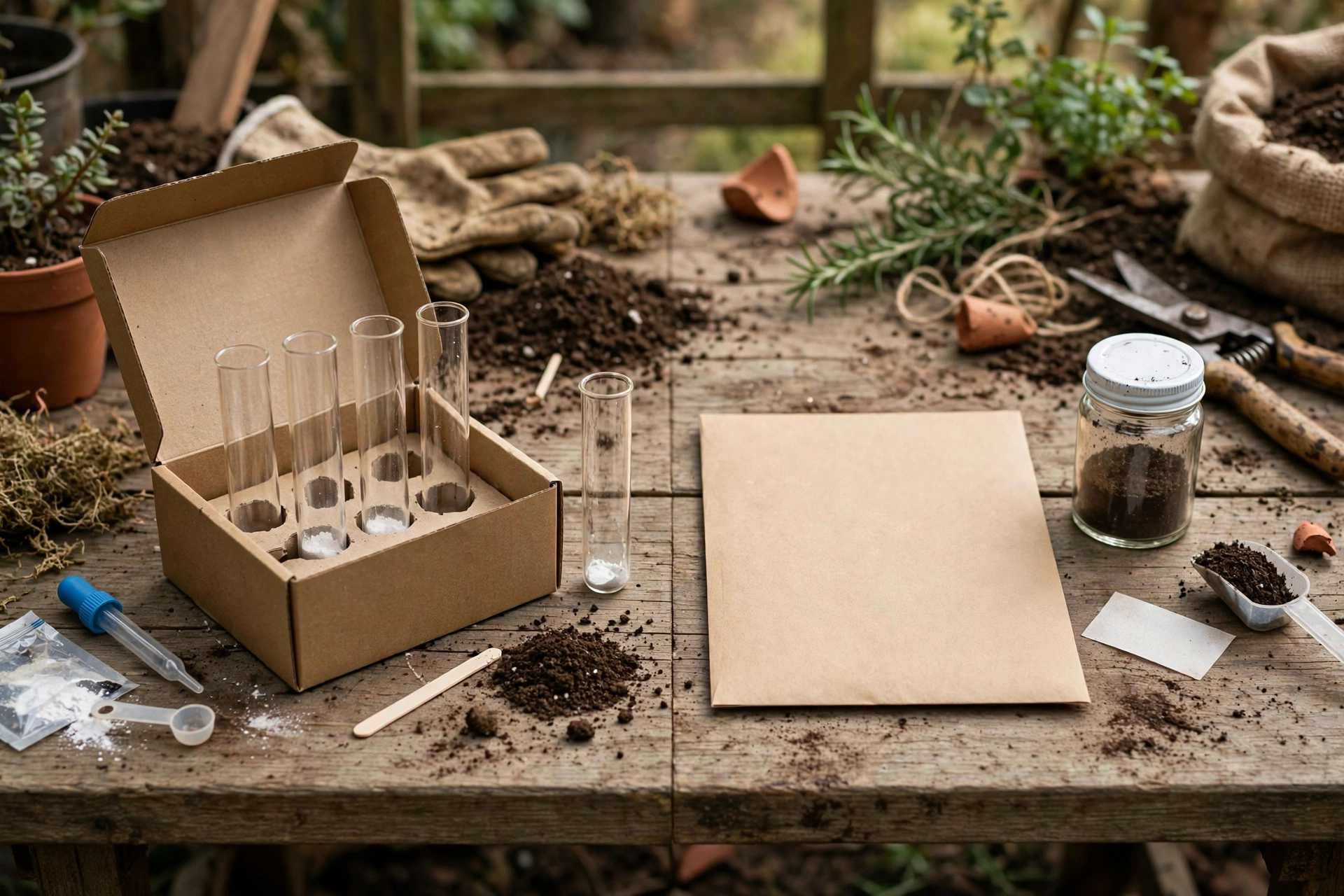
At-home capsule kits work by mixing soil with water and a reagent capsule, then matching the color to a printed chart. Your result is a range — pH in steps, nutrients rated from depleted to surplus — and two people can reasonably read the same vial a shade apart.
Labs use extraction methods that pull nutrients out of the soil sample with a chemical solution, then measure the extract with instruments. The result is a specific value, such as phosphorus in parts per million, plus a rating based on crop and lawn research for that measurement method.
For pH alone, a careful at-home reading is often within about half a point of a lab result, enough to spot strongly acidic soil. For phosphorus and potassium decisions involving real fertilizer money, the lab number is the one to trust.
What each one actually measures
A typical capsule kit covers four things: pH, nitrogen, phosphorus, and potassium. That is the whole panel, and nitrogen from a capsule test is the least stable of the four because soil nitrogen changes quickly after rain or fertilizing.
A mail-in lab panel runs wider. MySoil reports pH plus 13 nutrients, Soil Savvy reports pH plus 14, and lab reports commonly add buffer pH, organic matter, and CEC — cation exchange capacity, or how well soil holds nutrients. Those extra lines are what let a lab calculate an exact lime rate instead of a general suggestion.
Micronutrients draw the line clearly. Iron, zinc, manganese, and boron show up on lab reports. No capsule kit in this price range measures them, so a suspected micronutrient problem is a lab job from the start.
Our guide to how to read a soil test report explains each of those lines once you have one in hand.
Side by side
| Factor | At-home capsule kit | Mail-in lab test |
|---|---|---|
| pH result | Color range, steps of about 0.5 | Measured number, e.g. 6.2 |
| Nutrients covered | N, P, K only | P, K plus 11–12 more, incl. micronutrients |
| Buffer pH and lime rate | Not measured | Measured, with a specific lime rate |
| CEC and organic matter | Not measured | Included on most panels |
| Cost per test | Under $1 per test at 40 tests per kit | One test per kit purchase |
| Turnaround | Minutes | About 6–8 days for MySoil |
Cost and turnaround, honestly weighed
The Rapitest 1601 spreads its price across 40 tests, so checking a new garden bed, a side yard, and a problem patch in one afternoon costs very little per answer. Speed is its other advantage: you sample after breakfast and can buy lime the same day.
A mail-in kit costs more and returns one full report per purchase, with a wait of roughly a week. That wait matters less than it sounds, because lime and sulfur change soil pH over months anyway. Planning a week ahead, using the timing guidance in when to test your soil, removes most of the delay from the equation.
Per decision, the lab often costs less. One accurate phosphorus result can stop you buying a balanced fertilizer your soil does not need for several seasons in a row.
When the at-home kit is enough
Reach for a capsule kit when the question is rough and the stakes are small. A new raised bed before planting, a quick pH check on a hydrangea corner, or a mid-season sanity check between lab tests all fit.
It also suits gardeners testing many small areas separately. Forty tests let you sample the front lawn, the back lawn, and three beds without blending them into one average that describes none of them.
A color range can confirm soil is acidic. It cannot set a lime rate.
When the lab test is worth it
Choose the lab when you have never tested, when a lawn keeps struggling despite fertilizing, before a full renovation or new seeding, or when you need a lime rate you can defend. Those are the moments a wrong guess costs more than the test.
The lab is also the right call before spending on micronutrients or specialty amendments. Without buffer pH, CEC, and measured nutrient levels, those purchases are speculation.
Many homeowners settle into a rhythm: a lab test every two to three years as the baseline, capsule checks in between for spot questions. That pairing is the pattern behind the picks in our roundup of the best soil test kits for lawns, and the wider selection in the best soil test kits for home lawns and gardens guide follows the same logic.
The three kits, compared as purchases
MySoil Soil Test Kit
MySoil is a mail-in lab kit reporting pH plus 13 nutrients, with results in about 6 to 8 days and a prepaid envelope in the box. Its report pairs each nutrient rating with a custom amendment recommendation.
Pros: measured lab values, buffer-based amendment rates, and a complete baseline in one test. Cons: one report per kit, and results take about a week.
MySoil Soil Test Kit
Mail-in lab test for pH and 13 nutrients, with results in 6–8 days and a custom amendment plan.
Soil Savvy Soil Test Kit
Soil Savvy is also mail-in, reporting pH plus 14 nutrients. It leans harder into the recommendation, translating your results into a specific fertilizer suggestion.
Pros: the widest nutrient panel here, and guidance stated as a product decision rather than raw data alone. Cons: the same week-scale wait as other mail-in kits, and one test per purchase.
Soil Savvy Soil Test Kit
Mail-in lab test for pH and 14 nutrients, with a custom fertilizer recommendation for your lawn.
Luster Leaf Rapitest 1601
The Rapitest 1601 is the at-home option: color capsules and a chart, 40 tests in the box, results in minutes for pH and N-P-K.
Pros: lowest cost per test, instant answers, and enough tests for many separate areas. Cons: ranges instead of measured values, no buffer pH, no CEC, and no micronutrients.
Luster Leaf Rapitest 1601
Capsule kit for 40 at-home tests of pH and N-P-K, with results in minutes from a color chart.
Skip the probe sticks
Cheap 3-in-1 probe sticks are sold as soil tests, but the probe does not measure nutrients at all. Its pH needle moves with soil moisture, so the same patch can read differently before and after watering.
Use a probe, if you own one, as a rough moisture reminder. Do not set lime or fertilizer rates from it when a capsule kit costs little more and a lab test settles the question outright.
The decision, plainly
Buy the lab test first if you are starting from zero or fixing a real problem. Add the capsule kit afterward if you test often or manage several beds, and use it for quick checks between lab baselines.
If you can only buy one today, make it the mail-in lab kit. A measured baseline makes every cheaper test you run later easier to interpret.