Landscape & Leisure is reader-supported. When you buy through links on our site, including Botanical Interests seed links, we may earn a commission at no extra cost to you. Prices change, so click through to confirm current pricing.
You ease a carrot from loose soil and it comes up sweet and straight — the variety you chose in spring decided that moment. Carrots reward the match between root shape and soil more than almost any other crop: a long, slender type sulks in clay, while a short, wide-shouldered type pushes through that same bed without complaint.
Botanical Interests carries carrot types for deep sandy beds, heavy ground, shallow planters, and quick baby harvests, and the five packets below cover those jobs. Our sowing, thinning, and harvest guide walks through the timing that gets any of them to size, and our guide to bitter and woody carrots explains what to change when the flavor disappoints. For carrots alongside beets and radishes, see our earlier roundup of the best carrot, beet, and radish varieties.
Shape Is the Decision: Long, Tapered, or Round

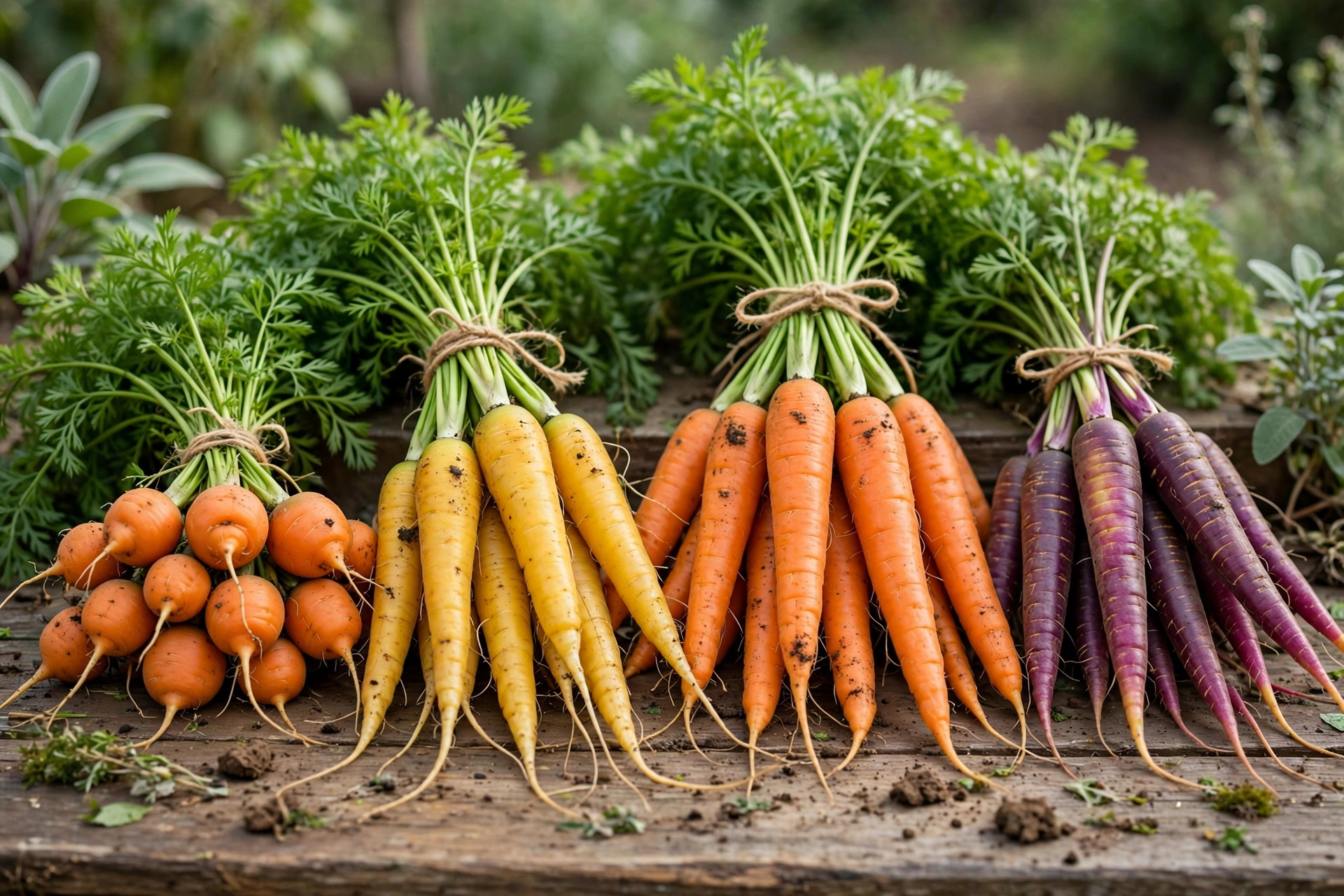
Carrot names describe root shapes, and the shape tells you where the variety will thrive. Nantes types are cylindrical and nearly coreless, bred for sweet eating in decent soil. Danvers and Chantenay types are wider at the shoulder and taper to a point or a blunt end, and that wedge shape is what lets them work through heavier ground.
Round types play a different game entirely. A carrot that matures as a small ball barely needs depth at all, which opens up shallow beds and containers that would fork or stunt a long root. Choose the shape first and the variety second, and most carrot disappointments never happen.
Best Overall: Shin Kuroda
Shin Kuroda is the carrot we would hand to the widest range of gardens. It is a Chantenay type with smooth, tapered, deep orange-red roots about 5 inches long with blunt ends and wide shoulders, and it grows through heavy soils with ease — the exact ground where longer types give up.
It is also unusually forgiving on timing. Shin Kuroda is quite heat resistant, so a late-spring or even summer sowing is reasonable where other carrots would sulk, and its high moisture content gives it a sweet flavor gardeners rate 4.7 out of 5 from 58 reviews, the strongest rating on this page. At $2.69, with roots ready in 75 days that also store well, it is the one packet to start with.
Pros: handles heavy soil; heat resistant for later sowings; sweet, high-moisture roots; 4.7 out of 5 from 58 reviews; stores well.
Cons: at 5 inches it will never be the long slicing carrot a deep sandy bed can grow; the blunt, wide-shouldered shape is less elegant for presentation cuts.
Shin Kuroda Carrot Seeds
Sweet, heat-tolerant Chantenay roots that push through heavy soil — rated 4.7 out of 5.
Best for Flavor: Scarlet Nantes
Some carrots are grown for size, and some are grown for the moment you pull one, wipe it on your sleeve, and eat it standing in the row. Scarlet Nantes is the second kind. This 1850s French favorite produces deep orange, sweet, crisp, cylindrical roots 6 to 7 inches long that are nearly coreless, so there is no woody center to chew around.
Scarlet Nantes rates 4.5 out of 5 from 25 reviews at $2.69 and matures in 75 days. It asks for reasonably workable soil in return for that texture, because a Nantes type shows stones and clods as bends where a Chantenay would shrug them off. In a prepared bed, nothing else here eats quite as well raw.
Pros: sweet, crisp, nearly coreless roots; 6 to 7 inches long; abundant producer; 4.5 out of 5 from 25 reviews.
Cons: wants loose, stone-free soil to grow straight; the slender roots are less forgiving in heavy clay than Shin Kuroda or Danvers 126.
Scarlet Nantes Carrot Seeds
Nearly coreless, sweet, and crisp — the fresh-eating carrot for a well-prepared bed.
Best for Storage and Heavy Soil: Danvers 126
Danvers 126 was bred in Danvers, Massachusetts, in the late 1800s by growers who wanted better color, yield, and uniformity, and it still does the heavy work its name promises. The orange roots are wide at the top and taper to a point at 6 to 7 inches, grow well in heavy soils thanks to their high fiber content, and resist cracking and splitting.
It is also the storage pick. Danvers 126 matures in 65 days — the quickest of the full-size carrots here — rates 4.6 out of 5 from 46 reviews, and stores exceptionally well once cleaned, at $3.49 for the standard packet and $5.99 for the large packet. If your fall plan includes a box of carrots in cold storage, this is your variety.
Pros: thrives in heavy soil; crack resistant; stores exceptionally well; ready in 65 days; 4.6 out of 5 from 46 reviews.
Cons: the high-fiber texture that stores so well is a touch less delicate raw than Scarlet Nantes; wide shoulders need thinning to a full 3 inches to size up evenly.
Danvers 126 Carrot Seeds
A heavy-soil workhorse that resists cracking and stores exceptionally well after harvest.
Best for Containers and Shallow Beds: Tonda di Parigi
Tonda di Parigi means “Round of Paris,” and the name is the whole pitch. This 19th-century Parisian favorite matures as a deep orange, sweet, tender ball about 1½ inches across, so its shallow roots grow happily in a bed that is not tilled deep, in heavy soil, and in containers where a long carrot has nowhere to go.
Sow the seed close together and pull the roots in bunches at mature size for roasting whole or snacking. Tonda di Parigi is ready in 65 days, rates 4.4 out of 5 from 23 reviews, and costs $2.69. The trade-off is honest: you are growing a delightful bite-size carrot, not a storage crop.
Pros: grows in shallow beds and containers; handles heavy soil; sweet, snack-size roots; ready in 65 days.
Cons: the lowest rating among our picks at 4.4 out of 5; small roots mean a modest yield per row compared with full-size types.
Tonda di Parigi Carrot Seeds
Round, sweet, bite-size carrots for shallow beds, heavy soil, and pots.
Fastest Harvest: Little Finger
Little Finger is a true baby carrot, bred in France for pickling and canning whole — not a full-size carrot cut down to look small. The smooth, cylindrical roots are picked at 3 inches, deeply colored even before maturity, and ready in just 57 days, the fastest variety on this page.
At $2.69, with a 4.3 out of 5 rating from 46 reviews, Little Finger suits short seasons, impatient gardeners, and anyone sowing a late row. Leave the roots in longer and they will grow toward 7 inches, but you would be trading away the tender baby size that makes the variety worth planting.
Pros: ready in 57 days; true baby carrot for pickling whole; deep color early; good late-sowing option.
Cons: 4.3 out of 5 is the lowest rating among the full picks here; the small harvest size means sowing more row for the same weight.
Little Finger Carrot Seeds
True 3-inch baby carrots in 57 days — bred for pickling and canning whole.
The Five Picks, Side by Side
| Variety | Type | Days | Rating | Best for |
|---|---|---|---|---|
| Shin Kuroda | Chantenay, 5-inch roots | 75 days | 4.7/5 (58) | Heavy soil, late sowings |
| Scarlet Nantes | Nantes, 6–7-inch roots | 75 days | 4.5/5 (25) | Fresh eating, flavor |
| Danvers 126 | Danvers, 6–7-inch roots | 65 days | 4.6/5 (46) | Storage, heavy soil |
| Tonda di Parigi | Round, 1½-inch roots | 65 days | 4.4/5 (23) | Containers, shallow beds |
| Little Finger | Nantes baby, 3-inch roots | 57 days | 4.3/5 (46) | Speed, pickling whole |
One We Would Skip for Now: Carnival Blend
Every roundup owes you an honest pass, and ours is Carnival Blend — not because it disappoints, but because you cannot buy it right now. The blend mixes purple, red, yellow, and orange roots and gardeners rate it 4.8 out of 5 from 30 reviews, the highest rating of any carrot here, but it is sold out, so there is no packet to recommend. When it returns, it earns a fresh look; until then, Shin Kuroda gives you the reliable harvest and Scarlet Nantes gives you the eating quality.
Bottom Line
Plant Shin Kuroda if your soil is heavy or your sowing runs late, Scarlet Nantes in a prepared bed for eating fresh, and Danvers 126 when the harvest needs to keep. That trio covers nearly every carrot job in a home garden, and each packet costs less than a single bag at the store.