This post may contain affiliate links. If you buy through them, we may earn a commission at no extra cost to you.
Compacted soil rarely announces itself as a soil problem. It shows up as thin grass that will not thicken, rain that sheets off instead of soaking in, and seed that germinates in patches or not at all — and the fix most people reach for first, a cheap spike aerator, presses the soil tighter instead of opening it.
Buy a core aerator instead — one that pulls plugs out of the ground and leaves the holes open. The pick for most lawns is the Brinly 40-inch tow-behind plug aerator: 24 heat-treated steel spoons pulling plugs up to 3 inches deep, an enclosed weight tray holding up to 150 pounds for hard ground, and a width that still turns around trees and beds without a fight.
Why cores, not holes
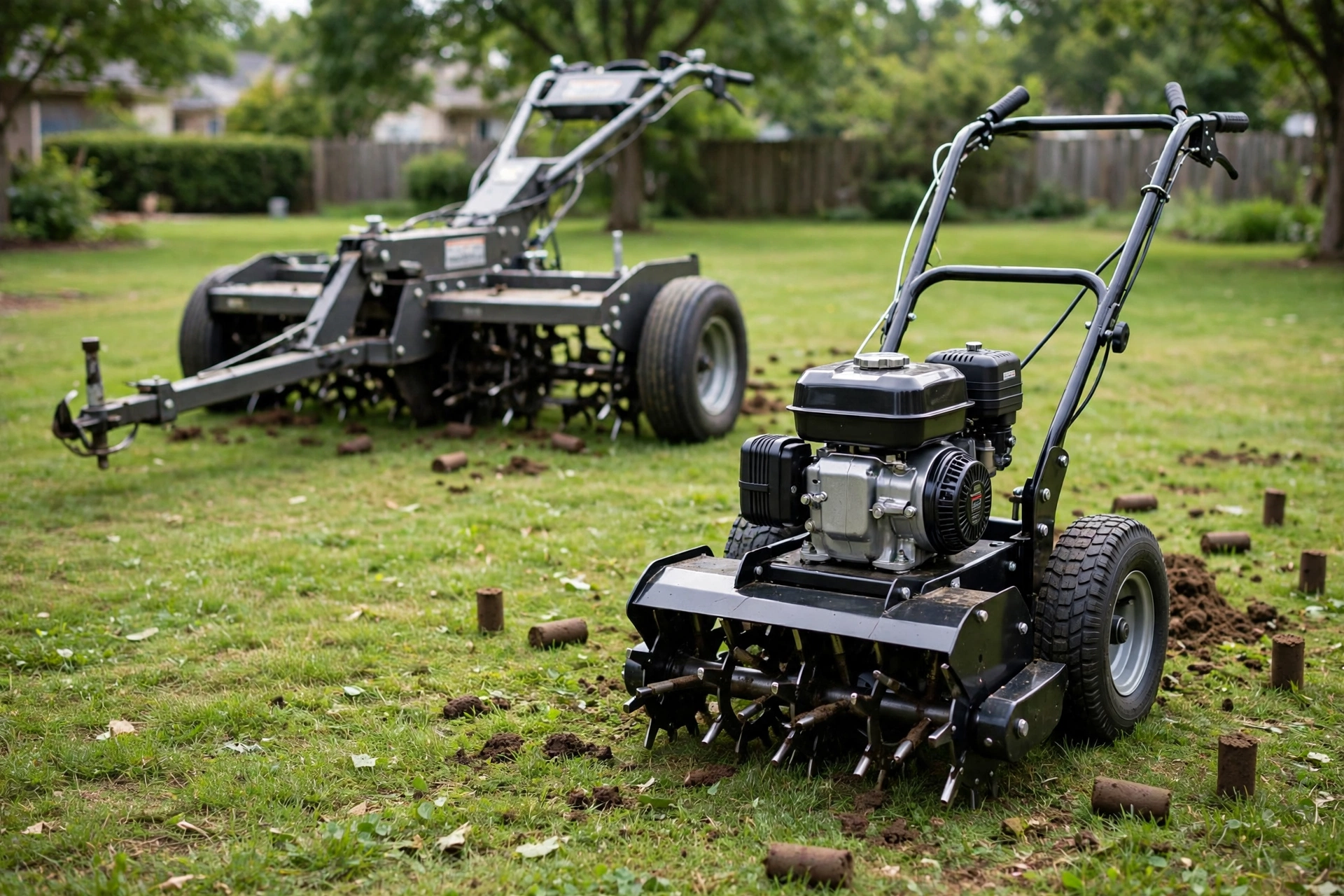
A plug aerator removes soil. Each hollow spoon cuts a core roughly 3/4 inch wide and up to 3 inches deep, lifts it out, and drops it on the surface to break down over the next week or two.
That empty hole is the whole point. Roots get room to expand sideways, water and fertilizer reach the root zone instead of running off, and the soil around each hole relaxes into the open space. A solid spike does the opposite: it shoves soil aside, packing the walls of its hole denser than the ground around them.
Depth matters more than hole count. Plugs from the top 2 to 3 inches relieve the layer where compaction builds — under footprints, mower wheels, and play areas. Our guide to how to aerate a compacted lawn covers timing, soil moisture, and pass patterns.
The three core aerators, side by side
| Aerator | Type | Width | Tines | Best for |
|---|---|---|---|---|
| Brinly 40″ Plug Aerator (PA-403BH-A2) | Tow-behind plug | 40 in | 24 steel spoons, plugs to 3 in | Most lawns with a rider or ATV |
| Agri-Fab 48″ Plug Aerator (45-0299) | Tow-behind plug | 48 in | 32 galvanized knives, plugs to 3 in | Half-acre and larger lawns |
| Yard Butler ID-6C | Manual coring | Two tines per step | 2 hollow tines, 3.5 in long | Small lawns and bad patches |
Best overall: Brinly 40-inch tow-behind plug aerator
The Brinly earns the top spot on fit. Forty inches finishes a typical suburban lawn in a reasonable number of passes, and still threads between trees, swing sets, and bed edges where a 48-inch unit slows down and doubles back.
The hardware is straightforward: 24 heat-treated steel plugging spoons in sections that rotate independently, limiting turf tearing on turns, and an enclosed weight tray rated for up to 150 pounds. That tray makes the Brinly a compacted-soil tool rather than a fair-weather one — on hard clay, unweighted tines skate, and ballast is the difference between 3-inch plugs and scratches.
The trade-off is the hitch. The Brinly does nothing without a lawn tractor, riding mower, or ATV to pull it — its universal hitch pin fits most of them, but a household with only a walk-behind mower owns an aerator it cannot use. Storage is the second cost: at 71 pounds, it wants a garage wall, not a closet.
Pros: real 3-inch plugs from 24 replaceable steel spoons; 150-pound weight tray for hard, dry soil; independently rotating tine sections tear less turf on turns; universal hitch fits most tractors and ATVs.
Cons: useless without something to tow it; takes real storage space; assembly required before the first use.
Brinly 40″ Tow Behind Plug Aerator (PA-403BH-A2)
The right width for most lawns, with a 150-pound weight tray that keeps the spoons pulling plugs in hard soil.
Runner-up: Agri-Fab 48-inch tow-behind plug aerator
The Agri-Fab 45-0299 is the same idea at a bigger scale: 48 inches of working width, 32 galvanized plug knives, plugs up to 3 inches deep, and a weight tray holding up to 140 pounds. On an open half-acre or more, those extra 8 inches per pass add up to a shorter afternoon, and the galvanized knives shrug off rust in a damp shed.
A cantilever lift handle raises and lowers the knives from the tractor seat, which matters more than it sounds — crossing a driveway on dropped tines is how spoons get bent. Agri-Fab backs it with a 3-year limited warranty.
Why it finishes second: on a lawn broken up by trees and beds, the wider frame turns every obstacle into a wider swing and a second pass, handing back the time saved on open ground. Buy it for open ground. The walk-behind vs. tow-behind aerator comparison works through the size math if the yard sits between the two.
Pros: widest coverage here at 48 inches; 32 galvanized, self-sharpening knives; lift handle works from the seat; 3-year limited warranty.
Cons: awkward around trees and tight beds; heaviest unit here at about 93 pounds; still needs a tractor or ATV to pull it.
Agri-Fab 48″ Tow Behind Plug Aerator (45-0299)
Eight extra inches of width and 32 galvanized knives for big, open lawns where passes are the whole job.
Best for small lawns: Yard Butler ID-6C manual coring aerator
Not every compacted lawn justifies a tow-behind. The Yard Butler ID-6C is a long-handled hand tool with two hollow tines, a foot bar, and cushioned grips: step down, and it pulls two plugs at a time from tubes 3.5 inches long. The whole tool weighs under 4 pounds and hangs on a nail.
The honest limit is arithmetic. Two plugs per step across a whole lawn is slow work, and on a quarter acre it stops being exercise and starts being a sentence. Where the ID-6C shines is the job tow-behinds do badly: the compacted strip by the gate, the worn path to the shed, the thin patch under the trampoline. Our roundup of the best manual aerators for small lawns covers the other hand tools worth comparing.
One working note: hollow tines clog in wet, sticky clay, so work when the soil is moist but not muddy, and clear the tubes as they pack.
Pros: pulls real cores with no engine, fuel, or hitch; cheap to buy and free to store; precise enough for single bad patches.
Cons: two plugs at a time is slow on anything past a small lawn; tines clog in wet clay; the work is physical, start to finish.
Yard Butler Manual Lawn Coring Aerator (ID-6C)
Real plugs from a hand tool — the right buy for small lawns and the compacted patches a tow-behind cannot reach.
Not recommended for compacted soil: any spike aerator
Spike aerators — tow-behind star wheels, rolling drums, and spike sandals — cost less than plug aerators and sell well, which is how compacted lawns end up worse a season later. A solid spike makes its hole by pushing soil sideways and down. Nothing is removed, so the soil around every hole ends up denser than it was.
Spikes have one legitimate use: roughing up the surface before overseeding soil that is not compacted, so seed makes contact instead of sitting on thatch. For hard ground that sheds water and starves roots, a spike tool deepens the cause. Skip it, and put the money toward a coring tool or a rental.
Renting instead of buying
A rental walk-behind core aerator is a legitimate fourth option, and for a lawn aerated once a year it can be the cheapest one. The math turns on frequency: two or three rentals a year approach the Brinly’s purchase price, while one yearly rental stays cheaper for years. Our breakdown of how much lawn aeration costs runs the numbers for each route.
Rentals carry a weight problem worth knowing first: rental-class walk-behind units are heavy and awkward to lift. The tow-behind trades that wrestling match for a hitch pin and a slow drive.
Bottom line
Buy the Brinly 40-inch plug aerator. It pulls real 3-inch plugs, its 150-pound weight tray keeps the spoons working in hard soil, and its width fits the way most suburban lawns are actually shaped. Move up to the Agri-Fab 48-inch when the lawn is open and big enough that passes are the bottleneck, keep a Yard Butler by the shed door for patches no machine reaches, and leave every spike aerator on the shelf.