Landscape & Leisure is reader-supported. When you buy through links on our site, including Botanical Interests seed links, we may earn a commission at no extra cost to you. Prices change, so click through to confirm current pricing.
If your cucumber vine produces a handful of curved, seedy fruit and then gives up, the variety was probably wrong for the job — or the vine was left sprawling on the ground where fruit rots and hides. Cucumbers are not one interchangeable crop. A slicing cucumber picked at 6 to 8 inches, a pickling cucumber picked at 1½ to 6 inches, and a gherkin picked at 1½ to 4 inches are different fruit from different plants, and choosing by use is the whole decision. The seven varieties below are picked for a specific kitchen job, with the trade-off each one carries stated plainly.
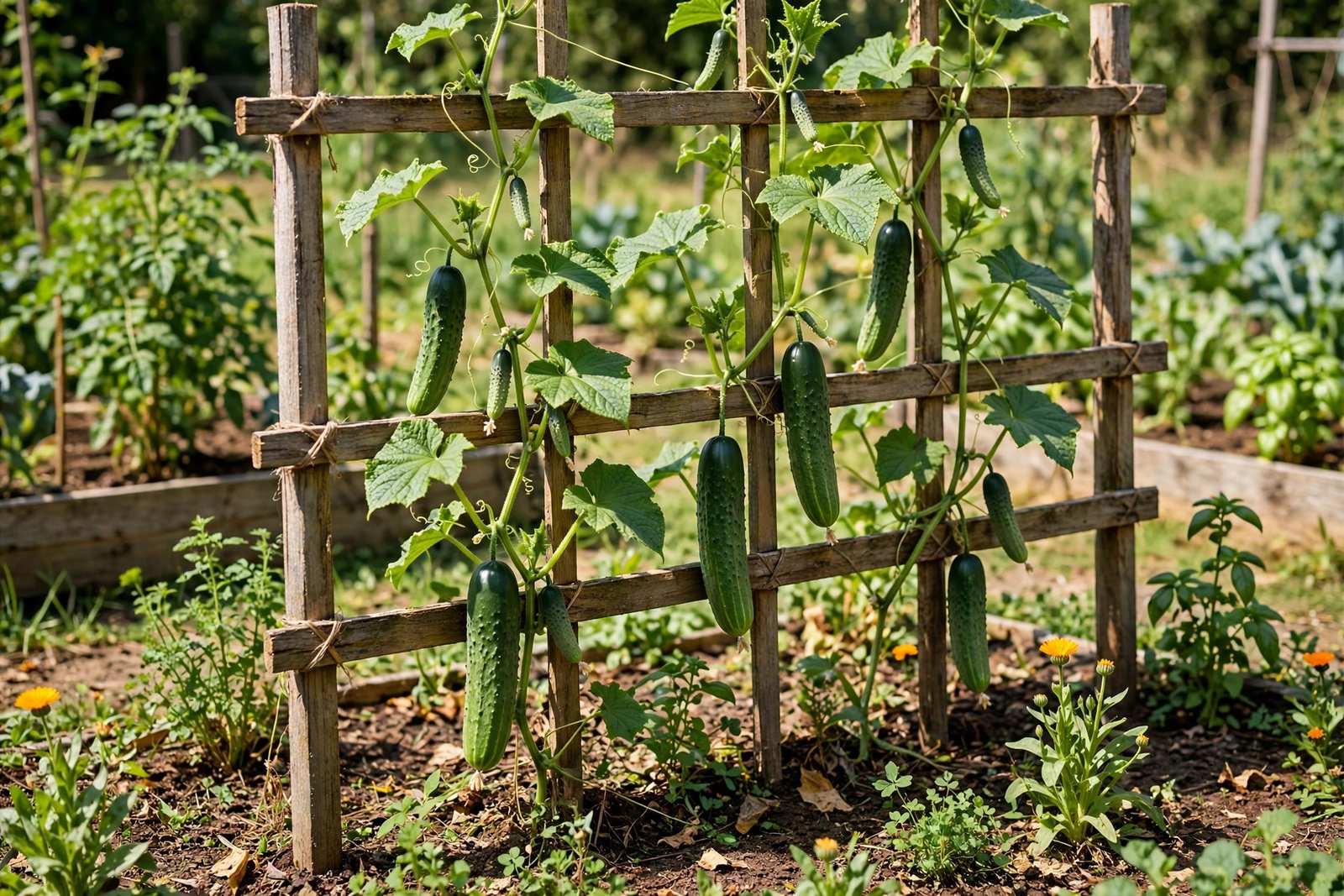
For how to grow these varieties upright, see our guide to trellising cucumbers. If a cucumber tastes bitter, see our causes and fixes for bitter cucumbers before blaming the variety.
How We Picked These Varieties
Three tests, same as every roundup. First, in stock and sold by Botanical Interests now, with the price and availability checked on the product page. Second, a real distinction: a fruit size, a vine habit, or a disease resistance that fits a specific use. Third, the variety’s own product page states the facts used here — fruit size, days to maturity, vine length, and resistance — so nothing below rests on a seed packet memory. One checkable fact anchors the roundup: ‘Marketmore’, introduced in 1968 by Cornell University, is still the standard slicing cucumber because its fruit keeps its size and shape even in poor weather, where other varieties curl and misshape.
Best Overall: Marketmore Cucumber
Marketmore is the cucumber to plant when only one variety goes in. It was developed at Cornell and introduced in 1968, and it is ready to pick at 6 to 8 inches long, with dark green, smooth skin. The 4- to 6-foot vines keep producing with regular picking, and the fruit holds its shape under poor weather instead of curling. It is resistant to cucumber mosaic virus, and Botanical Interests rates it 5.0 from 30 gardener reviews — the strongest rating in this roundup. The trade-off is ordinary: it is a full-size vining cucumber, so it needs a trellis or 36-inch rows and regular picking, and it will not fit a small pot on a balcony.
Pros: dependable 6- to 8-inch slicing fruit; holds its shape in poor weather; mosaic virus resistance; strongest gardener rating here.
Cons: needs a trellis or real row space; regular picking is required to keep vines producing.
Marketmore Cucumber Seeds
The dependable 6- to 8-inch slicer from Cornell, holding its shape in poor weather.
Runner-Up: Poinsett 76 Cucumber
Poinsett 76 is the disease-resistance pick. Developed in 1976 from the work of Dr. Henry M. Munger at Cornell with Clemson University, it produces dark green, straight cucumbers 7 to 8 inches long and 2½ inches in diameter over a long harvest period, and it resists anthracnose, angular leaf spot, downy mildew, powdery mildew, and scab. That resistance package is the broadest in this roundup, and in a humid summer it is worth more than a slightly earlier harvest. The honest caveat is the rating record: only 2 gardener reviews, averaging 3.0, so the variety earns its place on its stated resistance and its 65-day maturity, not on a crowd of happy growers. Plant it where mildew has ended cucumber seasons early, and judge it on your own harvest.
Pros: broadest disease resistance here; straight 7- to 8-inch fruit; long harvest period.
Cons: thin gardener rating record — only 2 reviews; full-size vines need trellis space.
Poinsett 76 Cucumber Seeds
Straight 7- to 8-inch fruit with resistance to mildews, anthracnose, scab, and leaf spot.
Best Pickling Cucumber: Homemade Pickles
Homemade Pickles is the variety to grow when pickles are the point. It yields heavily and early, picking anywhere from 1½ to 6 inches long, with the interior texture that takes brine well and few seeds when picked small. The 4- to 5-foot compact vines suit containers and raised beds, and it is disease resistant. It also eats well fresh, which matters when the harvest outruns the brine jar. The trade-off is picking discipline: this variety rewards daily picking at small sizes, and fruit left to size up gets seedier in the middle, though still smaller-seeded than many cucumbers at the same size.
Pros: heavy, early yields for pickling; good interior texture; compact vines for containers; eats well fresh.
Cons: needs frequent picking at small sizes; seediness increases if fruit is left to grow large.
Homemade Pickles Cucumber Seeds
Heavy, early yields picked at 1½ to 6 inches, with the texture pickles need.
Best Small-Space Cucumber: Spacemaster 80
Spacemaster 80 answers the question this roundup keeps asking: what if there is no room for a 6-foot vine? Its vines run only 2 to 3 feet, so it suits small gardens and containers, yet it produces full-sized slicing cucumbers for snacking, salads, and sandwiches — and it doubles as a pickler when harvested small. It is disease resistant. The trade-off is total yield per plant: a compact vine cannot carry what a full vine carries, so plant more than one if cucumbers are a staple rather than a snack. For a patio or a single raised bed, that is a fair exchange.
Pros: 2- to 3-foot vines for containers; full-sized slicing fruit; doubles for pickling when picked small.
Cons: lower total yield per plant than full vines; still needs full sun and steady water.
Spacemaster 80 Cucumber Seeds
Full-sized slicing cucumbers on 2- to 3-foot vines — the container cucumber.
Best Japanese Cucumber: Tasty Green
Tasty Green is the slender, thin-skinned Japanese type: tender skin, burpless, non-bitter, with very few tiny seeds, best picked before or at 9 inches. It resists powdery mildew and tolerates downy mildew, and it matures in 60 days. Grown on a trellis, it saves space while growing straighter fruit — the variety where trellising pays most visibly, because a straight Japanese cucumber is the point. The trade-off is the picking window: picked past 9 inches it loses the tenderness that justifies growing it, so this is a variety for a gardener who checks the trellis daily.
Pros: thin, sweet skin and few seeds; non-bitter and burpless; mildew resistance; 60 days.
Cons: must be picked at or before 9 inches; needs a trellis for straight fruit.
Tasty Green Cucumber Seeds
Slender, thin-skinned, non-bitter fruit picked at 9 inches — best grown on a trellis.
Best Fun Variety: Lemon Cucumber
Lemon cucumber is the one guests ask about. A gardener’s favorite since 1894, it grows round, lemon-sized, yellow fruit with excellent flavor, eaten skin and all like an apple, and it works as a slicer or a pickler. It is non-bitter and burpless, and more drought tolerant than other varieties. The trade-off is vigor: gardeners report long, prolific vines that can crowd neighboring plants in a shared bed, so give it its own trellis space and expect to prune or guide it. Grown with room, it is the most memorable cucumber in this roundup.
Pros: distinctive round fruit, eaten skin and all; non-bitter and burpless; drought tolerant.
Cons: vigorous vines can crowd neighbors; needs its own trellis space.
Lemon Cucumber Seeds
Round, lemon-sized fruit eaten skin and all — non-bitter, burpless, and hard to forget.
Best Gherkin: Hokus Gherkin
Hokus is the gherkin pick: tiny cucumbers used for pickles, seedless, bitter-free, and uniform in shape, used as small as 1½ inches or up to 4 inches for sweet pickles, French cornichons, or fresh use. The vines run up to 72 inches, so grow it against a trellis or fence. Two honest warnings come from the variety’s own reviews: the fruit is spiky, so harvest with gloves, and at least one gardener found fruit turning bitter in high-90s heat even when picked small. Pick daily for the right size, pick in the cool of the day, and keep water steady — the same care every pickling cucumber needs, with gloves added.
Pros: uniform, seedless gherkins at 1½ to 4 inches; bitter-free by description; suits trellis or fence.
Cons: spiky fruit needs gloves at harvest; bitterness reported in extreme heat.
Hokus Gherkin Cucumber Seeds
Uniform, seedless gherkins for sweet pickles and cornichons — harvest small, with gloves.
The One We Would Skip for an Outdoor Garden
Quick Snack is a parthenocarpic cucumber — it sets fruit without a pollinator — bred to grow indoors in 6- to 8-inch pots, with fruit best picked at 1½ to 2½ inches long. For a windowsill or balcony pot, that is a genuine niche. For a standard outdoor garden bed, it is the wrong tool: tiny fruit, a pot-sized plant, and an indoor-first growing method. Grow one of the picks above outdoors, and save Quick Snack for the pot it was bred for.
Side-by-Side Comparison
| Variety | Fruit | Vine | Best for |
|---|---|---|---|
| Marketmore | Dark green, 6–8 in. | 4–6 ft | Slicing, dependable shape |
| Poinsett 76 | Dark green, 7–8 in., 65 days | Vining | Disease resistance |
| Homemade Pickles | 1½–6 in., few seeds small | 4–5 ft, compact | Pickling, containers |
| Spacemaster 80 | Full-sized slicing fruit | 2–3 ft | Small spaces, containers |
| Tasty Green | Slender, to 9 in., 60 days | Vining, trellis | Japanese type, fresh eating |
| Lemon | Round, lemon-sized | Vigorous, long | Fresh eating, novelty |
| Hokus Gherkin | Tiny, 1½–4 in., seedless | Up to 72 in. | Gherkins, cornichons |
Final Thoughts
Plant Marketmore for slicing, Homemade Pickles for the brine jar, and one more variety for the job your garden actually has — Spacemaster 80 for a small space, Tasty Green for fresh eating, Lemon for fun, or Hokus for gherkins. Grow them up a trellis, pick at the size each variety is meant for, and pick often: an over-mature cucumber left on the vine slows the whole plant. The verdict stands on the variety pages, not on promises — sizes, days, and resistances above are as Botanical Interests states them. For the growing method, our trellising guide covers spacing, tying, and harvest, and our bitter cucumber guide covers the one flavor problem cucumbers have. For the wider first-garden plan, see our beginner vegetable seed roundup.