Landscape & Leisure is reader-supported. When you buy through links on our site, including Botanical Interests seed links, we may earn a commission at no extra cost to you. Prices change, so click through to confirm current pricing.
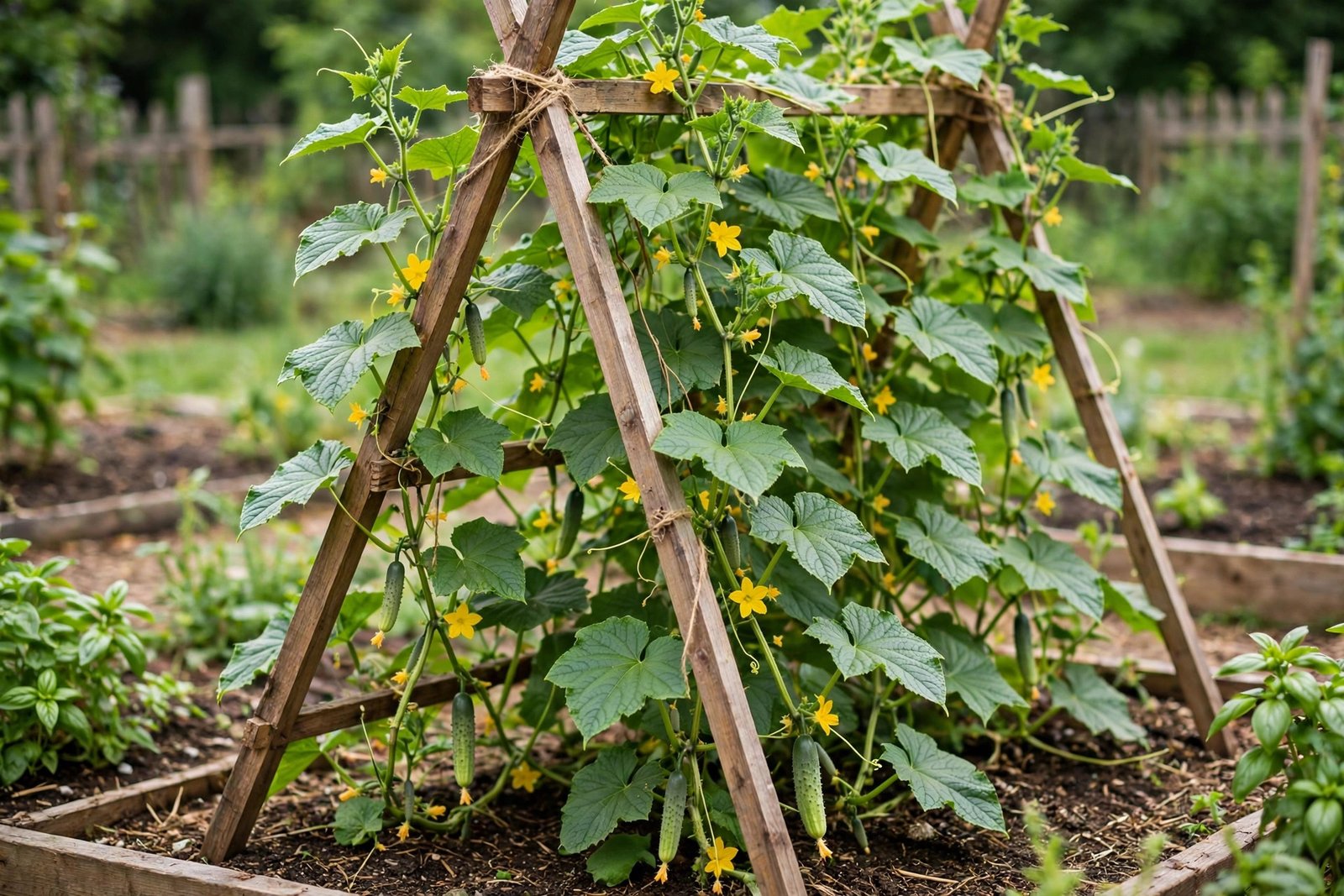
A cucumber vine left on the ground will still make cucumbers. They will just be the curved, yellow-bellied, half-hidden kind, with one side flat where it sat on damp soil. Trellising is the difference between that harvest and straight fruit you can actually see, pick, and keep clean. It is not decoration. A trellis lifts fruit off the soil, opens the canopy to air, and puts every cucumber at eye level, where picking happens on time instead of a week late.
For the varieties to grow on a trellis, see our cucumber varieties roundup. If a trellised cucumber still tastes bitter, see our bitter cucumber causes and fixes.
Why a Trellis Changes the Fruit
Three things happen when a cucumber climbs. First, fruit hangs straight. Gravity pulls a hanging cucumber down, so it grows long and even instead of curling around a stone or a stem on the ground. Second, air moves through the plant. Botanical Interests notes that trellising gives good air circulation, which helps prevent mildew — and mildew is the disease that ends most cucumber seasons. Third, picking happens. Fruit at eye level gets picked at the size it should be picked at; fruit under leaves gets found a week later, oversized and seedy, and an over-mature cucumber left on the vine slows production of new fruit. The trellis is a harvesting tool as much as a growing one.
The numbers behind the method come from the variety pages. Cucumbers are direct-sown 1 to 2 weeks after the average last frost, when soil is at least 60°F and ideally 70° to 90°F. Sow groups of 2 seeds every 12 inches, half an inch deep, and thin to 1 plant every 12 inches when seedlings have 3 leaves. Germination takes 5 to 10 days. A packet of Marketmore sows up to 20 feet of trellised cucumbers — one packet is a trellis run, not a whole garden.
Choosing a Trellis That Holds a Cucumber Vine
A cucumber trellis needs to hold a vine carrying heavy fruit in a summer storm. Flimsy netting stapled to two thin stakes will lean by August. The options that hold, in order of strength and effort:
A cattle-panel arch or flat panel. A rigid welded-wire panel, 16 feet long and about 4 feet wide, fixed to two sturdy posts, holds the heaviest vines and lasts for years. Vines climb it without tying for the first stretch, and fruit hangs through the grid where it is easy to see. This is the trellis for a main cucumber planting.
An A-frame. Two panels leaned together and joined at the top, with the base spread wide, give two climbing faces and a shaded walkway underneath. Vines on both faces get sun, and the structure stands on its own without posts sunk in concrete. Good for a bed where the trellis must come down in fall.
A fence or wall with twine. An existing fence works if the vine can grip it — add horizontal twine lines every 8 to 12 inches for tendrils to catch, and tie the main stem loosely to guide it upward. Do not let vines climb a fence the neighbor sprays, and leave a gap for air behind the panel where you can reach fruit from both sides.
A single stake per plant. The weakest option, and the one to avoid for full-size vining varieties. A stake holds one stem, not a branching vine, and the plant will outgrow it by midsummer. Save stakes for compact varieties like Spacemaster 80, and even then a short panel beats a stake.
Whatever the structure, set it before sowing or transplanting, not after. Driving posts into a bed full of young cucumber roots is the one trellis mistake that costs a season. Put the trellis up first, then sow at its base.
Spacing, Tying, and Pinching
Space for a trellis run is simple: rows 36 inches apart, plants 12 inches apart along the trellis, thinned to one plant per spot. That spacing comes straight from the variety pages, and it is tighter than ground-grown spacing because the vine goes up instead of out. Crowding closer than 12 inches costs air circulation, which costs mildew resistance — the trellis advantage, thrown away.
Tie the main stem to the trellis to guide the plant, loosely, with soft twine or strips of cloth. Tendrils will take over once the vine is climbing, but the first 12 to 18 inches need help. Check ties weekly; a tie that was loose in June can strangle a stem by August as the stem thickens. Retie, do not tighten.
When the plant reaches the top of the trellis, pinch the vine and let it spread sideways. Pinching puts the plant’s energy into producing more fruit instead of more vine, and it keeps new growth where it can be reached. Side shoots that hang down the far side of the panel are fine — fruit there is still off the ground and visible.
Three Picks for a Trellis Planting
Marketmore is the trellis standard: 4- to 6-foot vines that keep producing with regular picking, fruit that holds its shape, and a packet that sows 20 feet of trellis. Tasty Green is the variety where trellising shows most, because straight fruit is the point of a Japanese cucumber. Homemade Pickles is the compact pick for a shorter trellis or a container panel, with 4- to 5-foot vines and fruit picked small and often.
Marketmore earns the trellis run. Its 60-day maturity and steady production reward the gardener who picks every day or two, and its mosaic resistance covers the virus most likely to weaken a vine mid-season.
Marketmore Cucumber Seeds
The trellis standard — 4- to 6-foot vines, steady picking, fruit that holds its shape.
Tasty Green is the reason to build the trellis well. A slender Japanese cucumber picked at 9 inches needs to hang straight, and on the ground it will not. Its powdery mildew resistance helps, and the trellis air circulation helps more.
Tasty Green Cucumber Seeds
Slender, thin-skinned fruit that grows straightest on a trellis — pick at 9 inches.
Homemade Pickles suits the shorter trellis. Its compact 4- to 5-foot vines fill a panel without running over the top by July, and its small pickling fruit is easy to spot hanging through the grid — which is the whole point when pickling fruit must be picked daily at 1½ to 6 inches.
Homemade Pickles Cucumber Seeds
Compact 4- to 5-foot vines with small pickling fruit that is easy to spot on a trellis.
Trellis Types at a Glance
| Trellis | Best for | Watch out for |
|---|---|---|
| Cattle panel | Main planting, heaviest vines | Needs sturdy posts; lasts for years |
| A-frame | Two climbing faces, seasonal setup | Base must be spread wide or it tips |
| Fence + twine | Using an existing fence | Needs twine lines; reach both sides |
| Single stake | Compact varieties only | Outgrown by midsummer on full vines |
Harvesting Off a Trellis
Cut the stem rather than pulling at the fruit — stems are fragile, and pulling tears the vine and bruises the fruit. Pick, and pick some more: over-mature cucumbers left on the vine slow production of new cucumbers, and a trellis makes daily picking easy, which is its real yield advantage. Once picked, immerse fruit immediately in cold water to disperse field heat; that step, from the variety pages, improves quality and storage time. A trellis that makes fruit visible, plus a daily picking walk, is the whole system. Build the trellis before you sow, tie the main stem early, pinch at the top, and let the vine do the rest. For the varieties behind this guide, our cucumber varieties roundup has the sizes and resistances, and our guide to starting seeds indoors covers the indoor-start option for gardeners who start cucumbers in biodegradable pots — direct sowing is still recommended for cucumbers, which resent root disturbance.