Landscape & Leisure is reader-supported. When you buy through links on our site, including Botanical Interests seed links, we may earn a commission at no extra cost to you. Prices change, so click through to confirm current pricing.
The flat of marigolds at the garden center all looks the same until you plant it. Then one row towers over the fence and the other sulks at the edge of the bed, and you spend the summer wondering which one you actually bought. The fix is to choose by type before you choose by color, because African and French marigolds are different plants wearing the same name.
The six varieties below cover the whole range: tall Africans with blooms big enough for a vase, a white one nobody else on the block grows, and compact French types that edge a bed without ever flopping over it. For how to grow whichever you pick, see our guide to timing, spacing, and deadheading. For the full head-to-head on the two types, see our French vs. African marigolds comparison. If you are building a cutting garden more broadly, our best cut flowers roundup puts marigolds in good company.
Tall or Short? Pick the Plant Before the Bloom
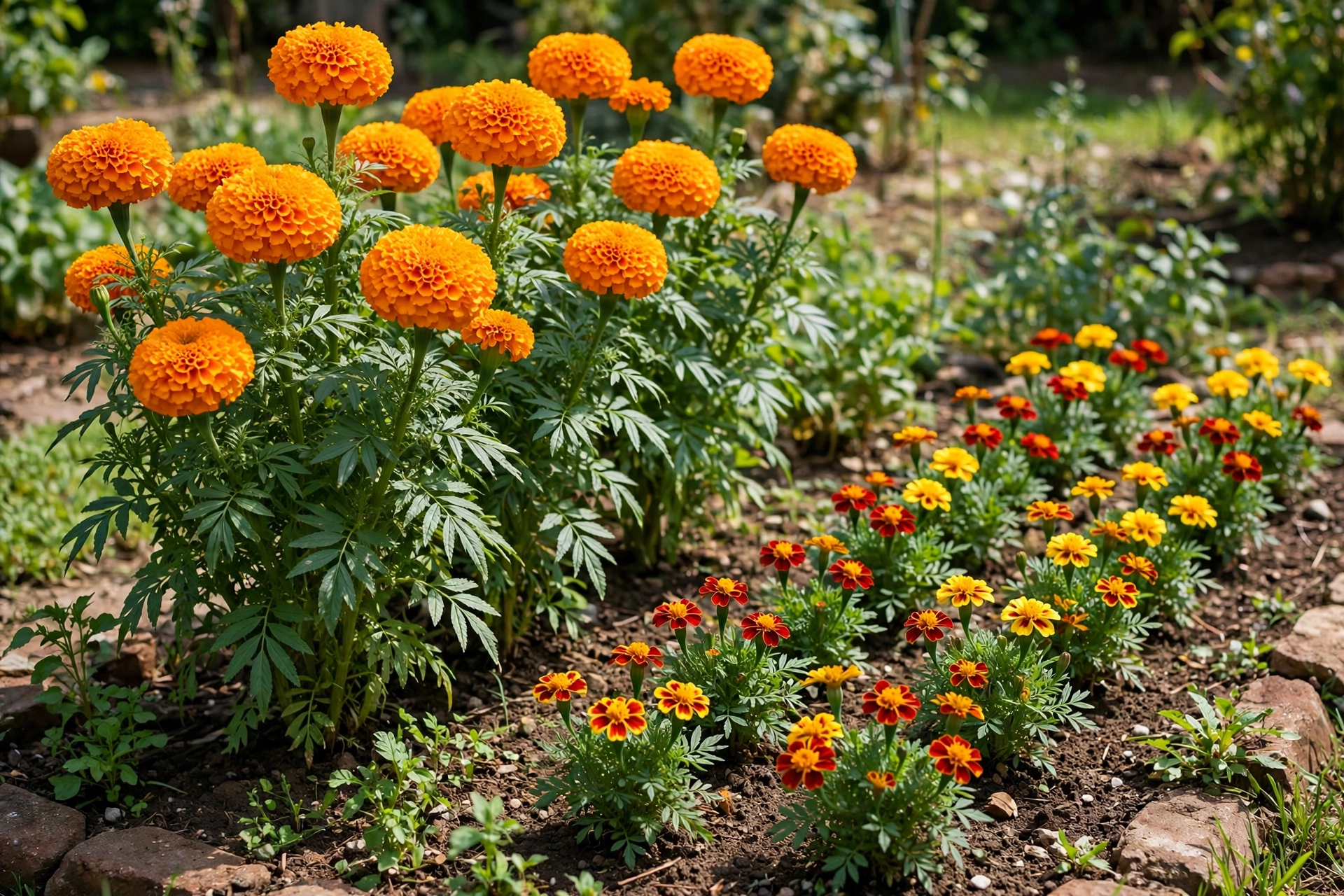
Before the varieties, one split decides almost everything. African marigolds grow 2 to 3 feet tall with big double blooms, 4 to 5 inches across, on long stems made for cutting. French marigolds stay 6 to 18 inches tall with smaller double blooms, up to 2 inches wide, on bushy plants built for edging and pots. The photo below shows the difference better than any description: one giant double bloom, and beside it a small single bloom on a much shorter plant.

Best Overall: Crackerjack African
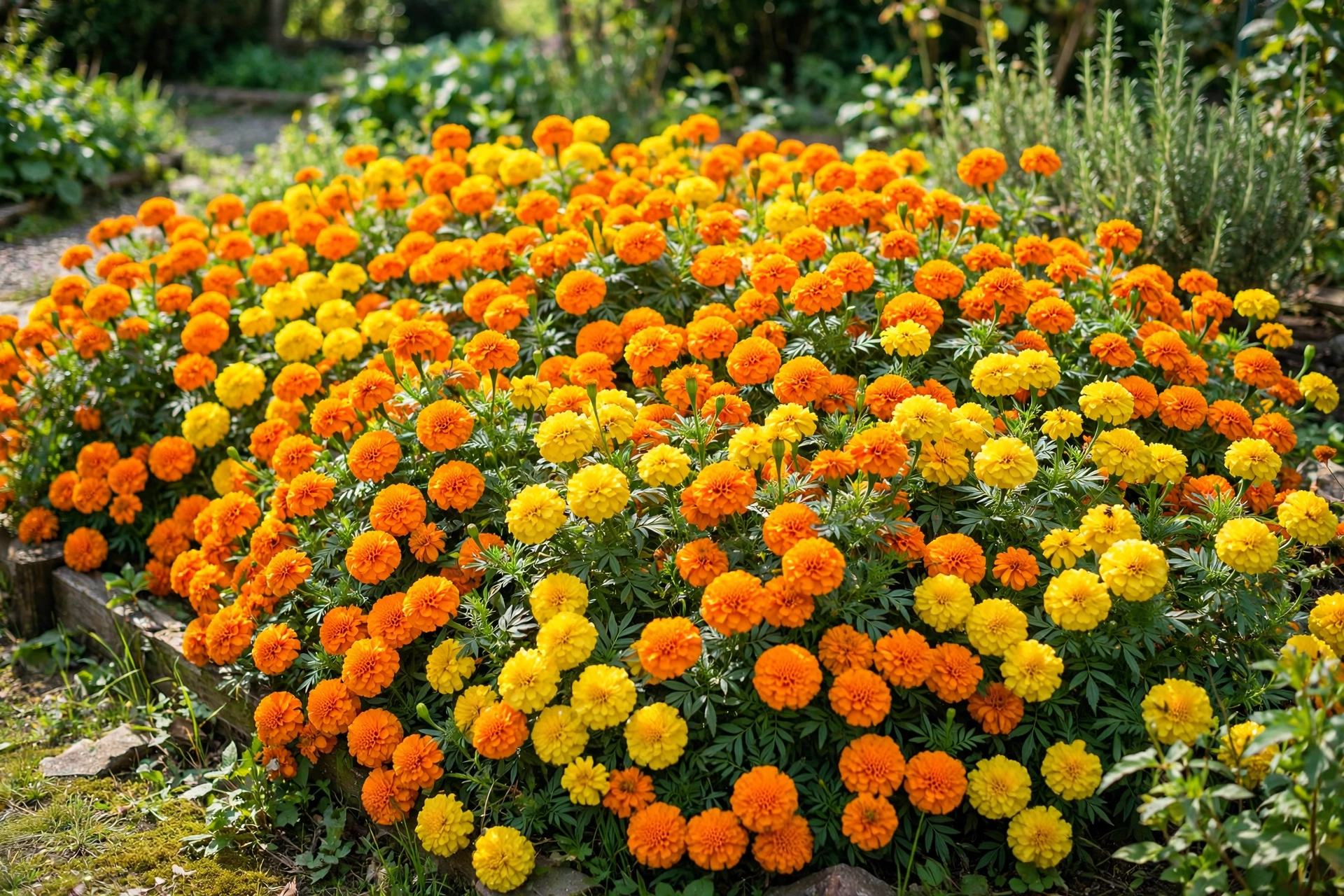
Crackerjack is the marigold most people picture when they hear the word, and it has earned that place the honest way: it grows tall, past two feet, and covers itself in 4-inch blooms in tangerine orange, rich gold, and lemony yellow. The flowers last a long time on the plant and in the vase, and the plants keep blooming from summer to frost. Gardeners rate it 4.3 from 47 reviews, a solid track record at the packet price.
The trade-off is that a blend gives you no control over the mix. You cannot order a bed of only the oranges or only the yellows. If you want one color in one spot, buy a single-color variety instead.
Pros: 4-inch blooms in three warm colors; long vase life; deer and rabbit resistant; drought tolerant once established.
Cons: a blend, so you cannot choose which color grows where; tall plants need their 18 inches of spacing.
Crackerjack African Marigold Seeds
Big 4-inch blooms in tangerine, gold, and yellow, on tall plants that keep cutting from summer to frost.
Runner-Up: Phyllis African
Phyllis is the quiet overachiever of the marigold shelf. It grows to a medium height, 12 to 24 inches, and carries full double blooms in a bright, clear yellow — the kind of yellow that reads from across the yard. Gardeners rate it 5.0 from 8 reviews, the highest rating of any marigold in the collection, and the comments keep coming back to the same thing: fast, near-complete germination and plants that bloom hard.
The trade-off is the review count. Eight reviews is the thinnest track record in this roundup, so the perfect score carries less weight than the 47 behind Crackerjack. The plant itself is a proven type, and the variety is named for the co-founder’s mother, who loved tall yellow marigolds around the patio.
Pros: the highest gardener rating here; bright yellow double blooms; medium height fits more spots than the tall Africans.
Cons: only 8 gardener reviews so far; one color only.
Phyllis African Marigold Seeds
A perfect gardener rating and bright yellow double blooms on a medium-height plant that fits almost anywhere.
Best White: Kilimanjaro White African
Kilimanjaro White is the marigold for a gardener who wants one flower nobody walks past. It took 21 years to breed a white marigold, and this one debuted in 1975 — soft, creamy vanilla-white 2½-inch blossoms with a sweet scent that is different from the usual marigold smell. The color is a genuine break from the yellow-to-orange range every other marigold lives in, and it makes a striking contrast in a bed or a bouquet. Gardeners rate it 4.1 from 69 reviews.
The trade-off is that the white is a soft vanilla, not a bright paper white, and the deep yellow centers can make the blooms read slightly yellow in warm light. If you want a crisp white, this is not it. If you want a marigold that stops people, it is.
Pros: the only white marigold here; a sweet scent, unlike other marigolds; edible petals with a slightly bitter, citrusy flavor.
Cons: creamy vanilla, not pure white; the lowest gardener rating of the African picks.
Kilimanjaro White African Marigold Seeds
Soft vanilla-white 2½-inch blossoms — 21 years in the breeding, and the only white marigold in the collection.
Best Bicolor: Naughty Marietta French
Naughty Marietta has been a garden standard since it won the All-America Selections award in 1947, and it is easy to see why it is still here. The yellow-and-maroon flowers are bold without being loud, the plants are tough and compact, and they bloom profusely and continuously from summer to frost. It is fairly drought tolerant, great for containers, and attracts butterflies. Gardeners rate it 4.8 from 16 reviews.
The trade-off is the scent. Like all French marigolds, the flowers are edible but carry a very strong flavor, much like the pungent scent — a garnish for the adventurous, not the everyday salad. Plant it for the flowers and the butterflies, and let the flavor be a curiosity.
Pros: a 1947 All-America Selections winner; bold yellow-and-maroon bicolor; great for containers; attracts butterflies.
Cons: the flavor is strong and pungent; small blooms, up to 2 inches, so it is not a cut flower.
Naughty Marietta French Marigold Seeds
Yellow-and-maroon flowers on a tough, compact plant — a 1947 award winner that still earns its place.
Best Color-Changer: Red Metamorph French
Red Metamorph is the marigold that does a trick no other variety here attempts. In cool weather the flowers are a deep burgundy. When the weather warms, splashes of yellow appear on the petals. When cool weather comes back, the blooms change back to solid burgundy. The plants are stout and dense, about 2 to 3 feet tall — tall for a French marigold — and they make a handsome garden hedge. Gardeners rate it 4.2 from 32 reviews.
The trade-off is that the trick is weather-dependent. In a steady hot summer you will see mostly the yellow-splashed version, and in a cool one mostly burgundy. Buy it for the plant and the prolific bloom — the color change is a bonus on top.
Pros: flowers change color with the weather; stout, dense plants that work as a hedge; a prolific bloomer that attracts beneficial insects.
Cons: the color change depends on the weather; at 2 to 3 feet tall, it is too big for a small pot.
Red Metamorph French Marigold Seeds
Burgundy in cool weather, yellow-splashed when it warms — a French marigold that changes its mind all season.
Best for Pollinators: Favourite Blend French
Favourite Blend is the French marigold to plant when you want the garden working, not just looking good. The flowers carry a single row of petals, which makes the pollen easy for bees and butterflies to reach, and the compact plants stay tidy and full at the front of a bed or tucked between vegetables. They grow and flower quickly, with continuous blooms from spring until frost. Gardeners rate it 4.6 from 38 reviews, the most-reviewed French marigold here.
The trade-off is that single-row flowers read as simpler than the big doubles. This is a working flower, not a show flower. Put it where the pollinators are, and let the Africans carry the vase.
Pros: single-row petals give pollinators easy access; compact, tidy plants; continuous blooms from spring to frost; fairly drought tolerant once established.
Cons: simpler flowers than the double varieties; a blend, so no single-color control.
Favourite Blend French Marigold Seeds
Single-row petals that bees and butterflies can actually reach, on compact plants that bloom from spring to frost.
The One to Skip: Lemon Drop French
Lemon Drop would have belonged in this roundup on merit — sunny yellow flowers on compact plants, made for the front of a bed, patio containers, and window boxes, and small enough to tuck into the vegetable garden without taking over. But it is sold out right now, and a variety you cannot buy is not a recommendation. Check back later in the season, or plant Naughty Marietta above — it covers the same compact French ground and it is in stock.
Side-by-Side Comparison
| Variety | Type | Bloom size | Height | Best for | Rating |
|---|---|---|---|---|---|
| Crackerjack African | African | 4 in | Tall, over 24 in | Cutting, mass planting | 4.3 (47) |
| Phyllis African | African | Double, yellow | 12–24 in | Bright color, mid-bed | 5.0 (8) |
| Kilimanjaro White African | African | 2½ in | Medium | White contrast, bouquets | 4.1 (69) |
| Naughty Marietta French | French | Up to 2 in | 6–18 in | Containers, edging | 4.8 (16) |
| Red Metamorph French | French | Up to 2 in | 2–3 ft | Hedge, color change | 4.2 (32) |
| Favourite Blend French | French | Single-row | 6–18 in | Pollinators, veggie beds | 4.6 (38) |
Final Thoughts
Plant Crackerjack first. It is the marigold most likely to make the summer feel like a summer, and the one your neighbors will ask about. Then add Phyllis for the yellow and Naughty Marietta for the edge — and if you want a white nobody else grows, Kilimanjaro White is worth the packet. Read our timing, spacing, and deadheading guide before you sow, because the one mistake that ruins a marigold season is planting into cold soil and finding out in June.