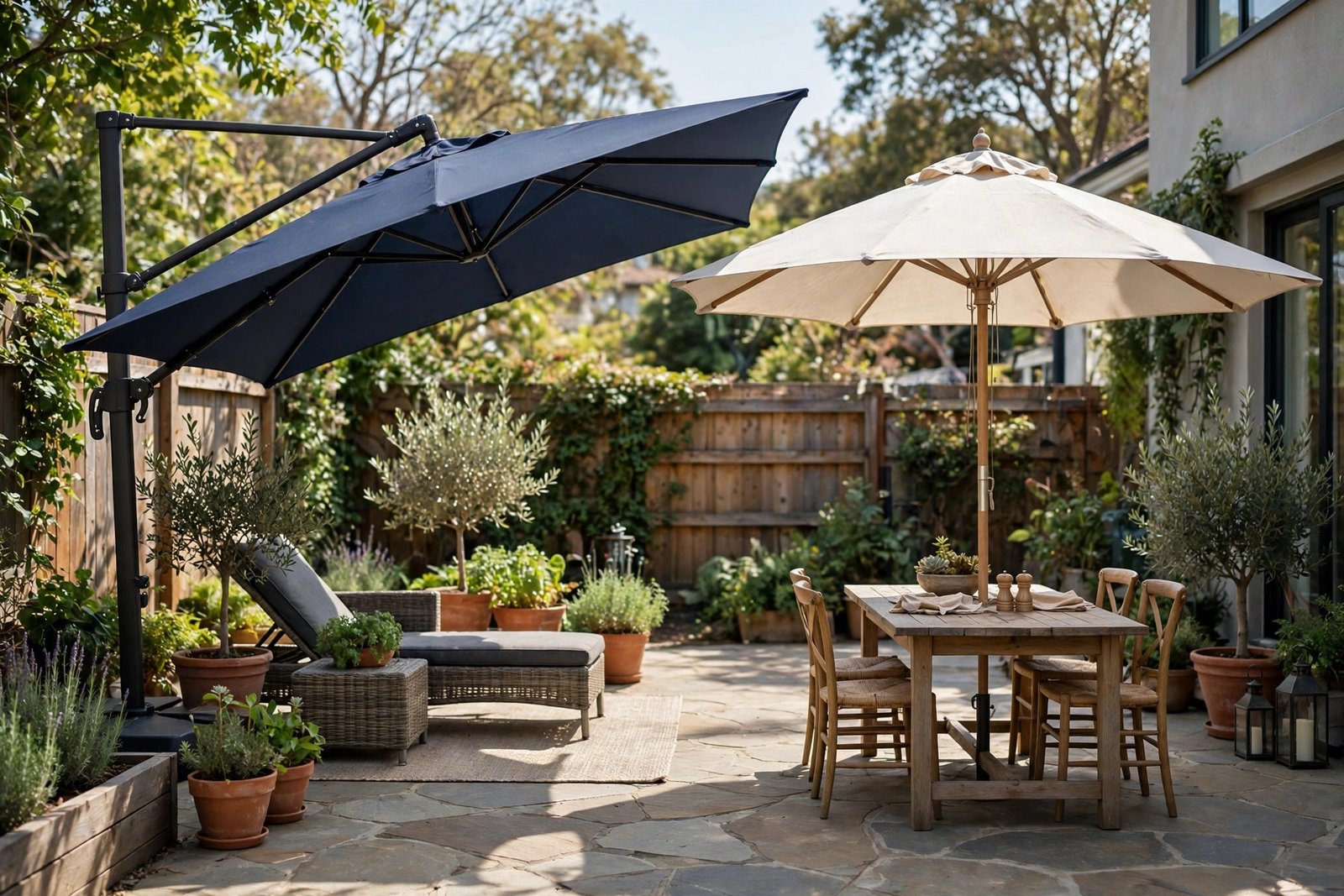
Two umbrellas can share the same canopy size and still behave like different products. A market umbrella stands through the middle of the table. A cantilever umbrella stands beside it and hangs the canopy over the seating from an arm. That one structural difference changes where the shade falls, how much floor space you lose, what the base must do, and what the umbrella costs to own.
This comparison sticks to those practical differences. It is based on manufacturer listings and standard designs, not on hands-on testing, and it ends with a clear answer for the most common patios.
How each one works
A market umbrella, also called a table umbrella, has a straight pole that drops through a hole in the table into a weighted base below. The canopy sits centered over the table, and a crank or push-button tilt adjusts the angle. It is the simplest design, the cheapest to build, and the one most patios already know.
A cantilever umbrella, also called an offset umbrella, has a side post and an arm that reaches over the seating. The canopy hangs from that arm, free of the table, and most models rotate or tilt so the shade can follow the sun without moving the base. That freedom is the whole point, and it is also the source of every trade-off that follows.
Side-by-side comparison
| Question | Market umbrella | Cantilever umbrella |
|---|---|---|
| Table needs a center hole? | Yes, in most cases | No |
| Pole in the middle of the table? | Yes | No |
| Base location | Under the table | Beside the seating |
| Shade follows the sun? | By tilt only | By tilt and, on many models, rotation |
| Typical base demand | Moderate | Higher, because the canopy hangs off-center |
| Best for | Standard dining tables | Lounge sets, poolside chairs, tables without holes |
Shade coverage: centered versus adjustable
A market umbrella shades symmetrically. That is a strength on a round or square dining table, where everyone sits at roughly the same distance from the pole, and a weakness everywhere else. Lounge chairs, a sectional, or a table pushed against a wall all sit off-center, and a centered canopy cannot follow them.
A cantilever umbrella shades where you point it. Rotation is the key feature here: a model with 360-degree rotation, such as the JEAREY 10-foot square cantilever compared in the hub, can swing its canopy across a lounge set through the afternoon without anyone moving furniture. The cost of that flexibility is precision. You have to aim the canopy, and a poorly aimed cantilever shades the empty patio while the chairs sit in the sun.
Space and the base: where each one actually lives
A market umbrella hides its footprint. The base sits under the table, out of the walkway, and the pole takes up one spot at the center of the table that nobody was using anyway. On a small patio, that efficiency is hard to beat.
A cantilever umbrella spends floor space to save table space. Its base sits beside the seating, and the arm needs swing clearance. On a large patio that is a fair trade: the table stays clear for food, laptops, and board games, and the base tucks beside a planter or a wall. On a narrow patio, the base can become the thing you trip over, and the swing area can eat the walkway.
Base weight is the other half of this story. A market umbrella’s centered pole loads its base straight down. A cantilever’s off-center canopy loads its base as a lever, so the base must be heavier and matched to the exact model. A concrete checkable example: the ABCCANOPY 12-foot cantilever listing gives a product weight of 69.3 pounds for the umbrella alone, before any base, which shows how much structure a large offset canopy carries. Never swap in a lighter generic base and assume it will hold.
Wind: the honest difference
Neither style is stormproof, and both should be closed in strong wind. Within that shared limit, a market umbrella has a structural edge: its centered pole and under-table base resist gusts more directly than an offset arm does. A cantilever umbrella compensates with vented, double-top canopies that let air through, and with heavier bases, but the arm still gives wind more leverage.
In practice, that means a windy patio favors a market umbrella, or a smaller vented cantilever with a properly rated base that gets closed early. A sheltered patio removes the penalty, and the cantilever’s rotation advantage takes over. Wind exposure, more than fashion, should settle this choice for exposed sites.
Cost and maintenance
Market umbrellas generally cost less for the same canopy size, because the design is simpler and the base is smaller. Cantilever umbrellas cost more, and the base is often a separate purchase, so compare the full setup, not the canopy alone. Replacement canopies, covers, and base weights add up on both styles, and a cover used through winter extends the life of either canopy.
Maintenance is similar: wipe the canopy, let it dry before closing it for storage, and check the crank and tilt mechanism at the start of the season. Cantilever models add one job, which is checking the arm joints and the base bolts, because those carry the offset load. A loose bolt on a market umbrella is an annoyance. A loose bolt on a cantilever arm is the mechanism itself.
Which one fits your patio?
- Choose a market umbrella if your table has a center hole, your patio is small or windy, and your seating is a standard dining set.
- Choose a cantilever umbrella if your table has no hole, your seating is a lounge set or poolside chairs, or you want to rotate shade across the afternoon without moving furniture.
- Choose neither yet if you have not measured the base area and swing path. Both styles fail when the base does not fit, and the cantilever fails louder.
For sizing help before you choose, see What Size Patio Umbrella Do You Need? And for specific cantilever models, the hub roundup in The Best Cantilever Patio Umbrellas for Shade That Actually Covers the Table names a best overall pick, a runner-up, and one model to skip.
Frequently asked questions
Can a cantilever umbrella replace a market umbrella on a dining table?
Yes, if the base fits beside the table and the canopy size matches the seating. It will shade the table without a pole in the middle, which many diners prefer. It will cost more and need a heavier base than a market umbrella of the same size.
Can a market umbrella shade lounge chairs?
Poorly. A market umbrella needs a table and base to stand in, and its centered canopy cannot reach a sectional or a row of loungers. That is the use case cantilever umbrellas were built for.
Do cantilever umbrellas need to be bolted down?
Some heavy models can be, and some bases accept bolts or sand filling. Follow the manufacturer’s instructions for your exact model rather than improvising a fix, and remember that bolting down does not make an open umbrella safe in a storm.
Bottom line
Pick the market umbrella when the table, the patio, and the wind all point to simple and centered. Pick the cantilever umbrella when the seating has no center hole, or when you want shade that moves with the sun across a lounge set. The right umbrella is the one whose base fits your patio, whose canopy covers your chairs, and whose wind limits you will actually respect.
Whichever style you choose, the rest of the patio still matters. See the best affordable outdoor furniture sets for the seating underneath, the best patio heaters for fall evenings for the season after shade season, and the right time to wash your outdoor cushion covers before you store it all away.