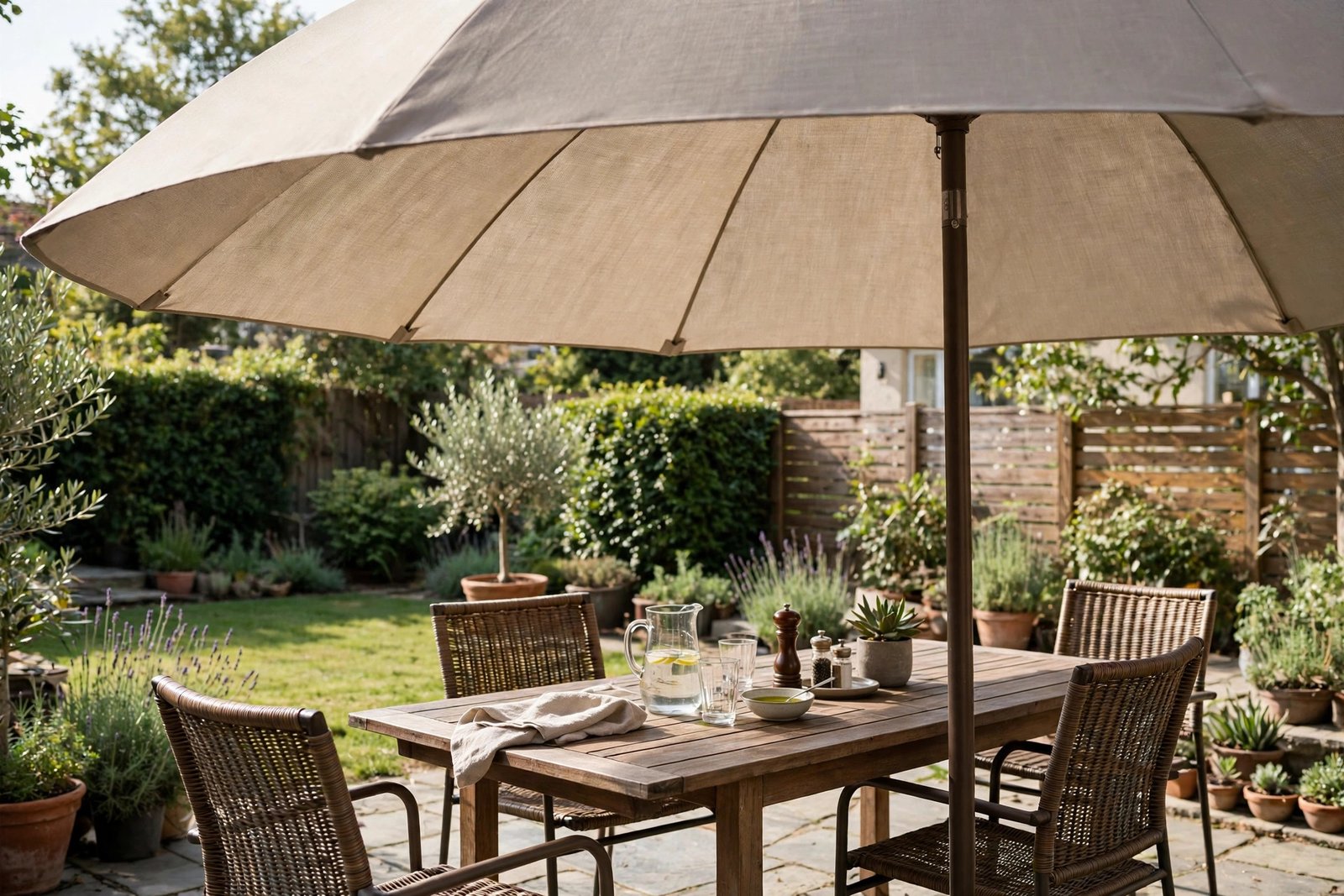
The wrong umbrella size fails in two opposite ways. Too small, and the sun lands on half the table no matter where you move the chairs. Too big, and the canopy brushes the house, crowds the grill, or needs a base that swallows the patio. Getting the size right takes three measurements and about ten minutes, and it saves the most common umbrella return: the one that technically fits the table but not the life around it.
This guide works for cantilever and market umbrellas alike. It starts with the table, adds the chairs, then accounts for swing room and wind, so the canopy you order shades the people, not just the furniture.
Start with the table, not the umbrella
Measure the table at its longest point, including any leaves you actually use. A round table needs its diameter. A rectangular table needs length and width. A square table needs one side. Write those numbers down before you look at any product page, because umbrella listings lead with canopy size, and it is easy to talk yourself into a bigger number than your patio supports.
A useful check comes from a manufacturer listing itself: JEAREY describes its 9-foot market umbrella as big enough to cover a 42-inch to 54-inch round, square, or rectangle table with 4 to 6 chairs. That is a real, checkable pairing, and it shows the pattern. A 9-foot canopy covers a mid-size table with room for chairs. A smaller table does not need a 9-foot canopy, and a larger table needs more.
The overhang rule
Shade only counts if it lands on people. A canopy that ends exactly at the table edge leaves seated diners in the sun, because chairs sit outside the table footprint. Aim for the canopy to extend past the seated area, not just past the tabletop.
For a rough plan, add the depth of a pulled-out chair on each side to the table size, then choose the next canopy size up. That is why a 48-inch table with chairs often ends up under a 9-foot umbrella rather than a 7.5-foot one, and why a 60-inch table can need a 10- or 11-foot canopy. If the numbers land between sizes, the deciding factor is the next section: how much patio you actually have.
Size by table shape
| Table | Starting canopy size | Why |
|---|---|---|
| Small bistro, 2 chairs | 7 to 7.5 feet | Two chairs need little overhang |
| 42 to 54 inches, 4 to 6 chairs | 9 feet | Matches the JEAREY pairing above |
| 60 inches or 6 to 8 chairs | 10 to 11 feet | Chairs and overhang push the size up |
| Long rectangular table | Rectangular or 11 feet plus | Round canopies leave long-table corners exposed |
Shape matters as much as diameter. A round canopy over a long rectangular table leaves the ends exposed, while a rectangular canopy, such as a 9-by-12-foot model, follows the table. Square canopies suit square tables and lounge sets. If your table is rectangular and your heart is set on a round canopy, go up a size and accept that the sides will carry extra shade you do not need.
Measure the space around the table, too
For a market umbrella, the space check is simple: the canopy must clear the house, the grill, and any low branches when tilted. For a cantilever umbrella, it is more involved. Measure the base footprint, the arm swing, and the canopy at its lowest tilt. The base sits to one side, so the umbrella needs clear floor on that side as well as clear air above the seating.
Walk the full swing path before you order. Pull the chairs out, open an imaginary canopy, and check every corner. A 10-foot square canopy, for example, has corners that reach further than a 10-foot round one, and those corners find planters, railings, and grill lids with impressive reliability. The detailed comparison of the two styles is in Cantilever vs. Market Umbrella: Which One Fits Your Patio?
Height and clearance
Canopy height decides whether people can walk under the umbrella without ducking and whether the edge clears heads at the table. Check the listed overall height and the clearance under the canopy edge, not just the diameter. Low-hanging edges shade well but turn a walkway into an obstacle course, and a canopy that sits too high throws shade that slides off the table as the sun moves.
Tilt and rotation change the effective clearance through the day. A tilted canopy dips on one side, so measure at the tilt you will actually use in late afternoon, when the sun is low and the shade needs to stretch furthest. That afternoon position, not the noon position, is the one that decides whether the size works.
Wind changes the size answer
Bigger is not automatically better in wind. A larger canopy catches more wind, and a cantilever canopy hanging off to one side acts as a lever on its base. In a windy spot, the right answer is often a slightly smaller canopy with a vented, double-top design and a base rated for that exact model, rather than the largest canopy that fits the patio.
Vents help by letting air pass through the top instead of pressing against the canopy, and closing the umbrella in strong wind helps more than any feature. No size choice makes an open umbrella stormproof. If your patio funnels wind between buildings or sits exposed on a hill, size down, buy the rated base, and plan to close the umbrella when gusts pick up.
A quick measuring checklist
- Measure the table at its longest point, leaves included.
- Add pulled-out chair depth on each side.
- Measure the base area and, for cantilever models, the full swing path.
- Check canopy height and edge clearance at afternoon tilt.
- Confirm the base weight and bolt pattern for the exact model you plan to buy.
Frequently asked questions
Should I size up if I am between sizes?
Usually yes, if the patio has room for the base and swing area. Extra shade is forgiving; a canopy that stops short of the chairs is not. The exception is a windy or cramped patio, where the smaller size with a proper base is the safer pick.
Does a bigger umbrella shade longer into the evening?
Somewhat. A larger canopy throws a longer shadow as the sun drops, but tilt and rotation matter more. An umbrella you can angle toward low sun beats a larger fixed one that only shades at noon.
What if my table has no center hole?
That points toward a cantilever umbrella, which stands beside the table instead of through it. The roundup in The Best Cantilever Patio Umbrellas for Shade That Actually Covers the Table compares the sizes and shapes worth considering first.
Takeaways
Measure the table, add the chairs, check the swing area, and let wind pull the size down when the patio is exposed. A canopy that covers the seated area, clears the obstacles, and sits on a properly rated base will get used every sunny day. One that only matches the tabletop will spend the summer half in the sun and half in the garage.
For the rest of the setup, the best affordable outdoor furniture sets covers the seating itself, the best patio heaters for fall evenings stretches the season, and the right time to wash your outdoor cushion covers keeps that seating fresh between seasons.