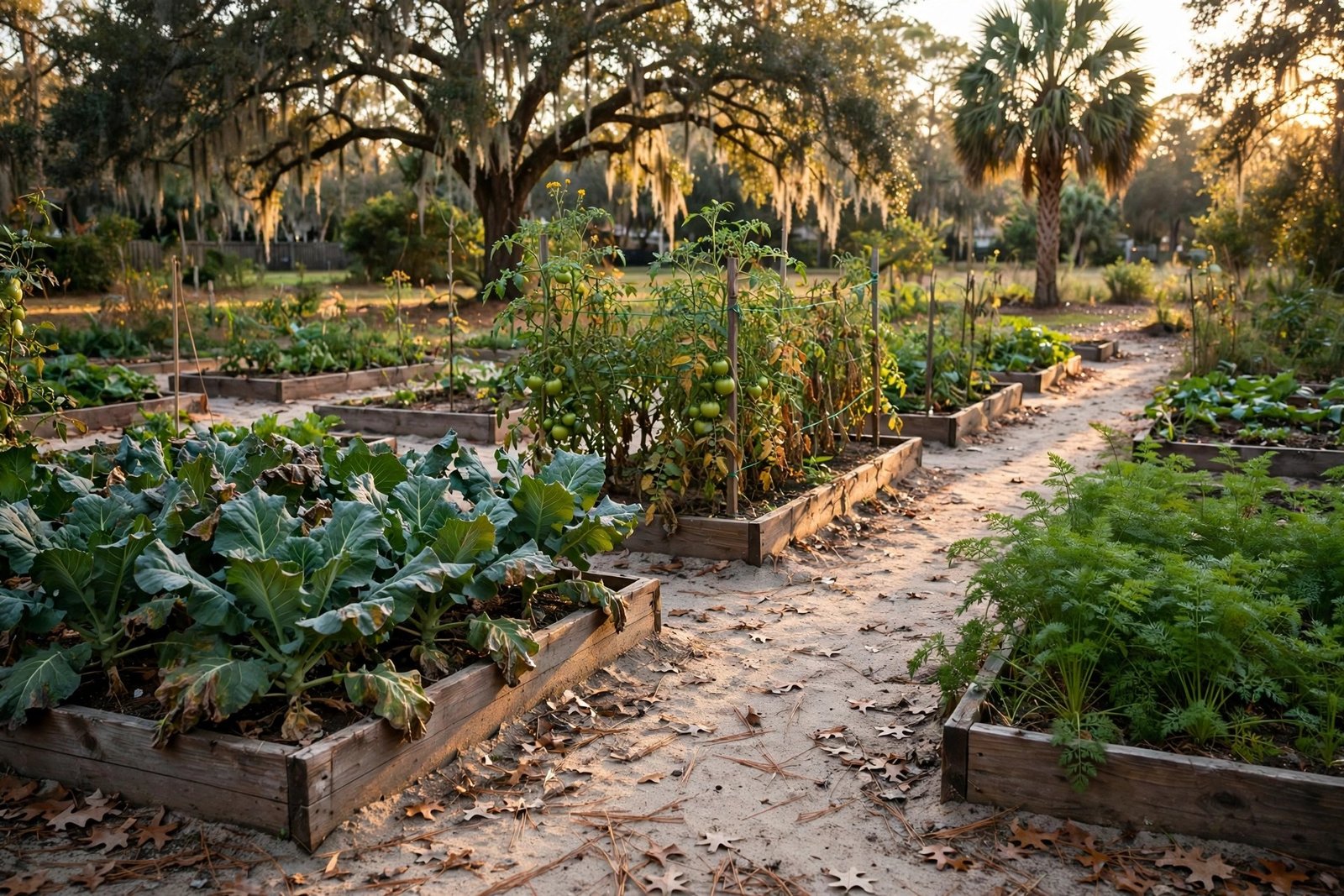
August is a planting month in Florida. Tomatoes, peppers, and eggplant go in during the hottest weeks of the year, aimed at a harvest that lands in October and November, and by the time most of the country is pulling frost-killed vines, a South Florida garden is just getting started.
That inversion is the whole Florida planting calendar. The state’s vegetable season runs fall through spring for most crops, summer belongs to a short list of heat specialists, and the University of Florida’s IFAS Extension splits the state into three regions to make the dates work: North, north of State Road 40; Central, between State Roads 40 and 70; and South, below State Road 70.
Pick your region first. Every date on this page is a regional date, consolidated from UF/IFAS Extension’s month-by-month planting lists for Florida, and a gardener in Tallahassee who plants on Miami’s schedule will lose tender crops to a March frost that Miami never gets. This calendar is one of the state calendars collected in planting calendars by state.
Three regions, drawn by two highways
UF/IFAS draws its lines on State Roads 40 and 70 because frost behavior changes at roughly those latitudes. The guide states the pattern plainly: North Florida is especially vulnerable to frosts and freezes, Central Florida gets them occasionally, and South Florida gets them rarely.
The state spans USDA Zones 8b to 11b on the 2023 map. Zones measure winter cold for perennials; for vegetables, the regional planting months and your local frost pattern decide the schedule, which is why this page is organized by region instead of zone. How a regional average becomes a date in your own yard is the subject of frost dates explained.
| Region | Where | Frost pattern | Anchor |
|---|---|---|---|
| North | North of State Road 40 — Tallahassee, Jacksonville, Gainesville | Real freezes most winters | Tallahassee: average last frost March 15, average first frost November 15 (UF/IFAS Leon County Extension) |
| Central | Between State Roads 40 and 70 — Orlando, Tampa, Daytona Beach | Frosts and freezes occur occasionally | Plant tender crops with a cover within reach through winter |
| South | Below State Road 70 — Fort Lauderdale, Miami, the Keys | Frosts and freezes occur rarely | Planting runs in every month; watch the forecast on the rare cold nights in January |
Tallahassee is the North’s anchor because it has the frost record to plan around: an average last frost of March 15 and an average first frost of November 15, in Zone 8b, where winter lows can reach 15 to 20°F. Jacksonville and Gainesville run a little milder, but they plant on the North’s months all the same.
The planting table, by region
Warm-season crops carry two windows in the North and Central regions: a spring window and a late-summer window for fall harvest. In the South, those two windows merge into one long fall-through-winter season, and it is the summer months that drop out.
| Crop | North | Central | South | How it goes in |
|---|---|---|---|---|
| Tomatoes | Feb–Mar, Jul–Aug | Jan–Feb, Aug–Sep | Aug–Feb | Transplant |
| Peppers | Feb–Mar, Aug | Jan–Feb, Aug–Sep | Aug–Feb | Transplant |
| Eggplant | Feb–Mar, Aug | Jan–Feb, Aug–Sep | Aug–Feb | Transplant |
| Bush beans | Mar–Apr, Aug–Sep | Feb–Apr, Aug–Sep | Sep–Apr | Seed |
| Pole beans | Mar–Apr, Aug–Sep | Feb–Apr, Aug–Sep | Sep–Apr | Seed |
| Lima beans | Mar–Aug | Feb–Mar, Aug–Sep | Sep–Apr | Seed |
| Cucumbers | Mar–Apr, Aug | Jan–Mar, Sep | Jan–Mar, Sep–Oct | Seed |
| Squash, summer and winter | Mar–Apr, Aug | Jan–Mar, Sep | Jan–Mar, Sep–Oct | Seed |
| Sweet corn | Mar–Apr | Jan–Mar | Jan–Mar, Oct | Seed |
| Okra | Mar–Jun | Feb–Jun | Jan–Feb, Sep–Oct | Seed |
| Southern peas | Mar–Jun | Feb–Jun | Jan–Feb, Sep–Oct | Seed |
| Broccoli | Jan–Feb, Sep–Oct | Oct–Feb | Oct–Dec | Transplant |
| Cabbage | Jan–Feb, Sep–Oct | Oct–Feb | Oct–Dec | Transplant |
| Cauliflower | Jan–Feb, Sep–Oct | Oct–Feb | Oct–Dec | Transplant |
| Collards | Jan–Mar, Sep–Oct | Jan–Feb, Sep–Dec | Sep–Feb | Transplant |
| Kale | Jan–Feb, Sep–Nov | Sep–Dec | Oct–Dec | Transplant |
| Lettuce | Jan–Mar, Sep–Oct | Jan–Feb, Sep–Dec | Sep–Feb | Transplant or seed |
| Carrots | Jan–Feb, Aug–Dec | Jan–Mar, Aug–Dec | Jan–Feb, Sep–Dec | Seed |
| Beets | Jan–Mar, Sep–Nov | Jan–Feb, Sep–Dec | Oct–Dec | Transplant or seed |
| Radish | Jan–Mar, Sep–Dec | Jan–Mar, Sep–Dec | Jan–Feb, Sep–Dec | Seed |
| Spinach | Jan–Feb, Sep–Dec | Jan–Feb, Sep–Dec | Oct–Dec | Transplant with care |
| English peas | Jan–Feb | Jan–Feb | Jan | Seed |
| Potatoes | Jan–Mar | Jan–Feb | Oct–Jan | Transplant with care |
| Sweet potatoes | Apr–Jun | Mar–Jun | Apr–May | Transplant with care |
The tomato row shows how the three regions diverge. North Florida transplants tomatoes in February and March, then again in July and August, because a spring plant has to finish before summer heat and disease pressure peak, and a fall plant has to finish before the November frost. South Florida transplants from August through February and skips the summer start entirely.
Transplant windows assume you are setting out plants, whether you bought them or started seed under cover six weeks earlier for tomatoes, peppers, and eggplant. The method behind counting back from a planting date is laid out in how planting calendars work.
What to plant, month by month
January. North Florida transplants the cool-season brassicas and greens — broccoli, cabbage, cauliflower, collards, kale, lettuce — and sows carrots, English peas, radish, and turnips. Central Florida adds tomatoes, peppers, and eggplant as transplants, plus corn and cucumbers from seed. South Florida is in full production season, with beans, corn, cucumbers, and okra all going in from seed.
February. Tomatoes, peppers, and eggplant move into North Florida gardens, while Central Florida opens its bean, okra, and southern pea season. South Florida keeps planting nearly everything on its winter list.
March. North Florida’s main spring planting: beans, corn, cucumbers, okra, squash, and watermelon from seed, tomatoes and peppers already in. Central and South Florida plant the heat list and begin winding down the cool-season crops, because April heat ends lettuce’s run.
April and May. The lists shorten fast. North and Central Florida plant okra, peanuts, southern peas, sweet potatoes, and tropical spinaches; South Florida’s May seed list is down to chayote. This is the season UF/IFAS reserves for soil work, cover crops, and solarizing beds against nematodes during the warmest weeks.
June and July. Okra and southern peas carry the North and Central gardens, and July reopens the fall door in the North, where tomatoes and peppers go back in as transplants for the autumn crop. South Florida mostly waits.
August. The second season starts in earnest. Tomatoes, peppers, and eggplant transplant across all three regions, beans and squash go in from seed, and the North begins carrots and turnips again. UF/IFAS warns that late-summer plantings face the insects and diseases that built up through the hot months, so this is the planting to scout twice a week.
September and October. The cool-season garden returns: broccoli, cabbage, cauliflower, collards, kale, and lettuce as transplants, carrots, radish, and turnips from seed, strawberries set out in September and October. South Florida joins in October with its full winter list, beans and corn included.
November and December. The North and Central regions hold to brassicas, greens, carrots, and radish. South Florida keeps planting through both months — tomatoes, peppers, beans, corn, and cucumbers — because frost there is rare enough that planting continues straight through winter.
The fall season is the main season
Gardeners moving from northern states tend to treat the August planting as an experiment and the March planting as the real garden. Florida reverses the confidence. The fall crop of tomatoes and peppers grows into cooling weather and lower disease pressure than the spring crop, which grows into heat.
Cool-season crops make the point harder. Broccoli, cabbage, carrots, and lettuce planted in September and October mature in weather they actually like, while the same crops planted in late spring bolt, bitter, or stall as temperatures climb past what they tolerate. If you plant only one Florida garden a year, plant the fall one.
Succession still applies inside the long southern season: beans, radish, and lettuce go in a little at a time, every few weeks, rather than in one row that matures on one weekend. The intervals are the subject of succession planting.
Sandy soil, and the pH that goes with it
Most Florida soils are low in organic matter, and UF/IFAS puts the best pH range for vegetable gardens on sandy soil at 5.8 to 6.3, with no adjustment needed between 5.5 and 7.0. Compost and other organic matter do double duty here, holding both water and nutrients that plain sand lets through.
Spade or plow the plot at least three weeks before planting, per the guide, and work un-composted material in a month ahead. In a state where something plants in every month, that prep window belongs in the calendar too — August beds get turned in July, January beds in December.
Sources
UF/IFAS Extension, Florida Vegetable Gardening Guide (SP 103/VH021) — the governing guide: regional frost pattern, soil pH range, site and soil preparation, and the planting guide behind the regional months. Fetched November 21, 2026.
UF/IFAS Gardening Solutions, Edibles to Plant in Florida, month by month (text version) — the transplant and seed lists for North, Central, and South Florida from which the table’s month ranges are consolidated. Fetched November 21, 2026.
UF/IFAS Leon County Extension, North Florida Vegetable Gardening Guide — Tallahassee-area Zone 8b, average last frost March 15 and average first frost November 15.
USDA Plant Hardiness Zone Map, 2023 — Florida’s span of Zones 8b to 11b.