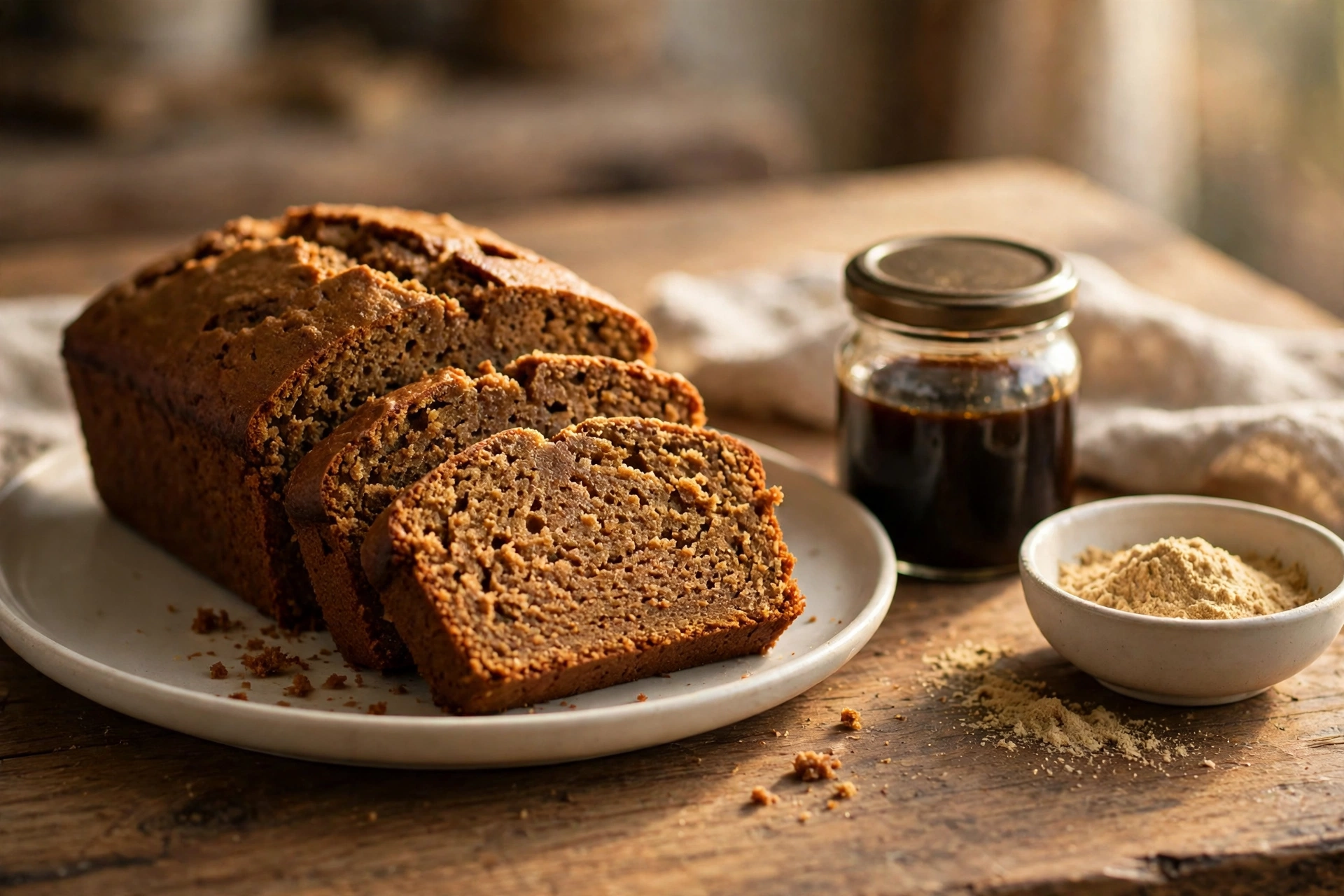
The house smells like molasses and ginger before the loaf is out of the oven. That is the whole point of a gingerbread loaf in November — not just the cake, but the hour it takes to bake, when the kitchen turns warm and dark-spiced and the afternoon slows down around it.
This is the loaf to bake when the weather turns and you want something in the oven for its own sake. Dark molasses, two teaspoons of ground ginger across the spice mix, and a crumb that stays moist for days. No frosting, no layers, no fuss — a slice with coffee, or with whipped cream if the occasion calls for it.
Why This One Works
The trick is the pairing of molasses and buttermilk with baking soda. Molasses is acidic, buttermilk is acidic, and baking soda needs acid to lift — so this loaf rises on chemistry that is already in the bowl, no heavy leavening required. The hot water does the other quiet job: it thins the thick molasses so it spreads evenly through the batter instead of weighing one side of the loaf down, which is how a gingerbread loaf stays light instead of turning dense.
One thing to get right at the store: buy regular unsulphured molasses, not blackstrap. Blackstrap is darker, less sweet, and bitter, and it turns the loaf heavy and harsh. The yellow jar with “Grandma’s” on it is the right one — it has been the right one for generations of gingerbread.

Gingerbread Loaf Cake
Ingredients
Method
- Heat the oven and prep the pan. Heat the oven to 350°F. Grease a 9×5-inch loaf pan and line it with parchment, leaving overhang on the long sides.
- Whisk the dry ingredients. In a medium bowl, whisk together the flour, baking soda, baking powder, ginger, cinnamon, cloves, nutmeg, and salt.
- Cream the butter and sugar. In a large bowl, beat the butter and brown sugar until light and fluffy, about 2 minutes. Beat in the molasses, then the egg.
- Alternate the dry mix and the buttermilk. Add the dry ingredients in three parts, alternating with the buttermilk and starting and ending with the dry mix. Stir just until combined — a few streaks of flour are fine.
- Stir in the hot water. Pour in the hot water and stir until smooth. The batter will look thin; that is right.
- Bake. Pour the batter into the pan and bake 50 to 60 minutes, until a toothpick inserted in the center comes out clean. Cool 10 minutes in the pan, then lift the loaf out by the parchment and cool completely on a rack before slicing.
Variations
A simple glaze takes the loaf from afternoon cake to dessert: whisk a cup of powdered sugar with two tablespoons of milk and a splash of vanilla, and drizzle it over the cooled loaf so it sets in thin ribbons. For a little more bite, fold a third of a cup of chopped crystallized ginger into the batter with the last of the dry ingredients — it adds bright, chewy sparks against the dark crumb.
Serve it plain, or with softly whipped cream, or with vanilla ice cream if the loaf is still warm from the oven. The loaf is sturdy enough to slice thin for a crowd and generous enough to cut thick for one person with a book. Either way, slice it with a serrated knife — a straight blade drags the soft crumb.
Storing
Wrapped tightly, the loaf keeps 3 to 4 days at room temperature, and the molasses keeps the crumb moist the whole time — it is often better on day two than on day one. For longer keeping, slice the cooled loaf, wrap the slices individually, and freeze them; a slice thaws in about half an hour on the counter, or a minute in the microwave if you are impatient.
Gingerbread is November baking in the same way our spiced pear bread and pumpkin cornbread are — dark, spiced, and built for cold afternoons. Bake this one when the house needs warming, and save the spiced pear crisp for the night you want something bubbling from the oven instead. The loaf will still be there tomorrow, and it will still be good.