You sit down on a storage bench with a coffee, a gust catches the patio umbrella, and the whole bench shifts half an inch on the deck. A bench that stores cushions should not wander, tip, or scrape its way across your patio all season.
Anchoring an outdoor storage bench means choosing a method that matches your surface: weight and placement on a deck, ground anchors on grass or gravel, and brackets or masonry fixings on concrete. Start with the least permanent method that actually holds, because most benches do not need bolts. The bench itself should come first — see our best outdoor storage benches and storage bench sizing guide.
First, check whether you need an anchor at all
A loaded bench on a sheltered deck often stays put on its own, because cushions and stored gear add real weight. Anchoring earns its keep in three cases: an empty or lightly loaded bench in a windy spot, a bench on a slope, and a bench that children climb on, where tipping is a safety question, not a nuisance.
On a deck or patio: weight, feet, and placement
Use placement first. A bench against a wall or railing, out of the main wind path, moves far less than one standing alone in the open.
Add grip under the feet. Non-slip pads or rubber feet stop the slow slide that scratches decking and pavers.
Store weight inside it. Keeping the bench loaded with its normal gear through windy weather is the simplest anchor there is.
On grass or gravel: ground anchors
Use ground stakes or auger anchors at the legs. Drive anchors beside the legs and strap or cable the frame to them, checking that the lid still opens freely.
Keep fixings clear of the storage space. Straps belong outside the box, never through the cushion compartment.
On concrete: brackets, with care
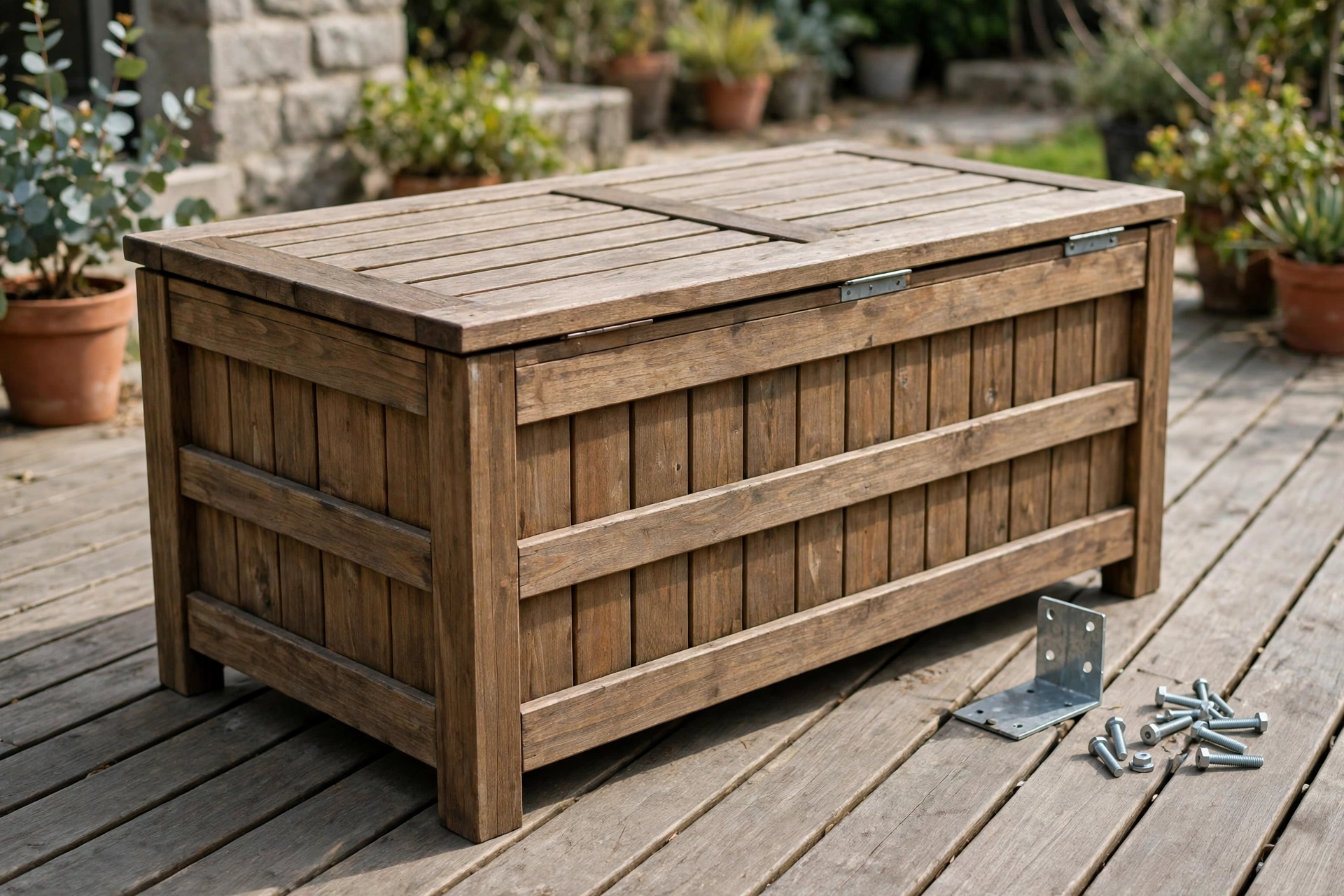
Where wind is severe and the bench must not move, L-brackets into masonry are the permanent option. Mark and drill only if you own the surface and accept the holes, use fixings made for outdoor use, and confirm the bench frame has a solid point to fix to — thin resin panels are not that point.
The mistake to avoid
Do not screw through the floor of the storage compartment to hold a bench down. You will let water in, soak the cushions the bench exists to protect, and void the point of the purchase. Every method above holds the bench from outside or underneath its legs.
Bottom line
Place it out of the wind and load it first, add grip or ground anchors if it still moves, and reserve masonry brackets for the windiest, most permanent spots. Never pierce the storage box itself.
Check it after the first storm
Whatever method you choose, inspect it after the first strong wind. Straps loosen, pads shift, and a bench that held in a breeze tells you little about a storm. Tighten, re-seat, and confirm the lid still opens and closes without the fixings fouling it. That five-minute check, once a season and after major storms, is what makes an anchoring job a solution rather than a one-time project.