This site contains product affiliate links. We may receive a commission if you make a purchase after clicking on one of these links.
The mistake with a first power station is buying the biggest battery on the page. You pay for capacity you never touch, the box ends up living in a closet because moving it is a chore, and when the power actually goes out it is sitting at half charge behind the paint cans. Vevor’s 1200W portable power station is the smaller, smarter bet: $481.90, 806 watt-hours of storage, and a carry handle that means it goes where the trouble is instead of staying where you stored it.
Twenty owners rate this station 4.3 out of 5, and that is a thin record, so read this review the right way: the design and the numbers earn the recommendation, while the long-term reputation is still being written. The verdict up front is that 806 watt-hours with 1,200 watts of output is the correct size for a first station, because it covers the essentials at home, travels without a second thought, and costs less than every bigger box in Vevor’s own lineup.
806 watt-hours, in plain terms
Two numbers run this purchase, and they answer different questions. The 1,200 watts is how much the station can run at one time, which is enough headroom for a kettle, a small cooktop, a mini-fridge, or a CPAP machine without crowding the limit. The 806 watt-hours is the size of the tank, and the load decides how far the tank goes: a steady 100-watt draw empties it in roughly eight hours, while a 400-watt load cuts that to about two. Neither figure is a promise about your house, because your fridge cycles on and off and your lights draw what they draw, but the arithmetic tells you the shape of the thing — an evening of essentials, a night of small loads, a long weekend of phones and cameras at camp.
That middle size is the point. A station half this size dies before the outage gets interesting, and a station three times this size costs three times the money for capacity most households touch twice a year. At 806 watt-hours, this one sits where a first purchase should sit: big enough to matter, small enough that you will actually carry it out to the truck, the tent, or the room that needs it.
Ten ports, and what each one is for
The port list is practical rather than padded. A 65-watt Type-C Power Delivery port charges a modern laptop at full speed, an 18-watt Quick Charge USB port handles phones, and a standard Type-C plus a standard USB-A at 5 volts and 2.4 amps cover the small gear — earbuds, speakers, camera batteries, headlamps. The 12-volt car socket at 8.3 amps runs the vehicle-born equipment, car freezers and air pumps and portable coolers, and an XT60 port at 20 volts and 10 amps serves the hobby and field gear that uses that connector. Ten ports in all, spread across the formats real devices actually use.
The AC side is where the 1,200 watts show up. The station runs household gear within its rating — phones and computers alongside CPAP machines, mini-fridges, drones, and cameras, and it handles the short starting surge that motor-driven appliances demand when they first kick on, which is what lets small power tools and kitchen equipment behave instead of tripping the unit at startup. Keep the total under 1,200 watts and the station does not care whether the load is a work light at a job site or a freezer keeping a season of food cold through the night.
Charging it back up
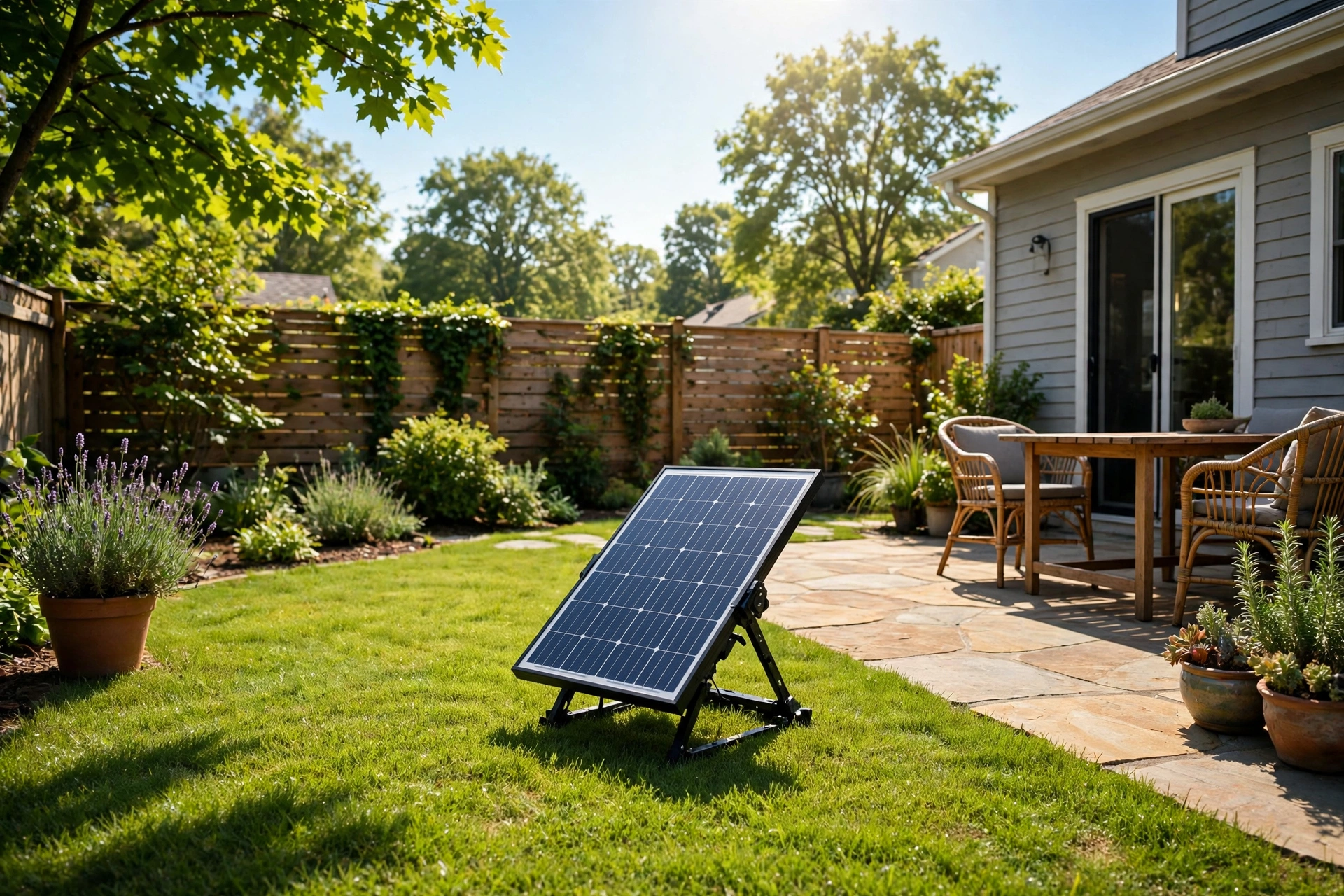
A wall outlet refills the battery in about seven and a half hours, so the routine is simple: plug it in after dinner, wake up to a full station. Charging from a car takes about nine hours of driving, which makes it a road-trip trickle rather than a quick fill, useful on the long haul to a campsite and not much use on a trip across town. Solar charging is ready when you are, with one honest catch — the panels are sold separately, so the $481.90 buys the battery and the ports, and sunshine costs extra whenever you decide to add it.
The battery itself is lithium iron phosphate, rated for up to 3,500 charge cycles and a service life of 10 to 15 years, which changes the math on the price: this is a decade-long appliance, not a gadget you replace when the next model lands. A built-in Battery Management System watches temperature, voltage, current, and cell balance on every cycle, guarding against heat buildup, overcharging, overdischarging, and short circuits while you get on with your evening. You never see any of that work, and that is rather the idea.
Living with it the rest of the year
A backup battery earns its shelf space in the months when nothing goes wrong, and this one is built to be easy to live with in the meantime. The carry handle and the compact footprint mean it stores in a closet or an RV compartment without a negotiation, rides in a car trunk without rearranging the trip, and comes out with one hand when the sky turns. The housing is built to take the knocks of everyday transport, which matters for a machine whose whole job involves being moved — from garage to truck, from truck to tent, from tent to the one room in the house where everybody gathers when the lights quit.
That portability widens the job list beyond storm duty. At a work site with no power yet, it runs the small tools and charges the batteries that run the bigger ones. At a tailgate or a picnic shelter, it quietly handles the speaker, the lights, and a portable cooler without a generator announcing itself to the whole field. None of that asks anything new of the station — the same ports, the same tank, the same silence — and it is the reason a box bought for emergencies ends up being used most weekends instead. A first station should pull that double duty, and at this size and weight, this one can.
The smallest station against its bigger siblings
Vevor now sells three stations in this family, and the honest question is how much tank your life actually needs. The table puts this entry-level box beside the two larger ones reviewed on this site.
| 1200W station | 1800W station | 3000W station | |
|---|---|---|---|
| Price | $481.90 | $545.90 | $1,741.90 |
| Capacity | 806Wh | 1,008Wh | 3,072Wh |
| Continuous output | 1,200W | 1,800W | 3,000W |
| Output ports | 10 | 9 | 15 |
| Solar panels | Sold separately | Sold separately | Not included |
| Best for | First station, camp and road | Essentials on an outage night | A whole evening of essentials |
The step up is smaller than it looks. Sixty-four dollars more buys the 1800W station, with about 200 extra watt-hours and half again the output, and that is the right upgrade if your outage list starts with a full-size fridge and a freezer running side by side. The 3000W station is a different purchase entirely at $1,741.90 — nearly four times the storage for a household planning around long evenings of heavy use. For a first station that has to earn its keep at home and away, the 806 watt-hour box is where the value sits, and this 1200W station is priced like it knows that.
The safety rule, stated plainly
A battery station is the indoor half of backup power: no fumes, no fuel, nothing to spill, and it can run in the room where you sleep while a fuel generator has to stay outside. Treat it with the respect any lithium battery deserves anyway — keep it dry, never charge a unit that has been damaged, and let the management system enforce its limits instead of working around them. Handled that way, it is the quietest insurance a house can own.
Know the boundary, too. Eight hundred six watt-hours is an essentials-scale battery, sized for lights, phones, a CPAP, and a small fridge through the night, and no battery at this price replaces a fuel generator across a multi-day outage. When the job stretches into days, the answer is fuel and fresh air, and the dual-fuel inverter generator in this site’s reviews is the machine built for that week. Buy each tool for the job it is actually sized to do.
Who should buy it
Buy this station if you are purchasing your first one, if it needs to split its life between the house and the campsite, or if a carry handle matters more to you than a second thousand watt-hours you will rarely use. It suits the apartment and condo owner who cannot run a generator at all, the camper who wants the fridge and the lights without the noise, and the household that loses power a few nights a year and wants those nights to be boring.
Skip it if a deep owner record has to come before the purchase — twenty reviews is a beginning, and waiting costs you nothing but time. Skip it, too, if your loads regularly pass 1,200 watts or your outages run for days, because both problems are solved by a different machine, not by hoping this one stretches. For the reader it is built for, though, the call is easy: charge it, keep it where you can grab it, and let the next storm be a story about a quiet house instead of a dark one.
VEVOR 1200W Portable Power Station, 806Wh LiFePO4, 10 Ports
806 watt-hours, 1,200 watts, ten ports and a carry handle — the entry-level station at $481.90.