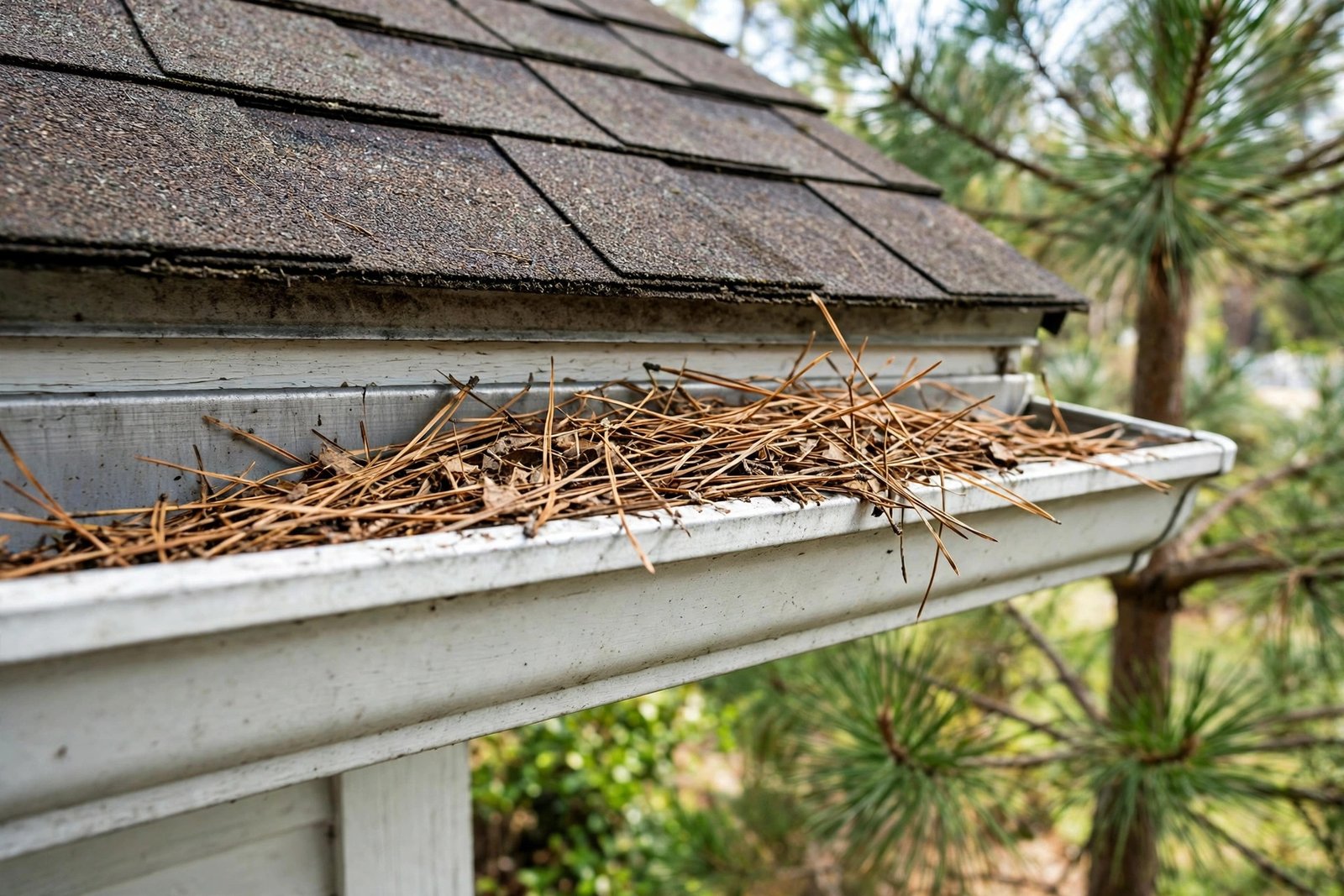
Pine needles are the worst gutter cloggers in the yard. Leaves mat together and eventually wash through, but needles slip through wide gutter covers, lodge in seams, and pack into dense mats that water cannot get past. If a pine stands anywhere near your roof, your gutters need a plan, not just a ladder visit once a year.
Here is how to keep needles out, how often to clean what gets through anyway, and the mistakes that turn a small chore into a waterfall over your siding.
Why Pine Needles Beat Most Gutter Guards
Most gutter guards are built to stop leaves. Needles are thinner, longer, and springier than leaves, so they slide through slots and perforations that stop an oak leaf cold. Once inside, they do not rot quickly. They knit together into a felt-like layer that holds water, adds weight, and feeds the sludge that blocks downspouts.
That is why the guard that works for a maple-lined street can fail completely under a white pine. The fix is not a stronger version of the same guard. It is a finer screen, a different cleaning routine, or both.
Which Gutter Guards Actually Help With Needles
Not all guards are equal against needles. Ranked from most to least effective for pine-heavy roofs:
Fine micro-mesh screens
Micro-mesh is the best widely available option for needle country. The openings are small enough that most needles sit on top of the screen instead of slipping through, and rain still passes. Needles that land on the mesh will still need brushing off, but that is a roofline sweep, not a gutter excavation.
The trade-off is real: fine mesh can clog with roof grit and pollen over time, and it costs more than basic screens. It also needs a secure fit. A screen that lifts at the edge becomes a needle funnel.
Perforated metal covers
Perforated aluminum covers with small holes do a decent job and hold up better than plastic. Some needles will still find the holes, especially after a storm drives them in at an angle. Expect to clean the gutters themselves less often, but not never.
Foam inserts and brush inserts
Foam and brush inserts are the weakest choice under pines. Needles work their way into foam and bristles, and once embedded they are miserable to remove. These inserts can also hold moisture against the gutter. Skip them if needles are your main problem.
Reverse-curve (surface-tension) covers
Reverse-curve covers shed leaves well, but needles can ride the curved surface right into the slot, and the narrow opening is hard to clean once needles pack in. They are a mediocre needle solution despite their price.
Cleaning Cadence: How Often Under Pines
Even with good guards, plan on checking twice a year at minimum: once after the heaviest needle drop in fall, and once in spring before storm season. Homes with a pine overhanging the roof should add a mid-summer check, because summer storms drop green needles and small branches that wedge into seams.
Without guards, the honest cadence under a mature pine is three to four cleanings a year. Stretching to once a year is how gutters end up sagging, overflowing, and dumping water against the foundation.
How to Clean Needle-Clogged Gutters
- Start at the downspouts. A clear gutter with a blocked downspout still overflows. Run water from a hose into each downspout first and find the blockages before you scoop.
- Scoop toward the downspout, not away from it. Work in sections, pushing debris toward the outlet so you are not chasing it back and forth.
- Flush after scooping. Needle mats leave behind grit and broken needle fragments. A hose flush moves that residue out before it hardens into a new dam.
- Check the elbows. Downspout elbows are the narrowest point in the system and the most common clog site. If water backs up, the elbow is the first place to open.
- Watch the water, not just the debris. A gutter that looks clean but still overflows in rain has a slope problem or a hidden downspout blockage, not a debris problem.
What Not to Do
- Do not blow needles off the roof into the gutters. A leaf blower pointed down the slope just relocates the problem into the trough. Blow off the roof away from the gutters, or rake needles into piles first.
- Do not seal downspouts with screens and forget them. A strainer at the downspout inlet catches needles, but it also becomes the new clog point. If you use one, it goes on the regular check list.
- Do not ignore overflow because it only happens in heavy rain. Heavy rain is exactly when gutters matter most. Overflow in a downpour means the system is already at capacity with debris.
- Do not walk on a wet, needle-covered roof to clean gutters. Needles on shingles are slick. Work from a ladder with a standoff, or hire the job out.
Reduce the Needle Load at the Source
Pruning helps more than any guard. Limbs that overhang the roof drop needles directly into the trough, while limbs cut back even a few feet let wind carry most needles past the roofline. Keep the cut legal and safe: stay clear of power lines and hire an arborist for anything above a comfortable ladder height.
Ground cleanup matters too. Needles that collect in beds and rock areas beside the house wash toward the foundation and into window wells during storms. Our full cleanup guide covers the yard side of the job, and the rock-and-gravel guide covers beds where needles wedge between stones.
When to Call a Professional
Call for help if the roof is steep, the gutters are two stories up, or overflow continues after a thorough cleaning. Persistent overflow after cleaning usually means a slope or downspout sizing issue, and that is a repair, not a cleaning problem. A pro can also spot sagging hangers and separated seams while the gutters are open.
The Bottom Line
Fine micro-mesh screens plus a twice-a-year check is the most reliable needle setup for most homes. Guards reduce the work; they do not eliminate it. The homes with dry basements and intact fascia are the ones whose owners treat needle season as a recurring chore, not a one-time fix.
For the yard side of needle season, see our complete pine needle cleanup guide, and if spring cleanup is on your mind, our lawn sweeper guide covers which sweeper type fits your yard. For needles trapped in beds, see how to remove pine needles from rocks, gravel, and flower beds.
Related: if needles are also smothering the lawn under those same pines, see what grass grows under pine trees.