String lights fail in two ways: they fall down, or they damage the thing they were hung from. Both failures come from the same cause — the strand itself carrying the load, pulled tight between two points that were never meant to hold it. Hang the wire, not the lights, and most of the problems disappear.
Why a guide wire comes first
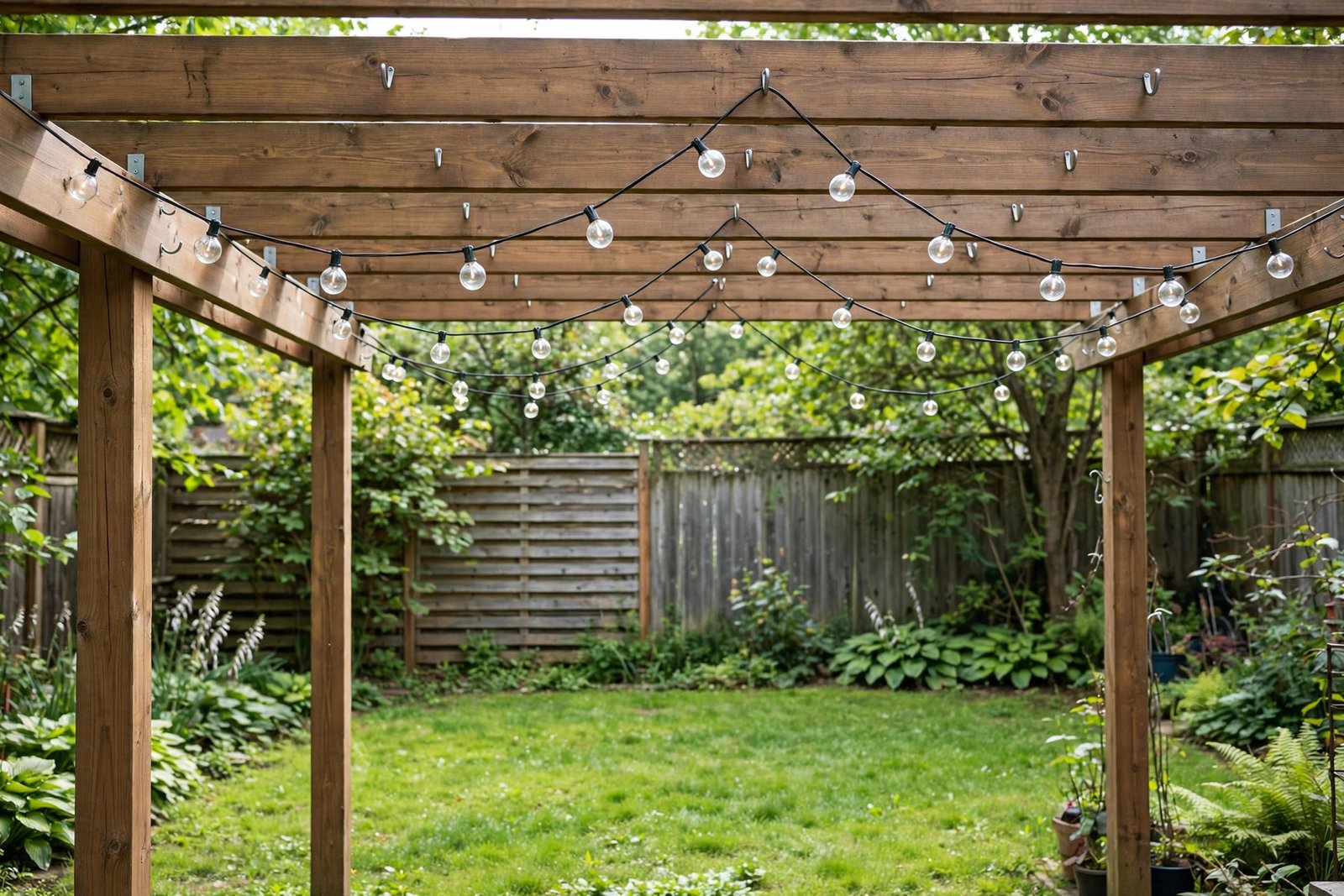
A strand of lights is a decoration, not a cable. On any span longer than about 10 feet, run a guide wire — vinyl-coated steel cable or a dedicated string-light suspension kit — between the supports, and clip the light strand to it. The wire takes the tension, the wind load, and the weight of rain or snow. The lights just ride along. On a pergola, the beams themselves can carry short runs without a wire, clipped at intervals so no section sags on its own.
Leave sag in the wire. A wire pulled drum-tight has no give when wind gusts or ice loads it, and it pulls at its anchors with far more force than a wire with a gentle curve. A few inches of drop over a 10- to 15-foot span is right; the lights will look relaxed rather than sloppy, and the anchors will last longer.
Choosing hooks and anchors for each surface
Wood — fascia boards, pergola beams, deck posts — takes screw-in cup hooks or eye screws directly. Drill a small pilot hole first so the wood does not split, and choose hooks rated for outdoor use so they do not rust and stain the wood. This is the strongest, simplest fixing, and the one to use wherever wood is available.
Siding, brick, and stucco need more care. Do not drive screws through vinyl siding: the holes let water in and the siding moves with temperature, working fasteners loose. Use adhesive hooks rated for the weight of the strand plus the wire, applied to clean, dry siding on a warm day, and check the weight rating — a 48-foot strand with bulbs is heavier than it looks, especially wet. On brick, use masonry anchors in the mortar joints rather than the brick itself, so a future removal does not scar the face. On stucco, adhesive hooks are the safer choice; drilling stucco cracks the finish and invites water behind it.
Trees take a different approach: wrap a wide strap around the branch rather than screwing into it, and leave slack for growth. A screw in a living branch is a wound that grows wider every year.
Hanging the strand, step by step
Measure the run on the ground first. Lay the strand out, count the distance including sag and the drop to the outlet or solar panel, and confirm the length before anyone climbs a ladder. A strand that is 5 feet short at the far end is a second trip to the store.
Set the anchors and the guide wire. Fix the end anchors, run the wire with its sag, and tension it just enough to hold the curve. Test it by hand: it should give a little when pulled, not twang.
Clip the lights to the wire. Use small zip ties or purpose-made clips at intervals of a few feet, not at every bulb. Leave the bulbs hanging below the wire so they read as lights, not as a cable with lumps.
Route the power last. For plug-in strands, run the cord to the outlet with a drip loop — a low point below the outlet so rain runs off the cord instead of into the socket. Keep connections off the ground. For solar strands, place the panel in full sun as covered in solar vs. plug-in string lights, and keep the lead cord out of foot traffic.
What not to do
Do not staple the strand to anything. Staples nick the insulation, and a nicked cord outdoors is a hazard, not a shortcut. Do not use indoor extension cords outside, do not run cords under rugs or through doorways that pinch them, and do not leave a strand plugged in through a storm with connections sitting in a puddle. Do not exceed the number of strands the listing allows to be connected end to end — the limit exists because the first strand’s cord carries the current for all of them.
Seasonal care
At the end of the season, take plug-in strands down if your winters bring ice: ice loads a strand far beyond its design weight and the thaw refreezes into the sockets. Coil strands loosely, never wound tight around an elbow, and store bulbs in a dry box with a spare or two. Solar strands can usually stay up, but bring the panel in if it will sit under snow for months — a panel that cannot see the sun is just a weight on a stake. When you re-hang in spring, check every socket for cracked insulation before plugging in. The strands themselves are compared in the best outdoor string lights roundup.
What to watch next
After the first windy night, walk the run and look for hooks pulling, wire slipping, and bulbs resting against hot surfaces or sharp edges. A strand that survives its first storm with its anchors intact will usually survive the season. The one mistake that undoes a good hang is tightening everything again in spring until the wire is taut — leave the sag alone.