Disclosure: This post contains affiliate links. We may receive a commission if you make a purchase after clicking on one of these links.
Solar and plug-in string lights look identical once they are hanging. They are not identical to live with. One depends on the weather that day; the other depends on an outlet you may not have. The choice is less about the lights and more about three facts of your patio: where the outlet is, how much sun the panel would get, and how many nights a week the lights actually run.
How each type actually works
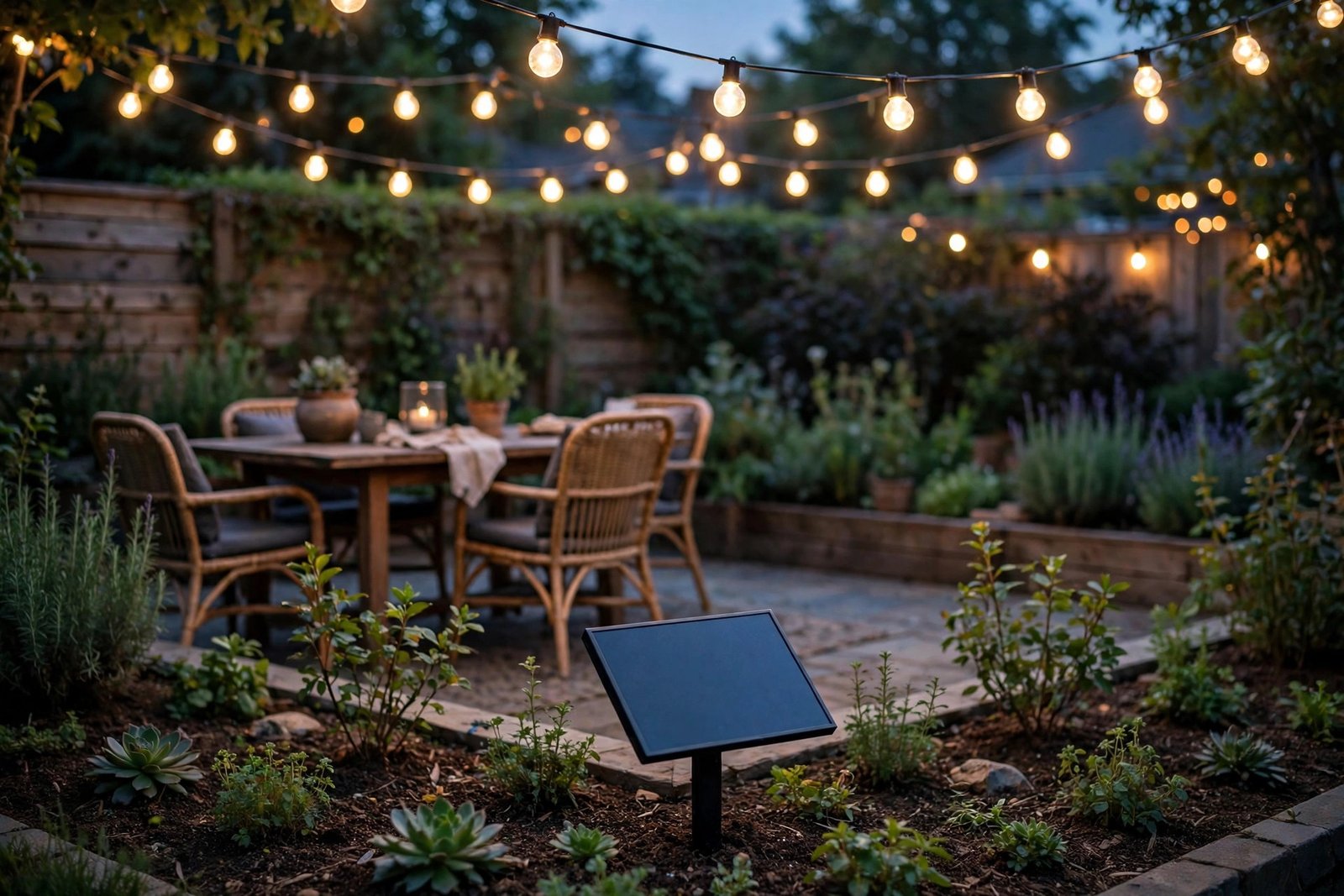
A solar strand charges a battery from a small panel during the day and runs the bulbs from that battery after dark. Runtime follows the sun: a bright summer day gives a full evening, a gray winter day gives a shorter one. A plug-in strand draws from the house supply, so brightness and runtime are the same every night, and dimming and timers come from the strand, a dimmer, or a smart plug rather than the battery.
| Question | Solar | Plug-in |
|---|---|---|
| Needs an outlet? | No — panel on a stake or mount | Yes — outdoor-rated outlet |
| Brightness | Varies with charge; dimmer late at night | Steady all evening |
| Best for | Occasional use, no outlet, rentals | Nightly use, long runs, dimming |
| Weak point | Shade and short winter days | Cord routing and outlet location |
When solar is the right answer
Solar wins when there is no outlet near the lights and adding one is not on the agenda — a back fence, a tree-hung strand, a rental patio. It also wins when the lights run a few nights a week rather than every night, because the battery has days to recover between uses. The Brightech Ambience Pro solar strand in our string lights roundup is the pattern: 48 feet, 15 shatterproof LED bulbs, remote, panel on a stake.
The condition that decides it is sun on the panel, not sun on the patio. A panel tucked under the same pergola as the lights will charge poorly. Put the panel where it gets direct sun for most of the day, even if that means the lead cord runs further than you expected, and angle it toward the sun rather than laying it flat.
Brightech Ambience Pro Solar Outdoor String Lights, 48 ft
No outlet needed; 15 shatterproof LED bulbs with a remote and a staked panel.
When plug-in is the right answer
Plug-in wins for nightly use, for long runs, and for anyone who wants dimming they can rely on. A 100-foot run like the addlon corded strand below needs steady power that a small solar panel cannot promise, and a plug-in strand stays at full brightness until you turn it off. If the patio already has an outdoor outlet — or a porch light circuit an electrician can extend — plug-in is the lower-fuss choice over a whole season.
The costs are a cord to route and connections to keep dry. Use an outdoor-rated outlet with ground-fault protection, keep plug connections off the ground and out of standing water, and do not join more strands end to end than the listing allows. Those are one-time setup jobs, not nightly ones.
addlon 100 ft Outdoor String Lights, 32 Dimmable Bulbs
Steady plug-in power for a long run, with dimmable warm-white bulbs.
The middle cases
A shaded patio with an outlet: plug-in, without hesitation — solar would starve in the shade. A sunny yard with no outlet and lights used on weekends: solar, and spend the outlet money on something else. A patio used every night in a northern winter: plug-in, because short days and long nights are the worst combination for a solar battery. A rental where you cannot drill or wire anything: solar, hung with removable hooks, as described in how to hang string lights without damaging your house.
Running costs and lifespan, honestly
Both types use LED bulbs at about a watt each, so the electricity cost of a plug-in strand is small — 15 one-watt bulbs running four hours a night use roughly 60 watt-hours a day, a rounding error on a power bill. The real cost difference is replacement: solar strands add a battery that weakens over seasons, while plug-in strands fail at the cord, the sockets, or the bulbs. In both cases, replaceable bulbs and a weatherproof strand matter more than the power source. Check the listing for the battery type and whether it can be replaced before buying a solar strand you plan to keep for years.
Final thoughts
Count the sun, count the outlets, count the nights. Sun and no outlet: solar. Outlet and nightly use: plug-in. Shade and nightly use: plug-in, full stop. The strand itself matters less than matching it to the patio it has to live on.