Landscape & Leisure is reader-supported. When you buy through links on our site, including Botanical Interests seed links, we may earn a commission at no extra cost to you. Prices change, so click through to confirm current pricing.
Most people buy the wrong one first. The packets sit side by side on the seed rack, the plants look like cousins — because they are — and the names sound interchangeable, so you grab marjoram when the recipe wanted oregano, or oregano when the sausage wanted marjoram, and the dish tastes wrong all season with no obvious reason why. The fix costs nothing: know which is which before you sow.

The Mix-Up, Explained
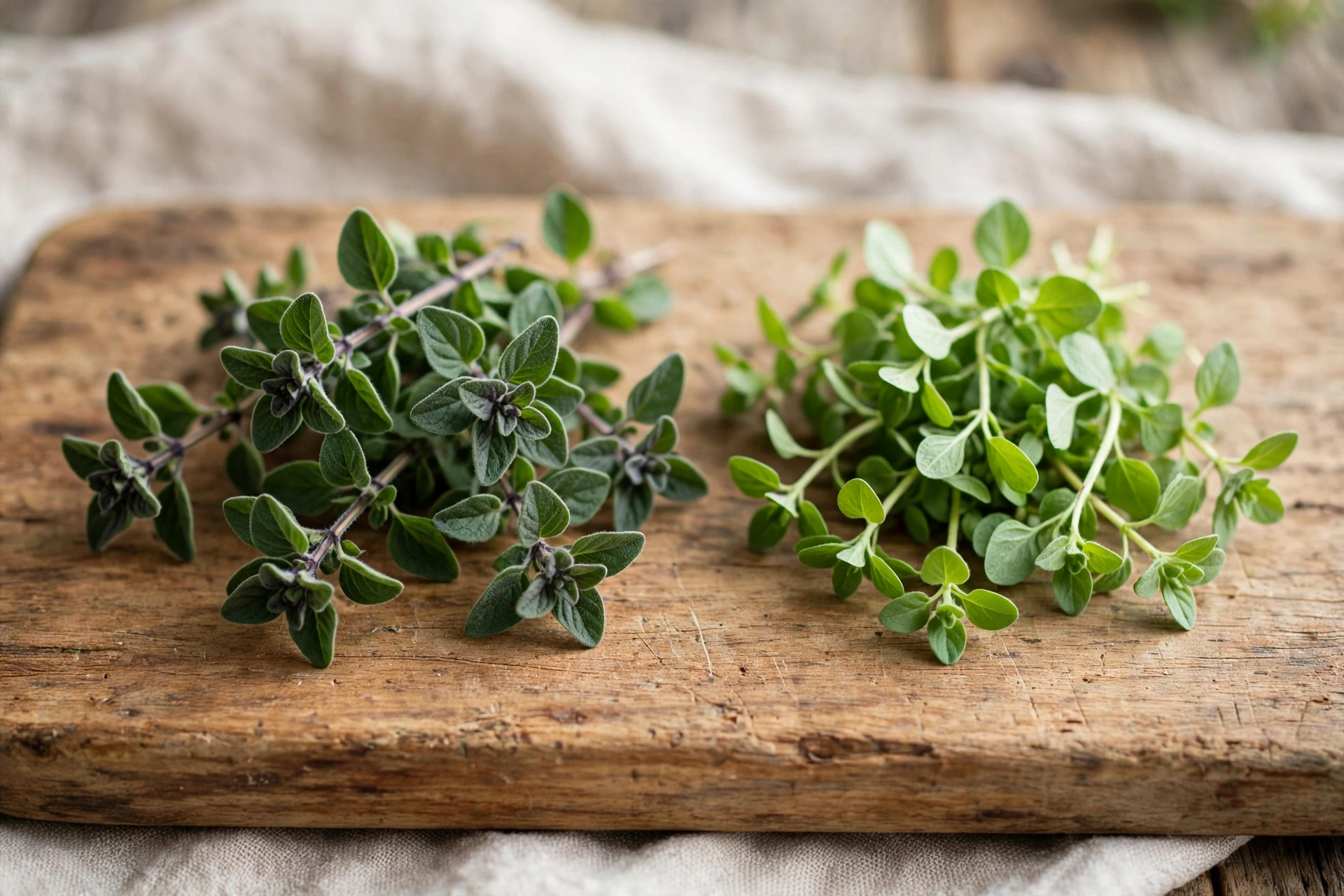
Oregano and marjoram are both Origanum, both in the mint family, and both Mediterranean plants that want sun and lean, well-drained soil. The difference starts with the species: oregano is Origanum vulgare, the true culinary oregano prized by Italian and Greek chefs; marjoram is Origanum majorana, a softer cousin with smaller, rounder, pale gray-green leaves and tiny white or pink flowers in midsummer.
The leaves tell them apart if you know what to look for. Oregano’s are oval, gray-green, and fuzzy, about an inch and a half long, on stalks that turn woody with age. Marjoram’s are smaller — a quarter to three-quarters of an inch wide — round, pale, and velvety. In the garden they grow to the same medium height, 12 to 24 inches, so size will not settle it; the leaf and the flavor will.
The Flavor Test
This is where the two part ways for good. Oregano is the strong one: highly aromatic and flavorful, the taste that makes a tomato sauce taste like a tomato sauce, and the herb that belongs in marinades and with grilled meat and fish. Marjoram is milder but more complex, with a hint of balsam — the herb for German sausage and herb breads, where oregano’s punch would elbow everything else off the plate.
If your cooking leans Italian and Greek, oregano is the workhorse. If it leans German and Central European, or if you want the herbal note without the bite, marjoram is the better call. And if you cook both ways, grow both — they want the same bed and the same treatment, so the second plant costs you almost nothing.
Growing Them Side by Side
They grow almost identically, with two differences that matter. The first is winter: oregano is a perennial in zones 4 through 8 and comes back in most of the country, while marjoram is perennial only in zones 9 and 10 and is grown as an annual everywhere else. The second is sowing time: marjoram can be sown outside 1 to 2 weeks before your last frost, while oregano waits until 2 to 4 weeks after it, when temperatures are warm and settled.
Everything else matches. Both want full sun. Both are pressed into the surface rather than buried — the seeds are tiny — and both start indoors 6 to 8 weeks before your last frost, oregano at 70 to 78 degrees and marjoram at 65 to 75. Oregano germinates in 7 to 14 days from a tiny pinch of seeds every 12 inches, thinned to one plant every 12 inches when the seedlings reach 2 to 3 inches tall. Marjoram germinates in 10 to 15 days from groups of 4 seeds every 12 inches, thinned to one every 12 inches. Both are drought-tolerant and deer-resistant, and both can be picked once the plant reaches 6 inches tall — oregano at its best just before it flowers.
| Oregano | Marjoram | |
|---|---|---|
| Species | Origanum vulgare | Origanum majorana |
| Zones | 4–8, perennial | 9–10 perennial, annual elsewhere |
| Height | 12″–24″ | 12″–24″ |
| Sowing depth | Press into surface | Press into surface |
| Germination | 7–14 days | 10–15 days |
| Start indoors | 6–8 weeks, soil 70–78°F | 6–8 weeks, soil 65–75°F |
| Direct sow | 2–4 weeks after last frost | 1–2 weeks before last frost |
| Flavor | Strong, aromatic — tomato sauce, marinades, grilled meat | Milder, more complex, balsam hint — sausage, herb breads |
The Catch: One of Them Is Sold Out
Here is the wrinkle. True Greek Oregano — the culinary oregano, the one this comparison recommends — is sold out as a single packet right now at $2.69, so you cannot order it on its own. The way to get it today is the Chef’s Herb Garden Seed Bundle, which includes True Greek Oregano among its twelve packets for $36.99. Marjoram, meanwhile, is in stock at $4.49.
And one warning about a lookalike: Kirigami Ornamental Oregano is also in stock, at $4.99, and it is a beautiful plant — hop-like bracts shifting from soft green to rosy-purple — but it is an ornamental for containers and bouquets, not a kitchen herb. If you buy it expecting oregano flavor, you will be disappointed twice: once at the price, and once at dinner.
BEST FOR MILD FLAVOR
Marjoram Seeds
Oregano’s gentler cousin — milder, more complex, and the right herb when oregano would take over.
BEST WAY TO GET OREGANO
Chef’s Herb Garden Seed Bundle
True Greek Oregano while the single packet is sold out — twelve packets, including the oregano.
Bottom Line
Grow oregano if your cooking leans Italian and Greek — it is the stronger flavor, the perennial that comes back in zones 4 through 8, and the herb a tomato sauce actually needs — and grow marjoram if you want the gentler flavor, or if you are in a hurry, since it can be sown outside before the last frost and picked all season. Grow both if you have the room, because they share a bed, a watering routine, and a harvest window. And if you are buying this week, start with marjoram and the Chef’s bundle — the oregano is inside the bundle, and the bundle is how you get it while the single packet is sold out. Our roundup has the full Mediterranean set, and our growing guide covers the sun, soil, and watering that keep both of them flavorful.