As the season winds down, the daisy patch tells you how its year went. The flowers are spent, the stems are drying down, and the clump that looked full in midsummer now shows the gaps where the middle has thinned out. Shasta daisies do not fade quietly — when they crowd themselves, they show it, and the fix is a spade and an afternoon.
Shasta daisy (Leucanthemum × superbum) is hardy across USDA zones 4 to 9, and in most of that range it grows fast enough to crowd itself within a few seasons. Dividing it is one of the simplest jobs in the perennial bed, and the plant rewards it with the full, even flowering that made you plant it in the first place.
Why it happens
A Shasta daisy clump needs dividing every 2 to 3 years. Left alone, the clump crowds itself: the stems pack tighter, flower numbers drop, and dead patches appear in the middle where the oldest growth has gone woody and tired. The outer ring keeps blooming while the center gives up, and the whole plant starts to look ragged rather than full.
The mechanism is the same one behind most crowded perennials. The vigorous new shoots grow outward, the center ages into a woody core that produces little, and the roots compete with each other for water and space. Dividing breaks that cycle by throwing away the tired center and giving the vigorous outer sections room to grow into full clumps of their own.
A two-year-old clump can still look fine from the path, which is why the thinning center is the sign to trust rather than the overall size of the plant. The clump keeps getting wider even as it flowers less, so size alone tells you nothing — the bare middle and the falling flower count are what say the roots have run out of room.
When to divide
There are two good windows, and which one suits you depends on your climate. Early spring, before the shoots emerge, is the first choice in cold zones — the plant wakes up in its new spot and grows straight into the season. Early fall is the other window, as long as you divide at least one month before your first average frost date, so the divisions have time to root before the ground cools.
The recommendation is simple: spring in cold zones, where a fall division would face winter before it has settled, and fall where frost comes late enough to give the new pieces a full month of warm soil. Either way, do not divide during summer heat or while the plant is in flower, when the roots are least able to recover from the move.
Spring dividing carries one practical trick worth knowing. Mark the clump’s location while you can still see it, and dig before the shoots sprout, because disturbing sprouted rootstock can cost that season’s flowers. A small stake or a plant label tucked beside the crown in fall saves you from guessing where the clump is once the stems have died back. For the fall side of the question, dividing perennials in fall follows the same rule — leave enough warm weeks for the roots to take hold.
The fix, step by step
- Pick your moment and mark the spot. In spring, find the clump before the shoots emerge and mark it, so you are digging the right place at the right time.
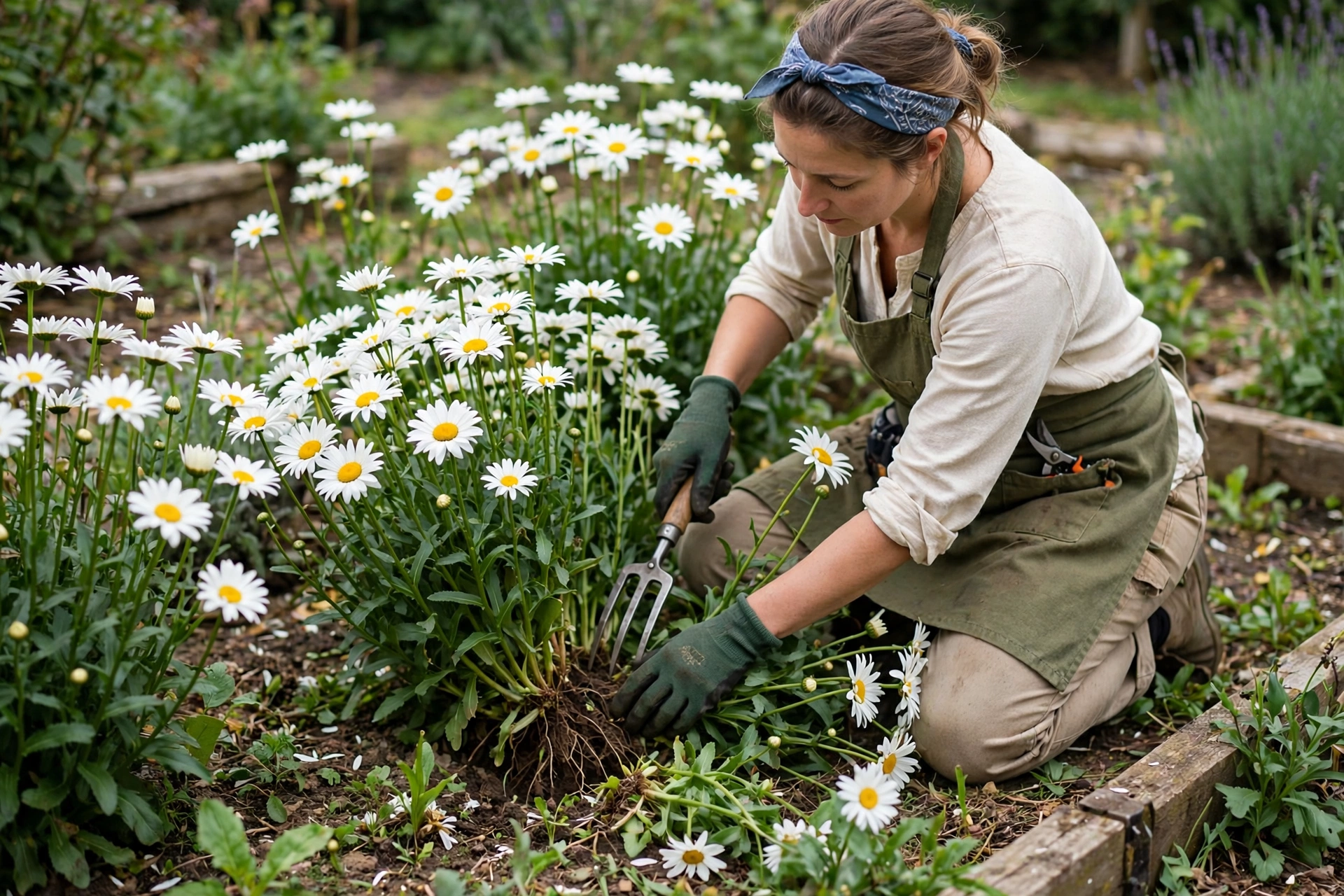
- Dig around the clump and lift it whole. Work around the outside of the clump and lever it out of the ground in one piece, keeping as much of the fibrous root mass intact as you can.
- Split into vigorous pieces. Pull the clump apart at the natural breaks or cut through it, keeping only the vigorous outer sections and discarding the tired woody center. Each division needs 3 to 5 healthy shoots with fibrous roots attached.
- Replant at the same depth. Set each division back in the ground at the same depth it grew before, spacing the divisions 18 to 24 inches apart so they have room to fill out.
- Cut back and water in. In fall, cut the dry foliage back to about 2 inches, then water the new divisions well so the soil settles around the roots.
What to watch next
A divided daisy clump spends its first weeks putting roots down, so the payoff shows up in the flowering that follows rather than in the first few days. The sign to look for is fresh shoots coming up evenly across each division, with no bare patch in the middle — that is the clump growing as one plant again instead of a ring around a dead core.
The one mistake that undoes the work is dividing while the plant is in flower or in summer heat, when the roots are least able to recover from the move. A division made at the wrong time takes far longer to settle, and the flowers you were hoping to save are the first thing it gives up. Pick the window, spring or fall, and the plant does the rest.
Other perennials in the same bed may be ready for the same treatment, and the rhythm carries over — here is how to divide coreopsis if a clump of that is crowding in beside the daisies. But start with the daisies: if they bloomed less this year than last, divide them this fall or next spring, spring in cold zones and fall where frost comes late, and the patch will come back full.