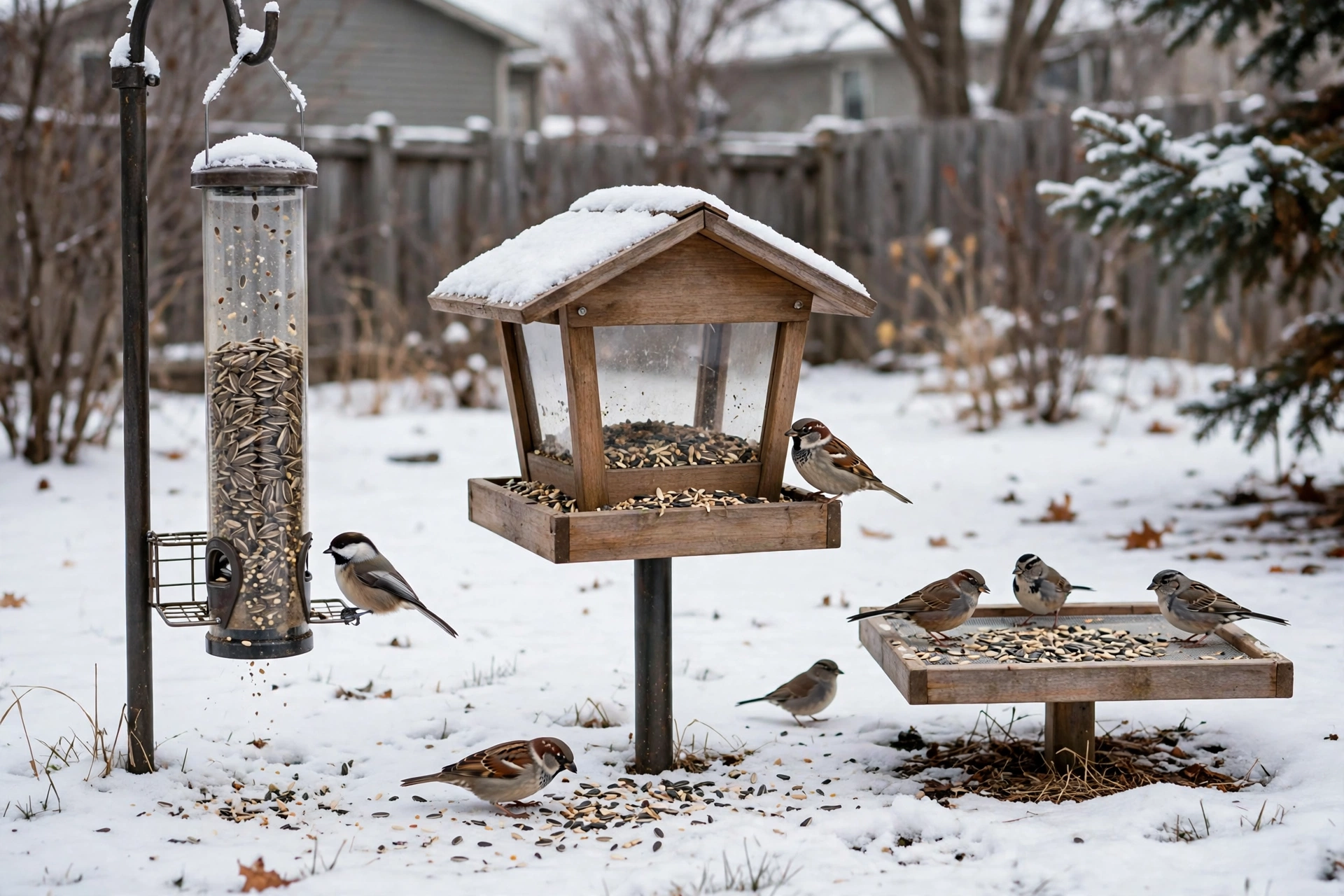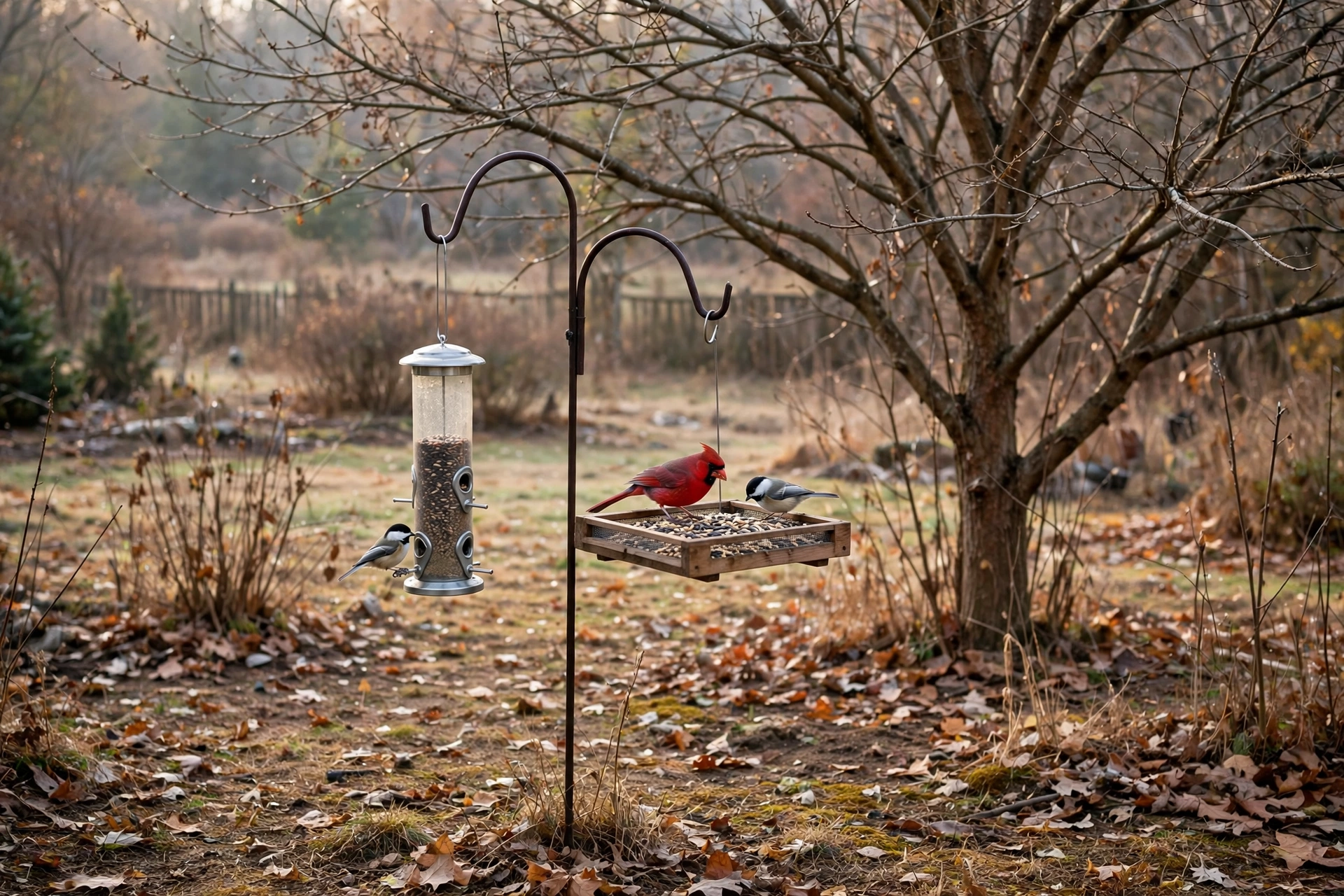
A mixed bag of seed and a bag of black-oil sunflower do different jobs at the same feeder. The mix gets picked through and half of it lands on the ground uneaten, while the sunflower is eaten by nearly every bird that shows up.
Winter is when that difference costs the most. Birds are burning extra energy just to stay warm, feeders get their heaviest traffic of the year, and seed bought for the wrong species sits until it spoils.
Match the food to the bird and the feeder to the food, and the waste mostly disappears. The table below pairs twenty common feeder birds and groups with the foods Cornell Lab of Ornithology’s Project FeederWatch lists for them, and the feeder types those foods belong in.
Bird seed preferences by species
| Species / group | Preferred foods | Feeder types | Source |
|---|---|---|---|
| Northern Cardinal | Black-oil sunflower seed, hulled sunflower seed, safflower | Large Hopper, Platform | Cornell Lab FeederWatch |
| Chickadees (Black-capped / Carolina) | Black-oil sunflower seed, hulled sunflower seed, mealworms, peanut hearts, shelled peanuts, suet | Small Tube, Small Hopper, Suet Cage | Cornell Lab FeederWatch |
| House / Purple Finches | Black-oil sunflower seed, hulled sunflower seed, nyjer | Small Tube, Large Tube | Cornell Lab FeederWatch |
| American Goldfinch | Nyjer, black-oil sunflower seed, hulled sunflower seed | Small Tube (small nyjer ports) | Cornell Lab FeederWatch |
| Pine Siskin | Nyjer, black-oil sunflower seed, hulled sunflower seed | Small Tube (small nyjer ports) | Cornell Lab FeederWatch |
| Common Redpoll | Nyjer, black-oil sunflower seed, hulled sunflower seed | Small Tube (small nyjer ports) | Cornell Lab FeederWatch |
| Tufted Titmouse | Mealworms, peanut hearts, shelled peanuts, black-oil sunflower seed | Small Hopper, Small Tube, Platform | Cornell Lab FeederWatch |
| Nuthatches | Mealworms, peanut hearts, shelled peanuts, suet | Suet Cage, Small Tube, Small Hopper | Cornell Lab FeederWatch |
| Wrens | Mealworms | Platform (flat tray) | Cornell Lab FeederWatch |
| Eastern Bluebird | Mealworms, fruit | Platform (flat tray) | Cornell Lab FeederWatch |
| Woodpeckers | Suet, black-oil sunflower seed | Suet Cage, Large Hopper | Cornell Lab FeederWatch |
| Sparrows (incl. Song / Fox, towhees) | Millet, cracked corn, black-oil sunflower seed | Ground, Platform | Cornell Lab FeederWatch |
| Dark-eyed Junco | Millet | Ground, Platform | Cornell Lab FeederWatch |
| Mourning Dove | Cracked corn, oats | Ground, Platform, Large Hopper | Cornell Lab FeederWatch |
| Quail | Cracked corn, oats | Ground, Platform | Cornell Lab FeederWatch |
| Blue Jay / jays | Peanuts (in shell or shelled), peanut hearts | Platform, Large Hopper | Cornell Lab FeederWatch |
| Wild Turkey / ducks | Whole corn | Ground | Cornell Lab FeederWatch |
| Orioles | Fruit (halved oranges), sugar water at 1 part sugar to 6 parts water | Nectar, Platform | Cornell Lab FeederWatch |
| Mockingbirds / catbirds / robins / waxwings | Fruit (grapes, raisins without preservatives, halved oranges) | Platform | Cornell Lab FeederWatch |
| Hummingbirds | Sugar water at 1 part sugar to 4 parts water | Nectar | Cornell Lab FeederWatch |
The seed that covers the most birds
Black-oil sunflower is the most common seed offered at feeders in North America, and it earns that spot: the shells are thin, the seed is high in energy, and FeederWatch lists it among the favorite foods of cardinals, chickadees, finches, and sparrows, with woodpeckers taking it on occasion.
Hulled sunflower removes the shell work entirely, and any bird that eats sunflower in the shell will eat the hulled version. Keep it dry, because hulled seed spoils faster than seed still in the shell.
If your feeders themselves need sorting out before the seed does, Best Winter Bird Feeders covers the styles that hold up through the cold months, and Tube vs Hopper vs Platform Bird Feeders walks through which birds each style actually serves.
Small seeds need the right feeder
Nyjer is tiny enough to pour straight through a standard port, so it goes in a feeder with very small feeding ports, and it is best fed by itself rather than in a mix. That one change is what brings in American Goldfinches, Pine Siskins, and Common Redpolls reliably.
Millet works the opposite way: it belongs low. A handful sprinkled on the ground or spread on a platform near the ground is what juncos and sparrows are looking for, because both groups feed on flat surfaces and rarely work an elevated feeder for long.
Foods that need a little care
Milo fills out cheap mixes, and in the East most of it goes to waste; western birds eat more of it. Reading the mix label for a heavy milo share is the fastest way to spot a bag that will leave seed behind.
Suet draws the insect-eating birds, but plain suet can turn rancid in hot weather unless it has been specially processed. Peanuts should never be salted or coated, and moldy peanut hearts get thrown out as soon as the mold shows.
Fruit gets discarded once it turns moldy, because some molds produce toxins that harm birds. Sugar water needs no red coloring at all — a red feeder port or a red ribbon on top of the feeder draws hummingbirds and orioles without it.
A small extra worth setting out
Birds grind food in the gizzard, and many will take grit — sand, small pebbles, or ground shells — as a supplement. Eggshells add calcium, which matters during egg laying: boil them for 10 minutes or heat them at 250 degrees for 20 minutes, let them cool, crush them to about the size of sunflower seeds, and offer them in a dish or on a low platform feeder.
Start simple this winter: black-oil sunflower in a hopper or tube feeder, nyjer in a small-port feeder if finches are the goal, and millet scattered on the ground underneath for the sparrows and juncos. Those three foods, in those three places, cover most of the birds in the table.
Sources
Cornell Lab of Ornithology, Project FeederWatch — “Food Types,” https://feederwatch.org/learn/feeding-birds/food-types/ (fetched November 29, 2026)
Cornell Lab of Ornithology, Project FeederWatch — “Feeder Types,” https://feederwatch.org/learn/feeding-birds/feeder-types/ (fetched November 29, 2026)