The last picking of the season is in the colander, the pot is at a rolling boil, and the freezer bags are already open on the counter. This is the part of the job that decides whether those beans taste like August in February, or like something the freezer forgot — and the difference comes down to minutes on the timer.
Blanching is the quick dip in boiling water that stops the enzymes in a vegetable from going on working in the freezer, where they would otherwise drain the color, the flavor, and the texture out of it over the months. Get the time right and the vegetable holds; shortchange it and the enzymes keep going, which is worse than skipping the blanch entirely. This table gives you the time for 28 vegetables, in minutes, for water blanching at sea level — every figure from the National Center for Home Food Preservation at the University of Georgia.
How to blanch before you freeze
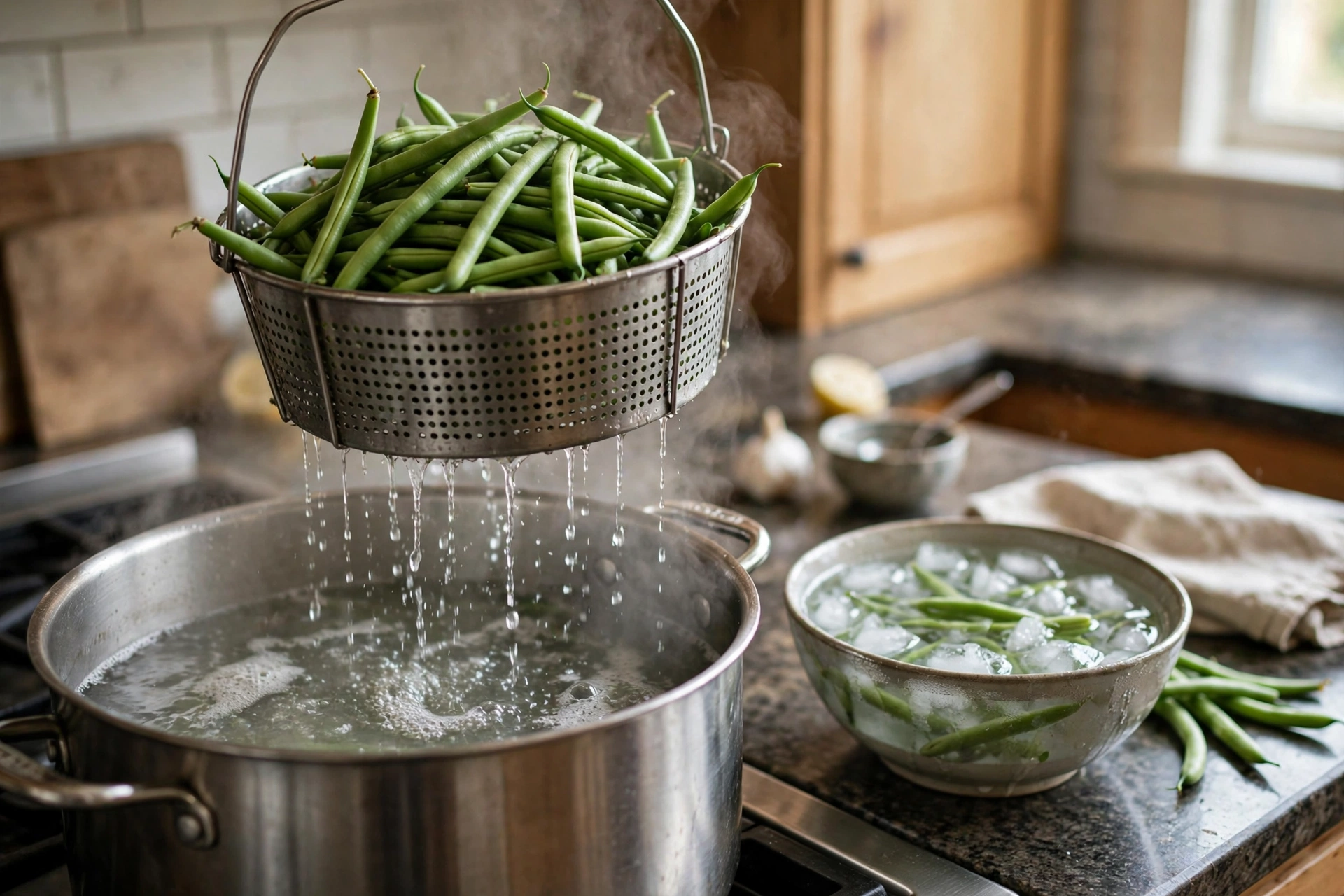
Start with a big pot and a basket that fits inside it, and use a gallon of water for every pound of prepared vegetables. Lower the basket into water at a full, rolling boil, put the lid on, and start counting only when the water comes back to a boil — if it takes longer than a minute to get there, the batch is too big for the pot, so split it and run it in two. Keep the heat high for the whole time the table gives you.
The moment the time is up, lift the basket straight into cold water, 60 degrees or below, and leave it there as long as the vegetables blanched. About a pound of ice per pound of vegetables keeps the water cold enough, and the cold bath matters as much as the hot one — it stops the cooking where the timer left off. Drain the vegetables well before they go into the bag, since extra water turns to ice crystals that cost you texture. Steam blanching takes about half as long again as water blanching, and the microwave is not a substitute: it may leave some enzymes working, which is exactly what blanching is meant to stop.
The table
Times below are in minutes, for water blanching, unless the row says steamed. Four vegetables — beets, pumpkin, winter squash, and sweet potatoes — have no blanching time at all: cook them until tender, then pack.
| Vegetable | Prep / size | Blanching time (minutes, water) |
|---|---|---|
| Artichoke, globe | Hearts | 7 |
| Artichoke, Jerusalem | — | 3–5 |
| Asparagus | Small stalk | 2 |
| Asparagus | Medium stalk | 3 |
| Asparagus | Large stalk | 4 |
| Beans, snap / green / wax | — | 3 |
| Beans, lima / butter / pinto | Small | 2 |
| Beans, lima / butter / pinto | Medium | 3 |
| Beans, lima / butter / pinto | Large | 4 |
| Beets | — | Cook until tender |
| Broccoli | Flowerets, 1½ in across | 3 |
| Broccoli | Flowerets, 1½ in across, steamed | 5 |
| Brussels sprouts | Small heads | 3 |
| Brussels sprouts | Medium heads | 4 |
| Brussels sprouts | Large heads | 5 |
| Cabbage or Chinese cabbage | Shredded | 1½ |
| Carrots | Small, whole | 5 |
| Carrots | Diced, sliced, or lengthwise strips | 2 |
| Cauliflower | Flowerets, 1 in across | 3 |
| Celery | — | 3 |
| Corn | Corn-on-the-cob, small ears | 7 |
| Corn | Corn-on-the-cob, medium ears | 9 |
| Corn | Corn-on-the-cob, large ears | 11 |
| Corn | Whole kernel or cream style (blanch ears first, then cut) | 4 |
| Eggplant | — | 4 |
| Greens | Collards | 3 |
| Greens | All other | 2 |
| Kohlrabi | Whole | 3 |
| Kohlrabi | Cubes | 1 |
| Mushrooms | Whole, steamed | 5 |
| Mushrooms | Buttons or quarters, steamed | 3½ |
| Mushrooms | Slices, steamed | 3 |
| Okra | Small pods | 3 |
| Okra | Large pods | 4 |
| Onions | Whole (blanch until center is heated) | 3–7 |
| Onions | Rings | 10–15 seconds |
| Peas, edible-pod | — | 1½–3 |
| Peas, field (blackeye) | — | 2 |
| Peas, green | — | 1½ |
| Peppers, sweet | Halves | 3 |
| Peppers, sweet | Strips or rings | 2 |
| Potatoes, Irish (new) | — | 3–5 |
| Pumpkin | — | Cook until tender |
| Rutabagas | — | 3 |
| Soybeans, green | — | 5 |
| Squash, chayote | — | 2 |
| Squash, summer | — | 3 |
| Squash, winter | — | Cook until tender |
| Sweet potatoes | — | Cook until tender |
| Turnips or parsnips | Cubes | 2 |
One adjustment if you cook at altitude: above 5,000 feet, add a minute to every time in this table.
After the blanch: cooling, packing, and how long it keeps
Once the vegetables are blanched, cooled, and drained, pack them tight, squeeze out the air, and label the bag with the vegetable and the date — a freezer full of mystery bags is a freezer full of food nobody eats. Most vegetables hold their quality for 12 to 18 months at 0°F, and the freezer itself has a speed limit: put in no more than 2 or 3 pounds per cubic foot of freezer space in a day, so everything freezes fast instead of cooling slowly.
Two things need no blanching at all: herbs, and green peppers. They go straight into the freezer as they are. For everything else, the companion table to this one — Reference Table: Cold Food Storage Times — Fridge and Freezer — picks up where blanching leaves off, and Storing the Garden Through Winter covers the crops that keep best out of the freezer altogether.
Bottom line
Blanch by the clock, cool as long as you blanched, and label every bag. Do that, and the last picking of the season is still dinner in February.
Sources
National Center for Home Food Preservation, University of Georgia, “Blanching Times” (from So Easy to Preserve, 6th ed. 2014, Bulletin 989) — https://nchfp.uga.edu/how/freeze/freeze-general-information/blanching-times/ — fetched November 13, 2026.
National Center for Home Food Preservation, University of Georgia, “Blanching Vegetables” — https://nchfp.uga.edu/how/freeze/freeze-general-information/blanching-vegetables/ — fetched November 13, 2026.
Colorado State University Extension, “Freezing Vegetable” (Fact Sheet 9.330, P. Kendall, Ph.D., R.D.) — https://extension.colostate.edu/resource/freezing-vegetables/ — fetched November 12, 2026.