15°F. That is the pavement temperature where ordinary rock salt stops melting ice, no matter how thick you spread it.
On a colder morning the bag in the garage is just weight, and the walk stays slick while the extra salt you poured on gets tracked to the lawn edge, where it shows up in April as a brown, burned strip. The fix is not more salt. It is a different product, chosen for the temperatures your winter actually delivers.
This table settles that choice: the lowest pavement temperature each common de-icer still melts at, how fast it works, and what it does to the plants and concrete around the walk.
Melting temperatures and plant safety, by product
The melting floor is a practical pavement temperature — the point below which the product stops doing useful work on a driveway or walk, not a laboratory figure and not the air temperature on the thermometer.
| Product | Practical melting floor | Relative speed | Plant and concrete notes | Source |
|---|---|---|---|---|
| Sodium chloride (rock salt) | 15°F | Moderate | Causes the most significant plant damage of the common de-icers; excess degrades concrete, corrodes metal, and is worst on newly poured concrete | MPCA; UMN Extension; UMD FS707 |
| Calcium chloride | -20°F | Fast | The most effective melter at very cold temperatures; plants tolerate limited use, but excess harms roots and foliage, and it is particularly damaging to newly poured concrete | MPCA; UMD FS707; K-State Extension |
| Magnesium chloride | -10°F | Very Fast | Moderate plant harm in the Extension rating; still a chloride salt, so keep excess off planting beds and sweep up what is left on dry pavement | MPCA; UMD FS707 |
| Calcium magnesium acetate (CMA) | 20°F | Slow | Contains no chloride; little effect on plant growth or concrete, non-corrosive to steel, and biodegradable — the trade-off is a higher cost | MPCA; UMD FS707; Iowa State Extension |
| Potassium chloride | 25°F | Slow | A fertilizer salt that can still cause serious foliage injury and root damage in excess; rated acceptable on old concrete, moderately harmful to plants | UMD FS707; K-State Extension |
| Sand | Never melts — traction only | None | Safe for pets and plants; adds grip on ice it cannot melt, and should be swept up in spring so it does not block drainage | MPCA; UMN Extension; Iowa State Extension |
Blends are not listed because a blend melts at whatever its main ingredient melts at, and most blends are built on rock salt. Read the ingredient line on the bag, then find that ingredient in the table.
Use less of any of them
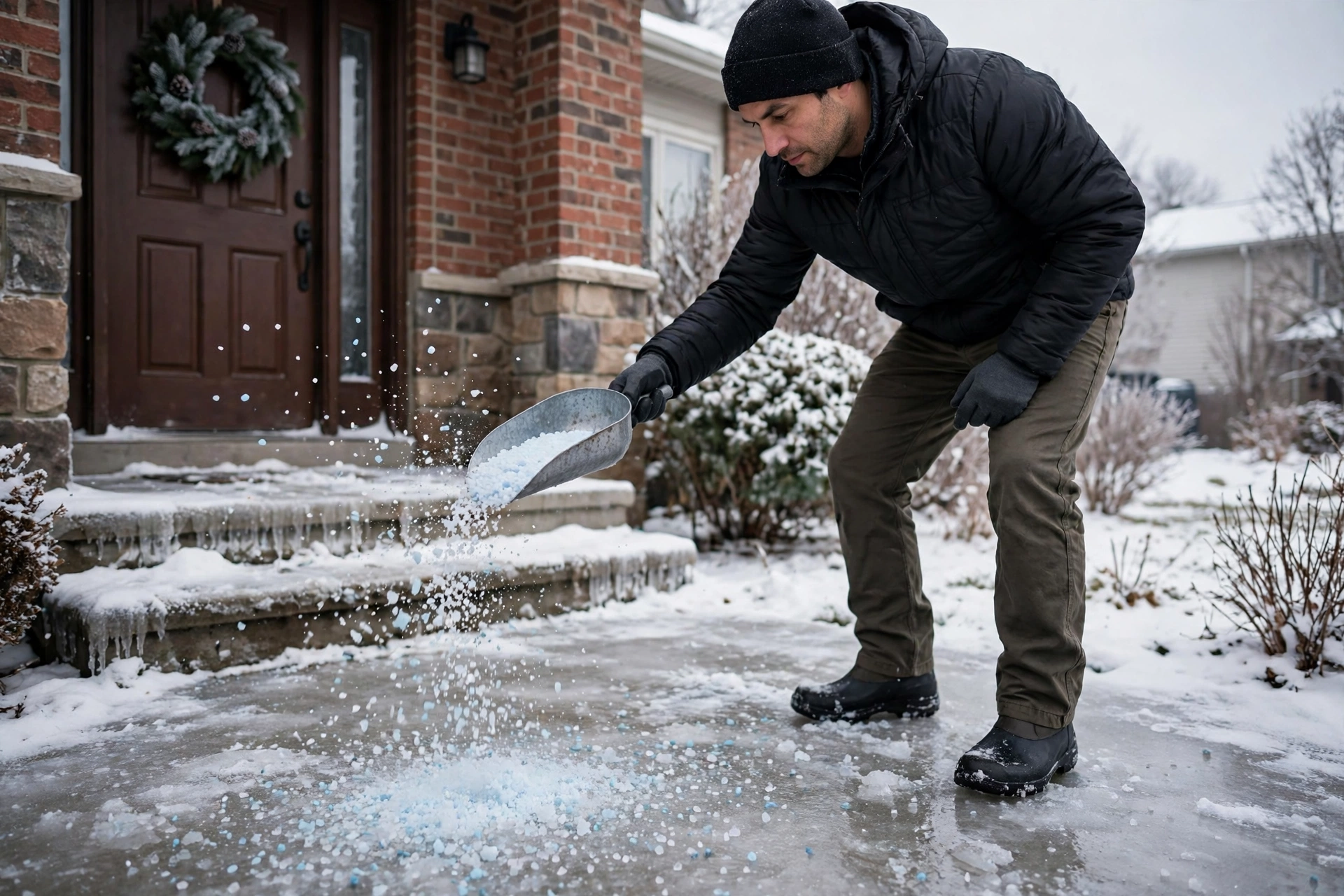
Shovel first, then scatter — de-icer is meant to break the bond between ice and pavement so the shovel can finish the job, not to melt a driveway clear on its own. About 12 ounces, roughly a coffee mug full, treats about 1,000 square feet when it is spread evenly with a few inches between grains.
You can hear the difference under your boots: a thin scatter crunches and grips, while a heavy pour leaves white piles that sit on dry concrete for days. Those leftover piles are the ones that wash into the lawn edge with the first thaw.
Whatever is still visible on dry pavement gets swept up and saved for the next storm. In spring, a good flushing rain — or a hose where rain has not reached — moves what is left in the soil past the roots before growth starts.
Picking by your winter
If your coldest mornings sit between 15°F and 25°F, rock salt and potassium chloride both still work, and rock salt is the cheaper bag. Once pavement temperatures drop below 15°F, switch to calcium chloride for the cold snaps and keep the rock salt for milder days, rather than doubling the rock salt and burning the lawn edge for nothing.
Where the walk runs tight against plantings you care about, CMA is the gentlest product in the table on both plants and concrete, and it earns its higher price on those few square feet even if rock salt handles the open driveway. On the coldest mornings, check the wind chill table before you head out to spread anything, and if the driveway is gravel, the snow blower guide for gravel driveways covers the clearing half of the job.
Match the bag to the thermometer on the pavement, use a mug rather than a bucket, and the spring lawn will not carry a white, burned record of every storm.
Sources
Minnesota Pollution Control Agency, Minnesota Stormwater Manual, “Lowest practical melting temperature” — https://stormwater.pca.state.mn.us/lowest_practical_melting_temperature — fetched in full November 23, 2026; re-verified in full November 24, 2026. Governs the practical melting floors.
University of Maryland Extension, Fact Sheet 707, “Melting Ice Safely” — https://api.drum.lib.umd.edu/server/api/core/bitstreams/9d9561b2-b749-4fb3-9630-fe71a8903e0a/content — fetched in full November 23, 2026. Governs relative speed and the plant and concrete ratings.
University of Minnesota Extension, “The effects of deicing salts on landscapes” (reviewed 2024) — https://extension.umn.edu/lawns-and-landscapes-minnesota/effects-deicing-salts-landscapes — fetched in full November 23, 2026; re-verified in full November 24, 2026.
Iowa State University Extension and Outreach, AnswerLine, “Deicers — helpful or harmful?” (reviewed June 2024) — https://blogs.extension.iastate.edu/answerline/2019/01/24/deicers-helpful-or-harmful/ — fetched in full November 23, 2026; re-verified in full November 24, 2026.
Kansas State University Extension (Johnson County), “Ice Melts Help But Can Be Harmful” — https://www.johnson.k-state.edu/programs/lawn-garden/agent-articles-fact-sheets-and-more/agent-articles/miscellaneous/ice-melts-damage.html — fetched in full November 23, 2026; re-verified in full November 24, 2026.