You check the forecast at supper and there it is — the first frost of the fall, due overnight, while the garden is still carrying tomatoes, beans, and a row of kale you have barely started on. Some of that needs picking tonight, some of it will shrug the cold off, and a few crops will actually taste better for having sat through it.
This table sorts thirty-four common vegetables into the three groups that decide the evening’s work: the ones damaged by the first frost, the ones that withstand a light frost between 28 and 32°F, and the hardy ones that tolerate a moderate freeze between 24 and 28°F. Find your crop, read its band, and you will know whether tonight means harvesting, covering, or leaving the bed alone.
How to read the bands
These ratings are for mature plants as they reach maturity, and they describe bands rather than exact kill points, because a brief dip to 28°F on a still night is a different event from hours at 28°F with wind behind it. A plant hardened by weeks of gradually cooling nights also takes more cold than the same variety hit by a sudden early freeze, so treat every band as a guide for action, not a guarantee.
Seedlings and young transplants are more tender than these rows suggest, which is worth remembering if you put out a late planting and are counting on it to behave like the mature crop in the table. When the forecast sits right on the edge of a band, act on the safer side of it — picking a tender crop a day early costs you almost nothing compared with losing it overnight.
The table
No frost tolerance — damaged by the first frost
| Vegetable | Frost tolerance | What to know |
|---|---|---|
| Basil | None — suffers below 50°F | Leaves can turn black when temperatures dip into the 40s, which makes basil the most cold-sensitive crop in this table. (SDSU Extension) |
| Beans | None | Damaged by the first frost, so pick or protect them before it arrives. (SDSU Extension) |
| Sweet corn | None | Damaged by the first frost. (SDSU Extension) |
| Potatoes | None | The tops die at the first frost, while the tubers stay safe underground and can be mulched and dug until the soil freezes. (SDSU Extension; Kansas State Extension) |
| Peppers | None | Damaged by the first frost. (SDSU Extension) |
| Eggplant | None | Damaged by the first frost. (SDSU Extension) |
| Cucumbers | None | Damaged by the first frost. (SDSU Extension) |
| Summer squash | None | Damaged by the first frost. (SDSU Extension) |
| Melons, including muskmelon | None | Damaged by the first frost. A muskmelon must slip easily from the vine if it is going to ripen further after picking. (SDSU Extension) |
| Sweet potatoes | None | Harvest before soil temperatures drop below 50°F. (SDSU Extension) |
| Tomatoes | None | Harvest before frost, because fruit that has reached at least mature green will ripen further after picking. (SDSU Extension) |
| Pumpkins | None — a very light frost at most | Protect them if you can. Pumpkins withstand 35°F nights when daytime temperatures reach 70°F or more, and fruit that has started to turn color keeps coloring after picking, although it keeps less well. (SDSU Extension) |
| Winter squash | None — a very light frost at most | May tolerate a very light frost, but protect it if possible rather than counting on that. (SDSU Extension) |
Light frost tolerance — withstands 28–32°F
| Vegetable | Frost tolerance | What to know |
|---|---|---|
| Beets | Light frost, 28–32°F | The tops may die back while the roots survive, and the roots can be mulched and used until the soil freezes. (SDSU Extension; Kansas State Extension) |
| Carrots | Light frost, 28–32°F | The roots gain sweetness as the soil temperature drops below 40°F, and they can be mulched and used until the soil freezes. (SDSU Extension; Kansas State Extension) |
| Lettuce | Light frost, 28–32°F | Harvest it if temperatures in the mid to upper 20s are forecast. (SDSU Extension; Kansas State Extension) |
| Onion, garlic, and chives | Light frost, 28–32°F | These three alliums sit together in the light-frost group. (SDSU Extension) |
| Parsley | Light frost, 28–32°F | Withstands a light frost in the 28–32°F range. (SDSU Extension) |
| Peas | Light frost, 28–32°F | Withstands a light frost in the 28–32°F range. (SDSU Extension) |
| Radish | Light frost, 28–32°F | Withstands a light frost in the 28–32°F range. (SDSU Extension) |
| Rhubarb | Light frost, 28–32°F | Withstands a light frost in the 28–32°F range. (SDSU Extension) |
| Spinach | Light frost, 28–32°F | Withstands a light frost in the 28–32°F range. (SDSU Extension) |
| Swiss chard | Light frost, 28–32°F | Withstands a light frost in the 28–32°F range. (SDSU Extension) |
Frost hardy — tolerates a moderate freeze, 24–28°F
| Vegetable | Frost tolerance | What to know |
|---|---|---|
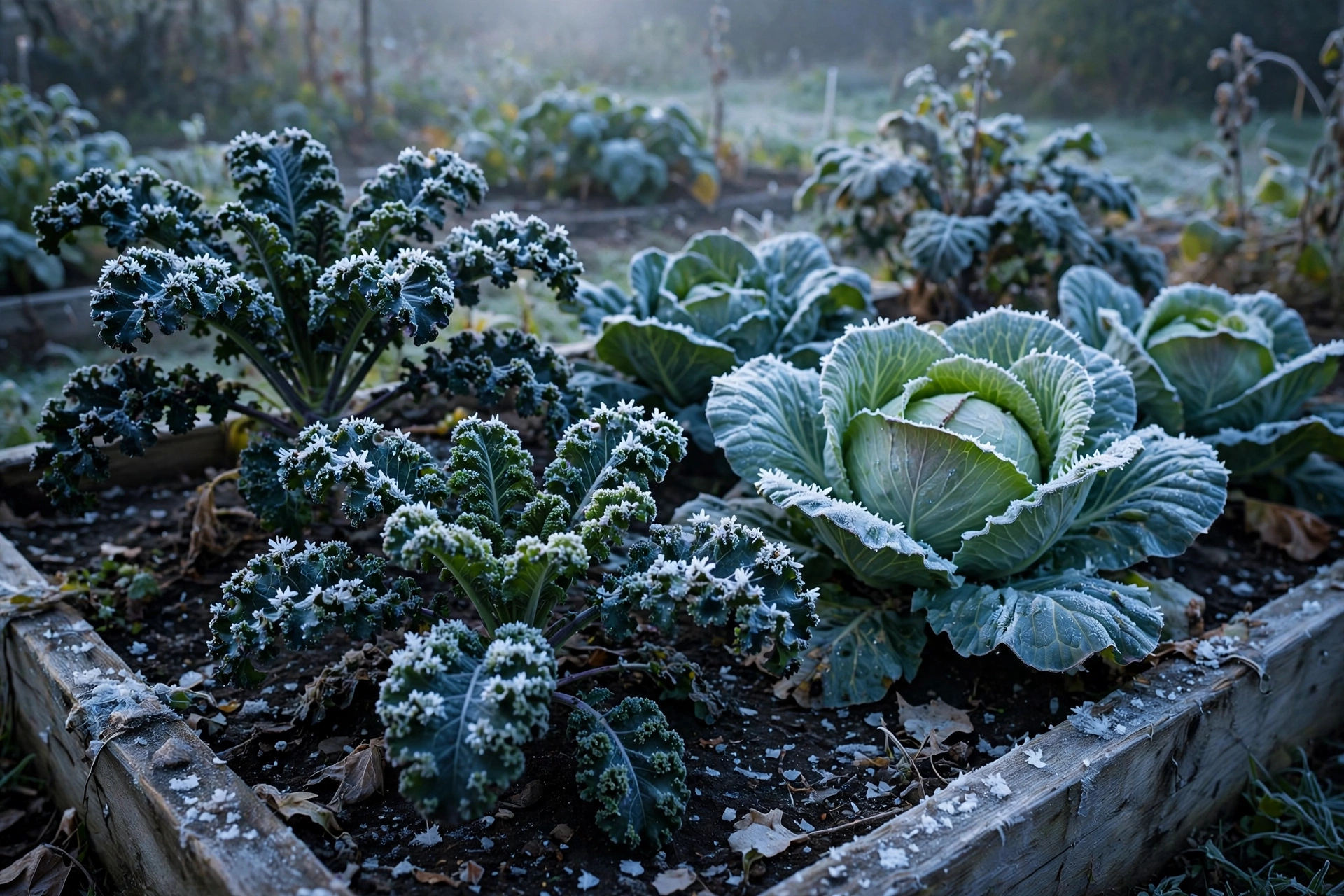
| Broccoli | Frost hardy, 24–28°F | Among the hardiest vegetables in the garden, and its flavor often improves with cool exposure. (SDSU Extension) |
| Cauliflower | Frost hardy, 26°F | Rated frost hardy at 26°F, so plan to pick it before a harder freeze settles in. (SDSU Extension) |
| Chinese cabbage | Frost hardy, 24–28°F | Tolerates a moderate freeze in the 24–28°F range. (SDSU Extension) |
| Cabbage | Frost hardy, 24–28°F | Among the hardiest vegetables in the garden. (SDSU Extension) |
| Kale | Frost hardy, 24–28°F | Among the hardiest vegetables in the garden, and its flavor often improves with cool exposure. (SDSU Extension) |
| Kohlrabi | Frost hardy, 24–28°F | Tolerates a moderate freeze in the 24–28°F range. (SDSU Extension) |
| Turnip | Frost hardy, 24–28°F | The roots can be mulched and used until the soil freezes. (SDSU Extension; Kansas State Extension) |
| Parsnips | Frost hardy, 24–28°F | Best quality comes after several moderate freezes in the 24–28°F range. (SDSU Extension) |
| Salsify | Frost hardy, 24–28°F | Best quality comes after several moderate freezes in the 24–28°F range. (SDSU Extension) |
| Brussels sprouts | Frost hardy, 24–28°F | Best quality comes after several moderate freezes, and the sprouts are often at their best after a light freeze. (SDSU Extension) |
| Horseradish | Frost hardy — and beyond | Harvest it after several severe freezes below 24°F, or leave it stored in the ground over winter under mulch. (SDSU Extension) |
When to pick, when to cover, and when to wait
Work the forecast in the same order the table is built. Anything in the first group comes in or gets covered before the first frost, full stop — and remember that crops from warmer climates can begin to suffer below 50°F, well before frost itself arrives, which is why basil needs attention on a merely chilly night.
For the light-frost group, harvest if temperatures in the mid to upper 20s are forecast, and for the hardy group, harvest if temperatures in the low 20s seem imminent. In between those calls, a temporary covering buys real time: polyethylene plastic, blankets, or tarpaulins stretched over the rows, anchored so the wind cannot shift them, with as little foliage touching the covering as possible, because the leaves that touch it freeze fastest. A small light bulb burning under the covering can hold protection down to around 25°F.
Root crops reward patience rather than panic. Beets, carrots, potatoes, and turnips can be mulched where they grow and dug as you need them until the soil itself begins to freeze, and the cold does them a favor along the way, since roots develop more sugars once the soil drops below 40°F.
Once the tender crops are in, how long they keep becomes the next question, and Storing the Garden Through Winter: Squash, Onions, and Garlic covers the storage side for the crops that carry into winter. This table is the fall bookend to spring planting, too — when the season turns again, Reference Table: Soil Temperatures for Germinating Vegetable Seeds has the soil temperatures those same vegetables need to sprout.
What is not in this table
A few familiar crops do not appear here — okra, celery, endive, radicchio, fennel, and leeks — so do not borrow a rating from a neighboring row for them. Treat an unlisted crop as an unknown, protect it on a frost night if losing it would bother you, and let the listed rows do the work they were measured for.
Bottom line
Pick everything in the no-tolerance group before the first frost, cover the light-frost group when the mid-20s are forecast, and leave the hardy group in the ground to sweeten in the cold. That order, worked row by row on the evening the forecast turns, is the whole job.
Sources
South Dakota State University Extension, “Fall Frost Tolerance of Common Vegetables” (Rhoda Burrows) — https://extension.sdstate.edu/fall-frost-tolerance-common-vegetables — fetched November 14, 2026.
Kansas State University Extension, “Cold Sensitivity of Vegetables” (Horticulture Resource Center, Hort Tips; updated December 3, 2024) — https://hnr.k-state.edu/extension/horticulture-resource-center/publications/publications/hort-tips/Cold%20Sensitivity%20of%20Vegetables.htm — fetched November 14, 2026.
Oregon State University Extension, “Planting and harvest dates and cold hardiness,” Table 2, PNW 548 supplement, “Winter Vegetable Production on Small Farms and Gardens West of the Cascades” (May 2022) — https://extension.oregonstate.edu/sites/default/files/documents/pnw548-supplement.pdf — fetched November 14, 2026.