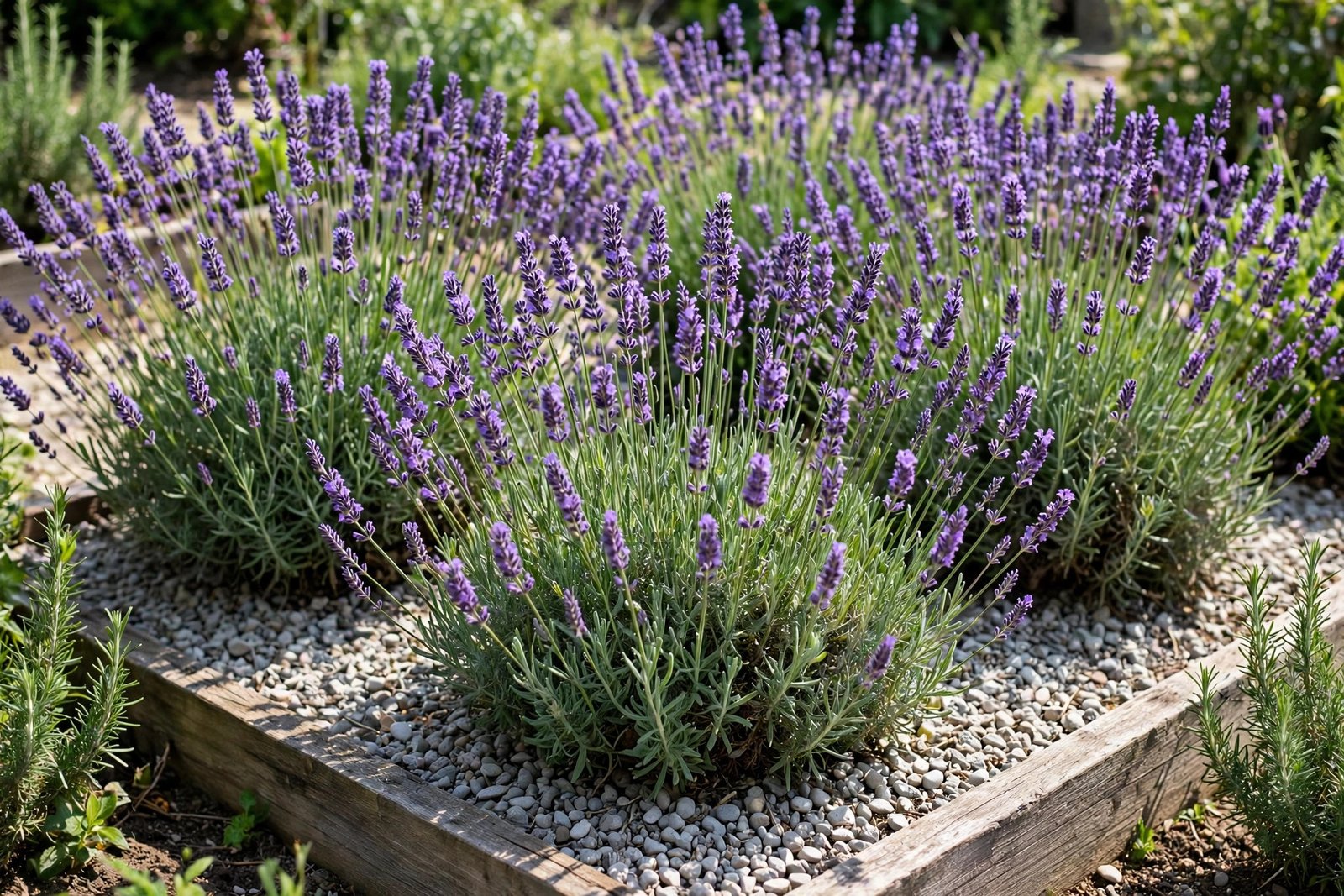
Your lavender has outgrown its spot, or gone woody and bare in the middle, and the obvious move seems to be splitting it like any other perennial. Reach for the spade, and you will probably kill it.
Lavender looks like a perennial you could divide. It is not. It is a woody subshrub that grows from a single central stem, and that one fact decides everything about how you multiply it.
Why dividing lavender fails
Most perennials divide well because they grow as a clump of separate crowns, each with its own roots. Cut between the crowns and each piece carries on. Lavender has no separate crowns to cut between. Its stems all rise from one woody base, and a piece hacked off that base usually has no root system of its own to live on.
The result is predictable: the division wilts, the wound on the mother plant invites rot, and you lose both pieces instead of gaining a plant. Fall makes it worse. A fall division gives damaged roots almost no time to recover before the ground freezes, and any tender new growth it pushes out has no chance to harden off.
This is the same verdict behind our guide to which perennials to divide in fall and which to leave alone. Lavender sits firmly in the leave-alone column, in fall and in every other season.
When to act, and when to wait
If your lavender is struggling right now, in November, the right move is to wait. Do not divide it, do not move it, and do not cut it hard. A light tidy-up after flowering is fine in summer, but hard pruning into old, bare wood rarely regrows, because lavender does not reliably sprout from wood that has lost its leaves.
Spring is the season for decisions. If a plant is truly done, woody to the core and bare through the middle, spring is when you replace it, ideally with a young plant or a cutting you rooted the previous summer. If it still has green, leafy growth on its stems, spring is also when a careful reshape, cutting back to just above green growth, gives it its best chance.
How to get more lavender instead
You do not need a spade to multiply lavender. You need cuttings, or patience with a branch that roots itself.
Take cuttings in early summer. This is the easiest, most reliable method, and the Royal Horticultural Society’s chief horticulturist names early summer as the easiest period. Choose healthy, non-flowering shoots about 2 to 4 inches long, cut just below a leaf node with a sharp knife, strip the leaves from the lower half, and set them in a pot of equal parts potting compost and grit. Keep them covered and damp, and they root over the following weeks.
Try layering for a no-risk start. Look for a low branch that already touches the ground. Where it meets the soil, it may already be rooting on its own. Peg it down lightly, cover the contact point with a little soil, and leave it through the season. Once it has its own roots, cut it free from the mother plant and move it. You risk nothing, because the mother plant stays untouched until the new plant is independent.
Propagate while the plant is still healthy. The time to take cuttings is when the plant is vigorous and full of good, non-flowering shoots, not when it is already woody and failing. Older plants still produce usable shoots, but the material gets harder to find as the plant ages. Root a few cuttings every couple of years and you will always have a replacement ready, without ever lifting a spade.
What to do with a woody lavender plant
A leggy, woody lavender is not a dividing candidate and usually not a rescue project. If it still flowers and holds green growth, enjoy it, prune it lightly after flowering, and take cuttings from it while you can. If it is bare wood with a tuft of green at the tips, it has told you what it needs: a successor, not surgery.
That is the honest trade with lavender. It gives you fragrance, pollinators, and years of low-maintenance color in a sunny, well-drained spot. In return, it asks to be left in one piece. Multiply it by cuttings, replace it when it is spent, and save the spade for the perennials that actually want splitting.