A bearded iris tells you when it needs dividing. The rhizomes creep to the surface, the center goes bare, and the blooms shrink. A Siberian iris does none of that, which is exactly why gardeners divide it at the wrong time, with the wrong technique, and wonder why it sulks for a year.
Siberian iris is a different plant underground, so it needs a different division. Get the timing and the root handling right, and it settles fast. Treat it like a bearded iris, and you will cut apart the very roots it depends on.
How Siberian iris differs from bearded iris
Bearded iris grows from thick, fleshy rhizomes that sit half out of the soil. You lift them, snap or cut them apart, trim the fan, and replant the pieces shallow. The method is in our guide to dividing bearded iris, and it works because those rhizomes are built to be handled that way.
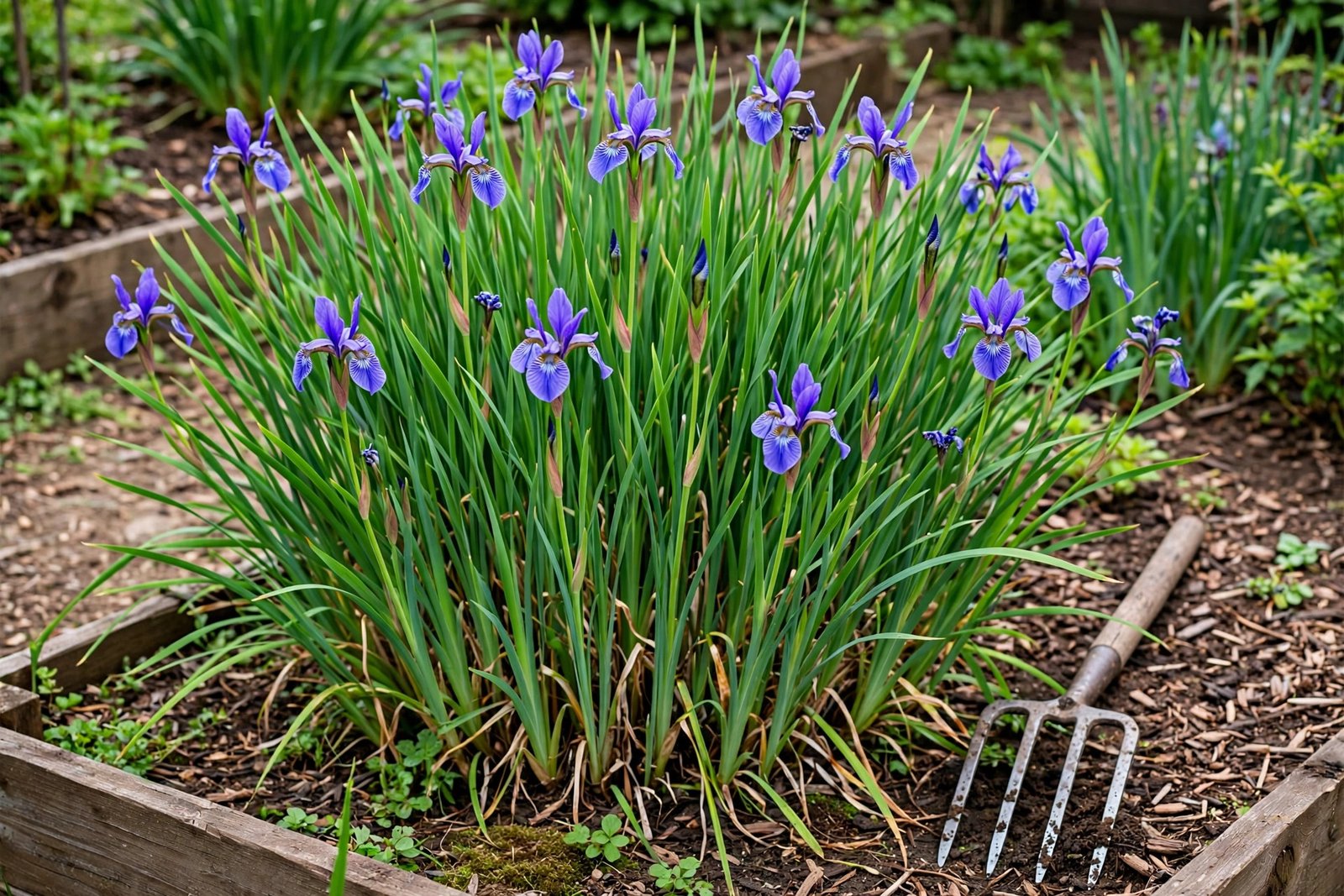
Siberian iris (Iris sibirica) grows from a dense, fibrous root mass that forms a clump, not a row of chunky rhizomes. It has no fat rhizome to cut into pieces with a fan attached. Each division needs several leaf fans and a good chunk of those fibrous roots, or it has nothing to draw on while it re-establishes.
That difference also explains why Siberian iris needs dividing less often. Iowa State University Extension notes that Siberian irises do not have to be divided as often as bearded irises. Divide when the clump gets crowded, vigor drops, or the clump forms a solid ring with a bare center, not on a fixed schedule.
| Trait | Bearded iris | Siberian iris |
|---|---|---|
| Underground part | Thick rhizomes at the soil surface | Dense, fibrous root mass forming a clump |
| How often to divide | Every 3 to 5 years, roughly | Less often, only when crowded or declining |
| Division piece | A rhizome section with a leaf fan | A section with several fans and plenty of roots |
| Planting depth | Rhizome near the surface | At the same depth it grew before |
| Soil preference | Well drained, drier is fine | Moist, fertile soil; happy near pond edges |
When to divide Siberian iris
Iowa State gives two windows: early spring, or late summer. In early spring, divide when new growth has just begun to appear. In late summer, August is the named month, and you cut the foliage back to 6 to 8 inches before you dig.
Spring division suits cold climates, because the plant has a full season to root before winter. Late-summer division suits gardeners who can water steadily afterward, since the divisions go into warm soil and root quickly. What does not suit Siberian iris is dividing in the heat of midsummer or late in fall, when new roots have little time to form before the ground freezes.
If your clump is blooming well and the center is still full, leave it alone. A Siberian iris clump can grow undisturbed for years, and an unnecessary division sets back a plant that was doing fine. The right trigger is a visible decline: fewer blooms, smaller flowers, or that hollow ring in the middle.
How to divide it, step by step
Water the day before. Moist soil lifts in a cleaner root ball than dry soil, and the roots are less likely to snap. This matters more here than with bearded iris, because fibrous roots are the division’s lifeline.
Dig the whole clump. Work a spading fork around the outside of the clump and lever it up in one piece. Do not try to slice a piece off the edge while the rest stays in the ground. You will tear roots blind and leave a ragged wound on the parent.
Divide into sections with several fans each. Pull the clump apart where it naturally separates, or cut through it with a sharp spade or soil knife if it is matted tight. Every section needs several leaf fans and a good root system. Small, single-fan pieces may survive, but they take far longer to look like anything, and in a dry spell they are the first to fail.
Keep the roots moist, always. Do not leave divisions sitting in the sun while you decide where they go. Shade them, cover the roots with damp soil or a wet cloth, and replant the same day. Siberian iris roots dry out fast once exposed, and dried roots do not revive.
Replant at the same depth. Set each division so the crown sits where it sat before, neither buried deeper nor perched higher. Firm the soil around the roots to remove air pockets, then water deeply. A light mulch over the root zone helps hold moisture while the plant settles, but keep it off the crown itself.
Aftercare: what success looks like
Keep the soil damp, not soggy, until you see new growth. That new growth is the signal the roots have taken hold. In a spring division, expect the plant to spend its first season rebuilding roots, with full bloom the following year. A late-summer division may bloom lightly the next spring and hit its stride the year after.
The one mistake that sets Siberian iris back is letting it dry out in the first weeks. It tolerates moist soil far better than drought while establishing, which is why it suits pond edges and low spots where bearded iris would rot. If a division wilts in its first month, water is almost always the answer, not fertilizer.
For the rest of the dividing calendar, including which perennials to split in fall and which to leave alone, see our guide to dividing perennials in fall. And if you are dividing several kinds at once, our roundup of tools for dividing perennials covers the fork, knife, and saw that make this job easier.