Your tomato beds are bare after the last harvest, and the pine tree overhead is dropping needles by the barrowful. It feels wasteful to rake all of that into bags when the beds are sitting empty, and it feels risky to spread it around next spring’s food. That tension is exactly right — free mulch is only a bargain if it helps the plants it covers.
The good news is that pine needles are a genuinely good vegetable-garden mulch, with one honest condition attached: they protect your soil rather than changing it, so you use them for what mulch actually does and never for the job people think they do.
The Acidity Question, Settled
Every gardener has heard that pine needles sour the soil. The worry makes sense on the surface, because fresh needles really are acidic — the University of New Hampshire Extension puts freshly fallen needles at pH 3.2 to 3.8, well below neutral. But the needles and the soil beneath them are two different measurements, and the mulch layer does not rewrite the soil.
UNH Extension is plain about this: pine needles themselves are acidic but do not have the capacity to appreciably lower soil pH, and even a 2- to 3-inch layer will not change the soil pH enough to measure. As the needles break down, the organisms doing the decomposing gradually neutralize them. The acidic soil you often find under a pine tree was usually acidic before the tree arrived — pines grow where the soil suits them, and they are not creating the acid conditions themselves.
That cuts both ways, and it matters for how you use the mulch. Pine needles will not harm your tomatoes, peppers, or beans by acidifying the bed. They also will not rescue a bed that is too alkaline for blueberries, no matter how thick you lay them. If a crop needs a different pH, test the soil and amend it directly — the mulch is not the tool for that job. Our general pine-needle mulch guide covers the same acidity question for ornamental beds, with the same answer.
Why Pine Needles Work in a Vegetable Bed
Mulch in a vegetable garden has a specific job list, and pine needles check most of it. The University of Georgia Extension’s vegetable-mulching guidance names the reasons: mulch holds moisture in the soil, suppresses weeds, keeps the soil cooler in summer heat, and puts a barrier between the plant and bare ground.
That last job is the one pine needles do especially well. When fruit sits on bare soil, rain splashes soil — and the organisms in it — straight onto the fruit, which is how soil-borne fruit rots get their opening. A mat of needles keeps tomatoes, squash, and peppers off the ground while letting rain pass through, because the needles knit together instead of matting into a soggy sheet the way wet leaves do.
They also stay put. Needles interlock as they settle, so they hold on slopes and in beds that catch wind better than shredded bark or straw, and they break down slowly enough that one application carries through the growing season. You will top them up in fall, when the trees conveniently deliver the next supply.
Which Vegetables Suit Them Best
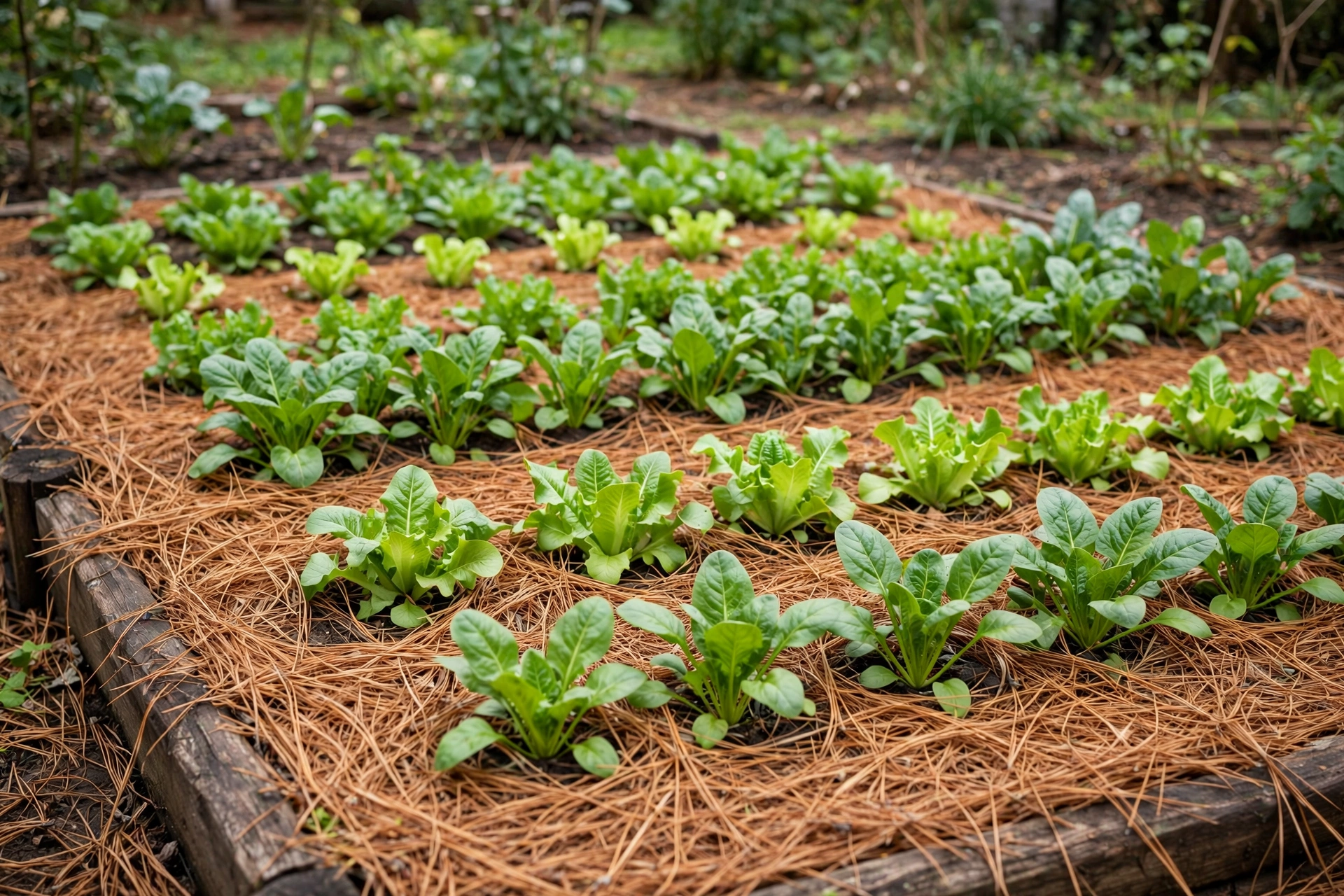
Almost every vegetable tolerates pine-needle mulch, but a few get the most from it. UGA Extension’s mulching guidance names peppers, tomatoes, squash, and eggplant as the crops where mulching pays extra dividends at harvest, and the reason is the fruit-to-soil barrier: anything whose fruit hangs low or sprawls across the bed benefits from a clean, dry layer underneath it.
Leafy greens and brassicas do fine under needles too, since the mulch’s real work there is moisture and weed control rather than fruit protection. Acid-loving plants are the other natural fit — UGA notes pine needles are especially good for them — though remember the acidity caveat above: the needles suit plants that already like acid soil, and they do not create it.
One place to hold off is a newly seeded row. Leave the seedbed uncovered while seedlings emerge, then mulch around them once they are established and sturdy enough to stand clear of the layer. Very small seedlings smother under any mulch, pine needles included, so the timing matters more than the material.
How Deep to Lay It
Depth is where most people get pine straw wrong, because it looks thicker than it is. UGA Extension suggests 3 to 4 inches as the general mulch depth for vegetables, and then adds the pine-straw exception: lighter mulches like pine straw may need to go on deeper, perhaps around 5 inches, since they settle rapidly once they get wet.
So lay it on thick at first — about 5 inches, fluffy and loose — and expect it to settle to that 3- to 4-inch working depth within a week or two of watering and rain. Too thin, and weeds push straight through while the soil dries out between waterings. Too thick, and air struggles to reach the roots. The 5-inch starting depth is the number that lands you in the right range after settling, not a target to maintain all season.
Check the layer after the first heavy rain and again mid-season, and top up the thin spots rather than re-mulching the whole bed. Needles that have knitted together can be lifted and fluffed with a fork where they have compacted, which restores airflow without adding material.
The One Gap That Matters
Keep the needles off the stems. Pull them back a couple of inches from every plant base, so no stem sits in damp mulch all day. Mulch piled against a stem holds moisture right where rot and stem diseases start, and the fix costs nothing — a bare ring of soil around each plant, visible at a glance.
The same rule holds for anything woody in or near the bed: mulch touching bark traps moisture against it, and bark was never meant to stay wet. A couple of inches of gap is enough, and it is the single most common mulching mistake in vegetable beds, whatever the material.
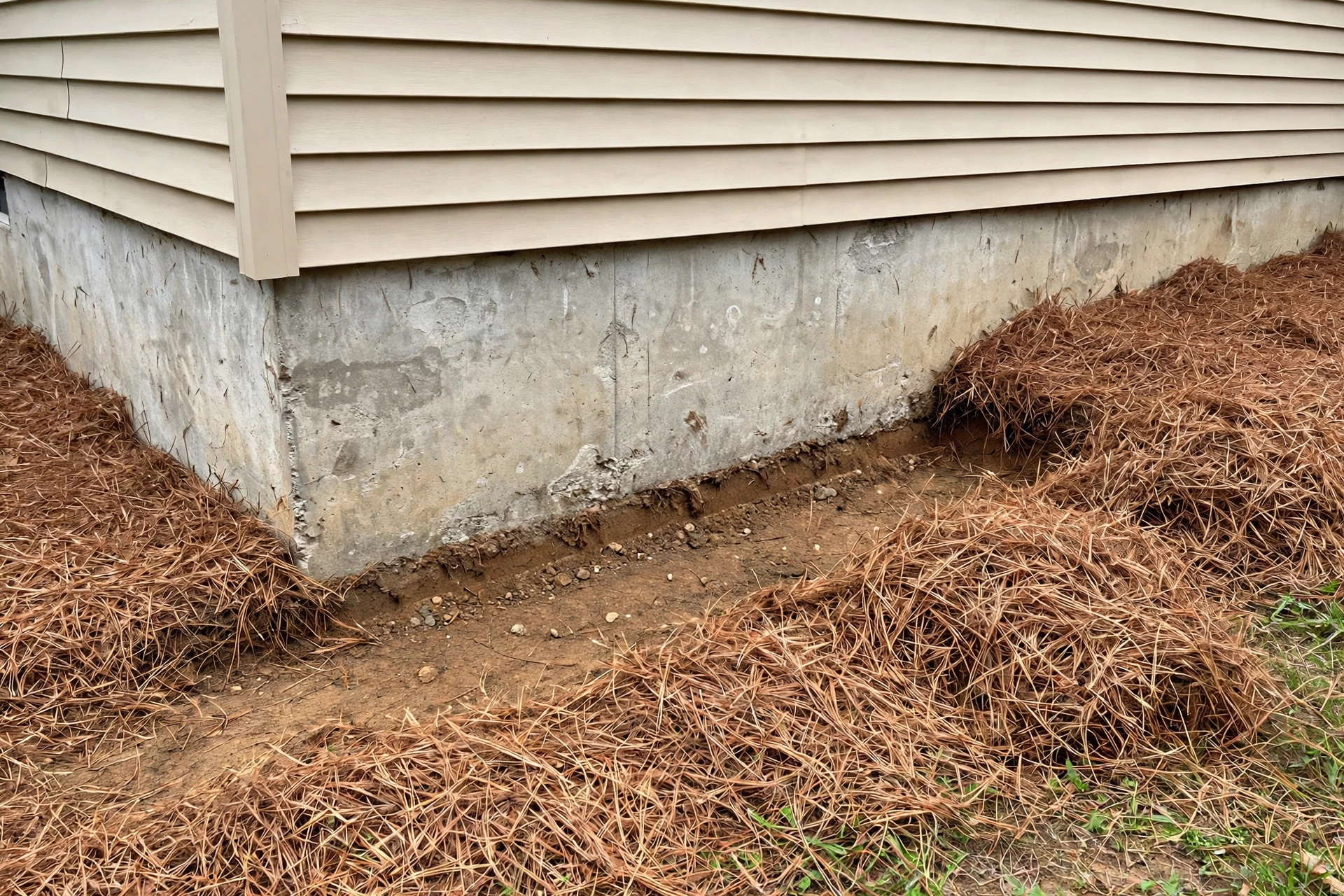
One more caution belongs here because it is easy to forget in a garden setting: dry pine straw is highly flammable, and UF/IFAS firewise guidance flags it as a poor choice in defensible space and near building surfaces. Keep needle mulch away from the grill and the fire pit, and do not run it right up against the house. In the beds themselves, a normal watering routine keeps the risk low — it is the bone-dry pile by a heat source that earns the warning.
When Pine Needles Are Not the Right Mulch
Pine needles are a strong default, not a universal one. Skip them on a freshly seeded bed, as above, and think twice on a very windy, exposed site before the mat has had a chance to knit — light needles can migrate in a hard wind until they settle and interlock, so a sheltered bed or a first watering to settle them in helps.
They are also a slow decomposer, which is a feature in a bed and a drawback in a compost pile: needles take their time breaking down, so surplus needles composted on their own will sit there longer than you expect. That is not a reason to avoid them as mulch — it is a reason to use the surplus as mulch instead of composting it, which is the better home for it anyway. If you do end up with more needles than your beds can take, our guide on how to dispose of pine needles walks through the bag, compost, and curbside options.
Bottom Line
Use the needles. Lay them about 5 inches deep around established vegetables — tomatoes, peppers, squash, and eggplant first among them — let them settle to a 3- to 4-inch mat, and keep a couple of inches of bare soil around every stem. The acidity worry is a myth in practice: the mulch will hold moisture, smother weeds, and keep your fruit clean all season, and the soil pH underneath will barely notice it was there.