Late November is when yarrow tells the truth about itself. The flowers are long gone, the ferny foliage has slumped, and what remains visible is the clump’s structure — a vigorous green edge around a center that has gone woody and thin. That bare center is the plant asking to be divided.
The work itself belongs to early spring or early fall, and this post settles the timing, the signs that a clump is due, and the method. Yarrow (Achillea) is one of the toughest perennials in the border, and division is how it stays that way instead of aging into a ring of flowers around a bald patch.
When yarrow is due
Plan on dividing every 3 to 4 years. The calendar matters less than the signs, and the signs are consistent: the center of the clump dies out or goes woody, flowering thins even though the plant’s size has not changed, and the whole clump spreads wider while blooming less.
Yarrow grows outward from its crown, so the youngest, most vigorous tissue is always at the edge. The center is the oldest wood, and no amount of feeding persuades it to flower like new growth. Division is not rescue — it is simply taking the plant at its word and keeping the parts that still work.
Choosing the day
Early spring, as new growth emerges, is the primary window: divisions get a full season to establish, and you can see exactly which sections are alive. Early fall, after flowering finishes, is the second window, and it works where falls are long enough for roots to settle before the ground freezes — the same 4-to-6-weeks-before-frost arithmetic that governs fall division generally.
Avoid midsummer. A freshly divided yarrow in July heat spends its energy on survival instead of roots, and yarrow’s whole value is that it asks for almost nothing. Keep the job in the cool shoulders of the year and it stays that way.
The method
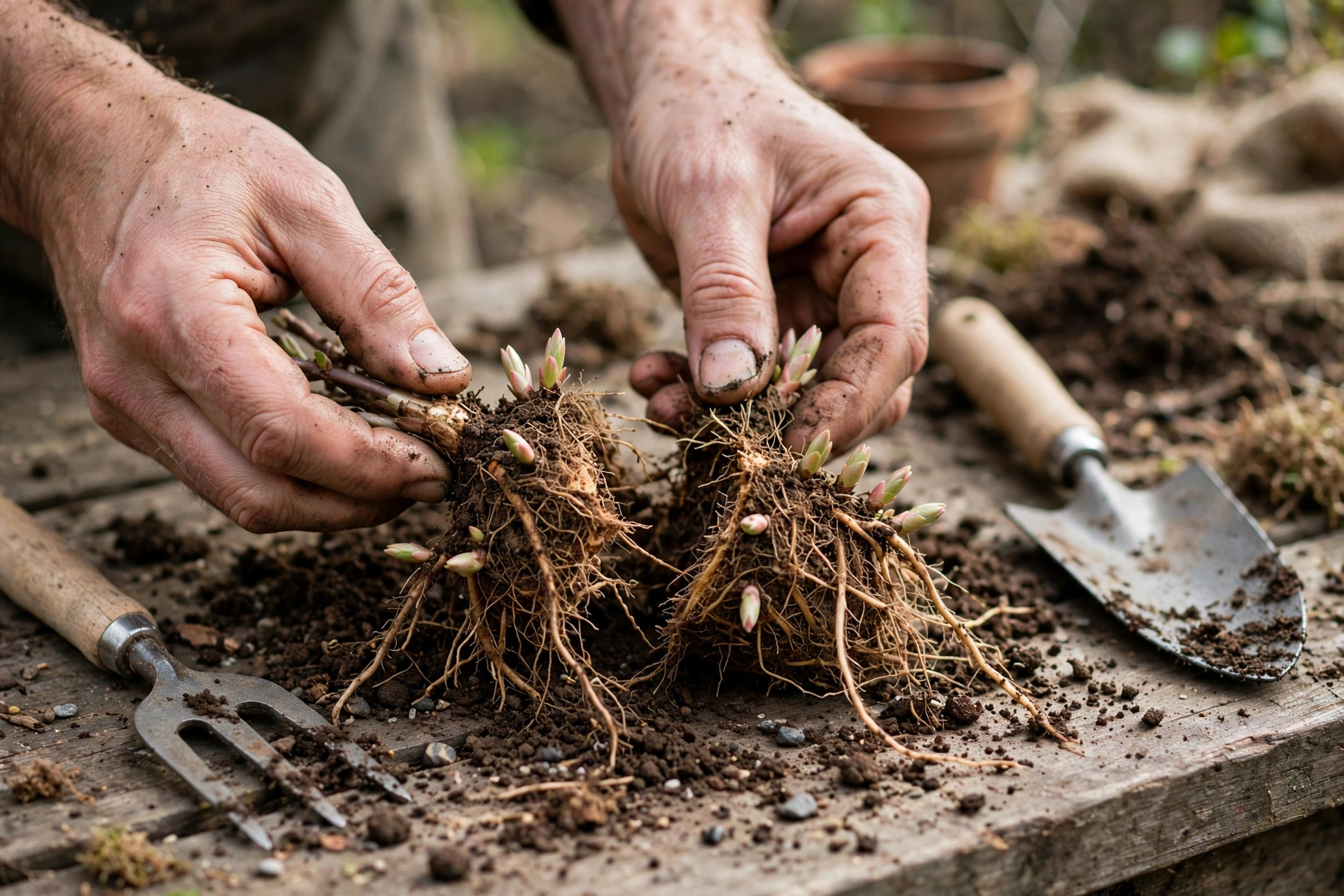
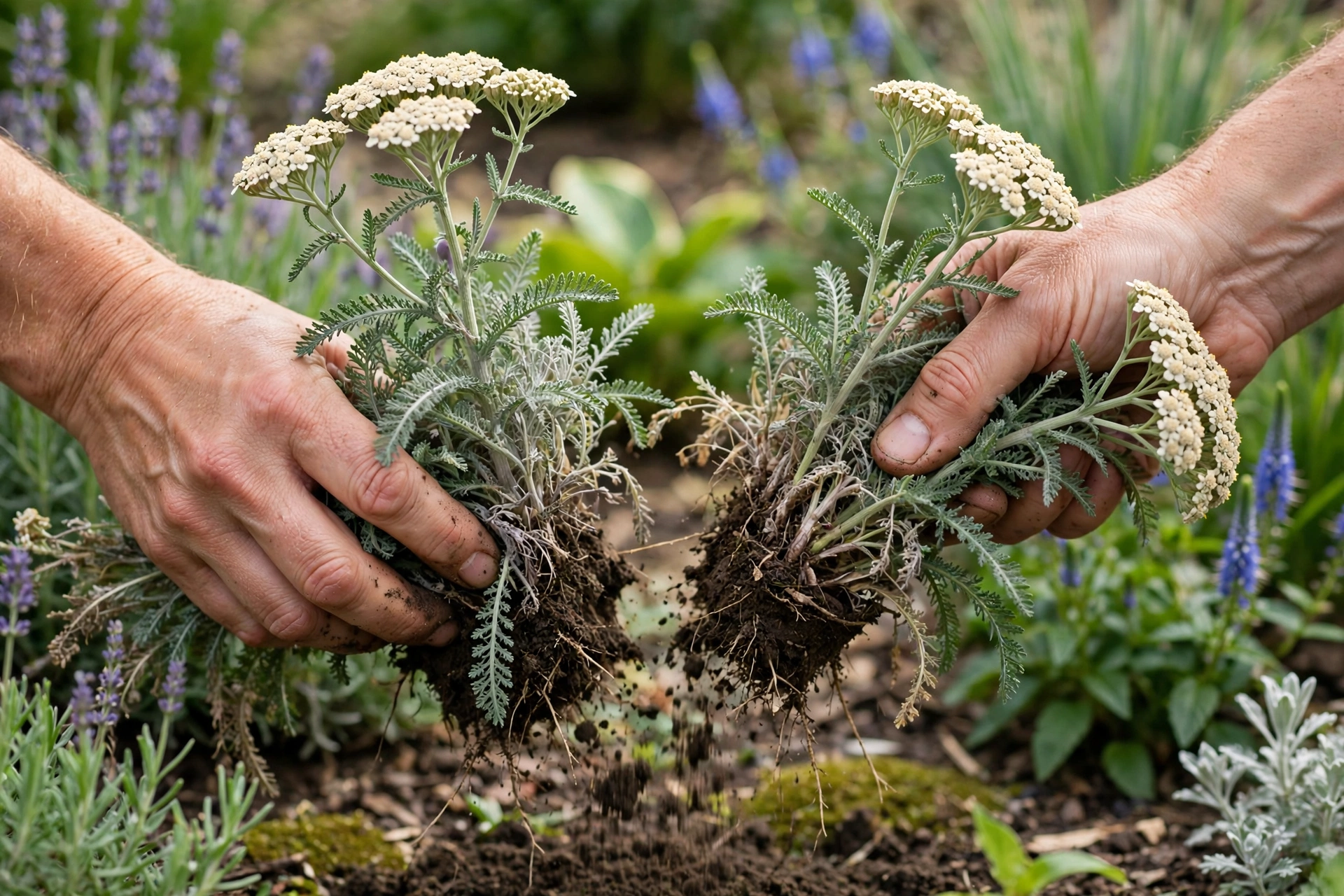
1. Lift the whole clump. Dig around the clump with a fork and lift it in one piece. Shake off the loose soil so the crowns and roots are visible — the structure you saw from above in November is now in your hands.
2. Cut away the center. Slice the clump into sections with a sharp spade or knife. Discard the woody middle outright; it goes to the compost, not back into the border. Keep the outer sections, each carrying several healthy shoots and its own roots.
3. Replant at the same depth. Set each division at the depth it grew before, spaced 1 to 2 feet apart depending on the variety, in well-drained soil in full sun. Crowns planted deeper than they grew tend to sulk and rot in wet soil.
4. Water in, then back off. Water thoroughly once to settle the soil around the roots, then keep the divisions evenly moist for the first week or two. After that, yarrow wants to be left alone — established plants are drought-tolerant, and fussing is the main way gardeners kill them.
The tools are the same ones that handle every clump-forming perennial — a fork, a sharp spade, a knife for the tight crowns — as laid out in our guide to tools for dividing perennials. Yarrow asks for nothing specialized.
What yarrow does not want afterward
Rich soil and generous fertilizer make yarrow worse, not better: stems grow soft, flop by midsummer, and flower less. Divisions go back into ordinary garden soil, unamended beyond what the bed already has. If the clump came out of a lean, sunny spot where it thrived, the divisions want the same conditions in their new home.
Deadheading is the one summer chore worth keeping. Cutting spent flower clusters back to a strong leaf node encourages a second, smaller flush — and it keeps a vigorous variety from seeding itself into every gap in the border.
The short version
Divide yarrow every 3 to 4 years, in early spring or early fall, the moment the center goes woody and the flowers thin. Keep the vigorous outer sections, discard the middle, replant at the same depth, water once, and walk away. The clump you split this spring will be the one still flowering hard when its undivided neighbor has gone bald — and the bed’s soil and mulch aftercare follows the same rules as any fresh division.
Sources
Established Achillea care guidance: division every 3 to 4 years in early spring or early fall; signs of a due clump (thinning center, woody crowns, reduced flowering); divisions kept to several shoots with healthy roots, replanted at the same depth in well-drained soil.