This post may contain affiliate links. If you buy through them, we may earn a commission at no extra cost to you.
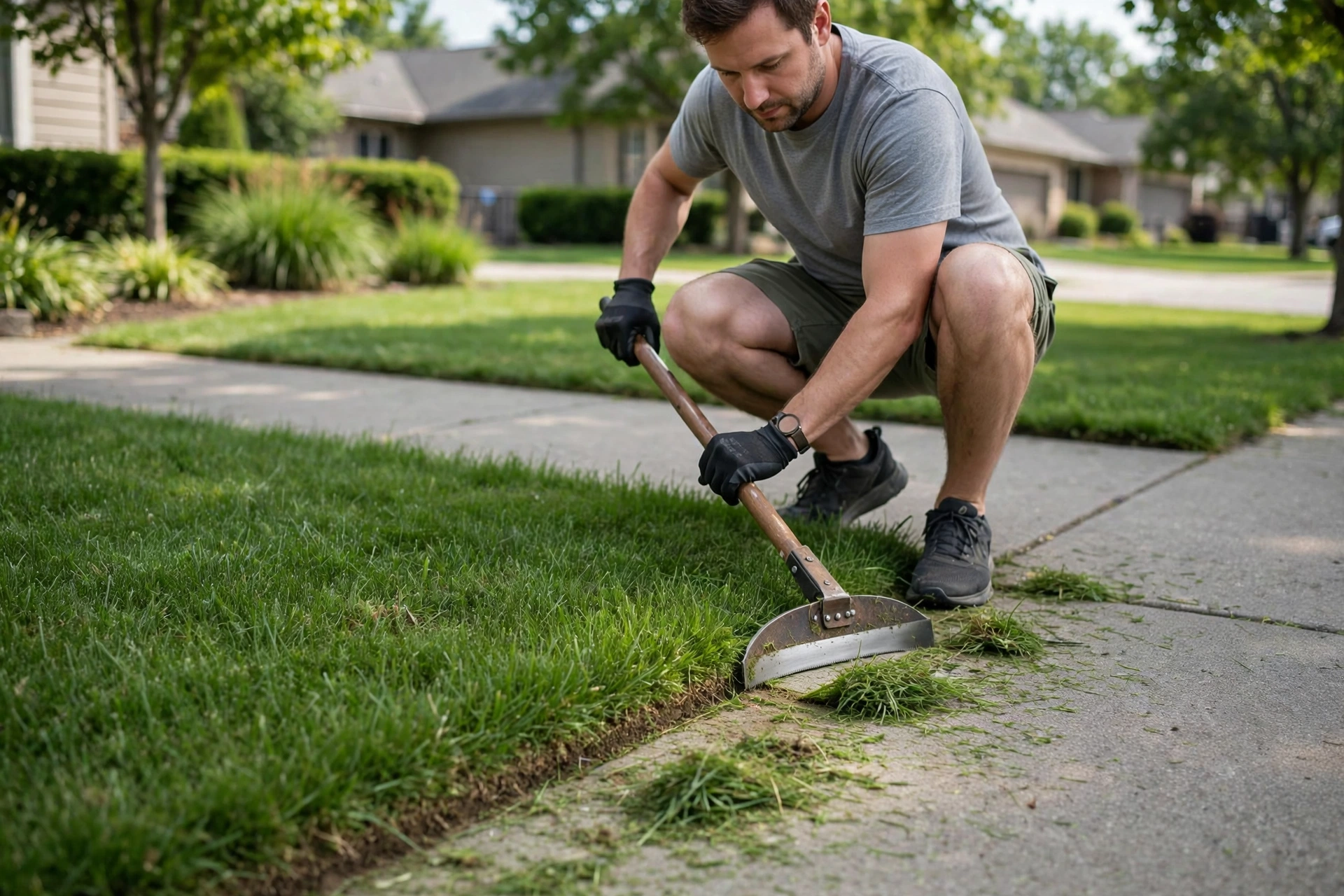
Thick grass does not drift over an edge. Bermuda sends stolons across the sidewalk joint and roots them on the other side, St. Augustine lays down runners as thick as a pencil, and within a month the clean line you cut in spring is a green braid spilling onto the concrete.
A light edger makes that worse, because a blade that skims the runner mat leaves every stolon rooted, and the edge needs cutting again in two weeks. Buy the EGO Power+ MHC1502 combo kit first: its 8-inch steel blade adjusts down to a 3-inch cut, deep enough to sever runners below the point where they root, and the 56V brushless power head holds its speed in dense turf instead of bogging down at the first thick patch.
Why thick grass defeats a light edger
Bermuda spreads by stolons above ground and rhizomes below it, Zoysia does the same and mats tighter, and St. Augustine creeps on stolons alone — thick, coarse stems that root at every node they touch. An edge through any of the three is not a trim. It is a cut through a rooted stem network, and anything the blade misses stays alive and keeps growing.
That is why blade and depth decide this purchase before brand does. A straight steel blade slices the mat cleanly, while a string head frays stolons and leaves half of them attached; the star blade vs. straight blade trade-offs matter less here than simply having steel in the ground. Depth matters just as much: a cut that stops at 1 inch scores the top of a Bermuda mat whose rhizomes run deeper, so look for an edger that reaches 2 inches at minimum and 3 inches if the lawn has been neglected.
Power is the third leg. Corded 12-amp motors and full-size 56V battery systems hold blade speed when the mat fights back, while small battery platforms slow down exactly where the grass is thickest — and a slowing blade tears instead of cutting. If you already own batteries for a large platform, staying on it is the cheap move; our guide to the best cordless lawn edgers covers the smaller platforms honestly.
The picks at a glance
| Product | Power | Blade | Max depth | Best for |
|---|---|---|---|---|
| EGO Power+ MHC1502 kit | 56V battery, brushless | 8-inch steel | 3 inches | Thick runners, cordless power |
| WORX WG896 | 12 amp corded | 7.5-inch serrated steel | 1.5 inches | Steady power near an outlet |
| Greenworks 27032 | 12 amp corded | 7.5-inch double-edged steel | Variable, spring-assisted wheel | Budget corded edging |
Best overall: EGO Power+ MHC1502 edger kit
The MHC1502 bundles EGO’s Multi-Head power head with the EA0800 8-inch edger attachment, a 15-inch string trimmer attachment, a 5.0Ah battery, and a charger. For thick grass, the numbers that count are the 8-inch steel blade and the guide wheel’s depth adjustment, which runs down to a 3-inch maximum cut — the deepest first pass in this group, and the one that gets under a neglected Bermuda mat instead of combing it.
The brushless power head is the other half of the case. It holds RPM as the blade loads up, so the cut stays a cut through the dense stretch along the fence instead of turning into a tear at the exact spot the lawn is thickest.
- Pros: 3-inch maximum depth; brushless motor holds speed in dense turf; one power head runs the trimmer and EGO’s other attachments.
- Cons: the kit costs more than a dedicated corded edger, and the battery only works inside the EGO 56V system.
EGO Power+ MHC1502 Multi-Head Kit with 8-Inch Edger
The 3-inch cut and brushless 56V power head sever thick runners instead of combing them.
Runner-up: WORX WG896 12 amp edger and trencher
The WG896 is the corded answer to the same problem: a 12-amp motor spinning a 7.5-inch serrated steel blade at 4,700 RPM, with power that never fades at the far end of the yard because there is no battery to fade. The serrated edge bites into a stolon mat rather than skating on it, and the cutting-line indicator on the deck shows where the blade will land before it lands.
The trade-off is depth. Its three settings stop at 1, 1-1/4, and 1-1/2 inches, which handles a maintained edge and most seasonal cleanups but gives you less room on a first cut through an overgrown Bermuda border. At 14 pounds it is easy to push, and the same head trenches for landscape-lighting wire — but you are dragging a cord, and the work stops at the end of your longest extension cord.
- Pros: full 12-amp power for the whole job; serrated blade bites thick mats; doubles as a shallow trencher.
- Cons: 1.5-inch maximum depth; corded, so range ends at the outlet and cord you own.
WORX WG896 12 Amp 7.5-Inch Electric Lawn Edger & Trencher
Corded 12-amp power and a serrated blade that bites stolon mats without any battery fade.
Best budget: Greenworks 12 amp corded edger 27032
Greenworks’ 27032 runs the same basic formula as the WORX — a 12-amp corded motor and a 7.5-inch steel blade — at a lower price, and the blade is double-edged, so when one side dulls you flip it instead of buying a replacement that week. Depth adjusts through a spring-assisted front wheel, which is quick to change along a run where the soil rises and falls.
What the lower price gives up is precision. The spring wheel sets depth by feel rather than by the WORX’s three fixed stops, so holding one exact depth along a long sidewalk takes more attention, and there is no trenching mode. For a smaller yard with an outlet nearby, those are fair trades.
- Pros: 12-amp power at the lowest price here; double-edged blade flips when one side dulls; cord lock keeps the plug seated.
- Cons: depth set by feel, not fixed stops; corded range limits; no trencher mode.
Greenworks 12 Amp Electric Corded Edger 27032
Full 12-amp power and a flip-over double-edged blade at the lowest price in this group.
The one to skip for this job: McLane 101-5.5GT-7
The McLane is not a weak machine, and that is exactly why it lands here. Its 5.50 gross torque Briggs & Stratton engine drives a 9-inch spring steel blade on a four-wheel walk-behind frame, which is the right build for a quarter-mile of straight curb — the stick edger vs. walk-behind edger differences are real, and this is the walk-behind end of that line.
Most thick-grass edging is not that job. It is beds, short sidewalk runs, and corners, where a heavy gas walk-behind is slow to turn, loud at 8 a.m., and one more engine asking for fuel, oil, and belt attention through the winter. The power is genuine; the fit is wrong for the typical yard fighting Bermuda creep, so skip it unless your edges are measured in hundreds of straight feet.
How deep to cut, and how often
Make the first cut of the season at or near the edger’s maximum depth, because that pass has to sever runners that rooted all last year, not just trim this month’s growth. Our guide to how deep you should edge your lawn walks through the depth math by grass type and soil.
After that first cut, maintenance passes can run shallower — the goal changes from severing a mat to clipping new stolons before they root, which in peak Bermuda and Zoysia growth means roughly every two to three weeks. Skip a month in July and you are back to a maximum-depth first cut, with the torn edges to show for it.
Bottom line
Buy the EGO MHC1502 kit if thick grass is the standing problem: the 3-inch cut and the brushless power head are the combination that severs Bermuda, St. Augustine, and Zoysia runners in one pass instead of scheduling the same edge twice. Buy the WORX WG896 instead if your edges sit within cord reach of an outlet and the lawn is already under control — you give up depth, and you never think about a battery again.