Late summer is when a dry yard tells the truth. The lawn has gone tan at the edges, the hose has been out more days than it has been put away, and the beds that still look composed are the ones planted with species that never asked for much water in the first place.
That is the planting decision worth making before next spring, not during it. A bed built on low-water plants holds its shape through a dry August on rainfall and an occasional deep soak, while a thirsty bed needs attention every third day of a heat wave.
The list below sorts the reliable ones by type, with the zones, sizes, and water needs that decide where each one belongs.
Low-water plants at a glance
| Plant | Type | Zones | Mature size | Water once established |
|---|---|---|---|---|
| Lavender | Perennial herb | 5–9 | 2–3 ft tall and wide | Low; sharp drainage required |
| Sedum (stonecrop) | Perennial groundcover and upright forms | 3–9 | 6 in.–2 ft tall | Very low |
| Yarrow | Perennial flower | 3–9 | 2–3 ft tall | Low |
| Russian sage | Perennial subshrub | 4–9 | 3–4 ft tall and wide | Low |
| Coneflower | Perennial flower | 3–8 | 2–4 ft tall | Low to moderate |
| Ornamental grasses | Perennial grass | 4–9, by species | 2–6 ft tall, by species | Low, by species |
| Yucca | Evergreen accent | 4–11, by species | 2–3 ft rosette, taller flower spike | Very low |
| Agave | Succulent accent | 8–11, most species | 1–4 ft wide, by species | Very low |
The backbone perennials
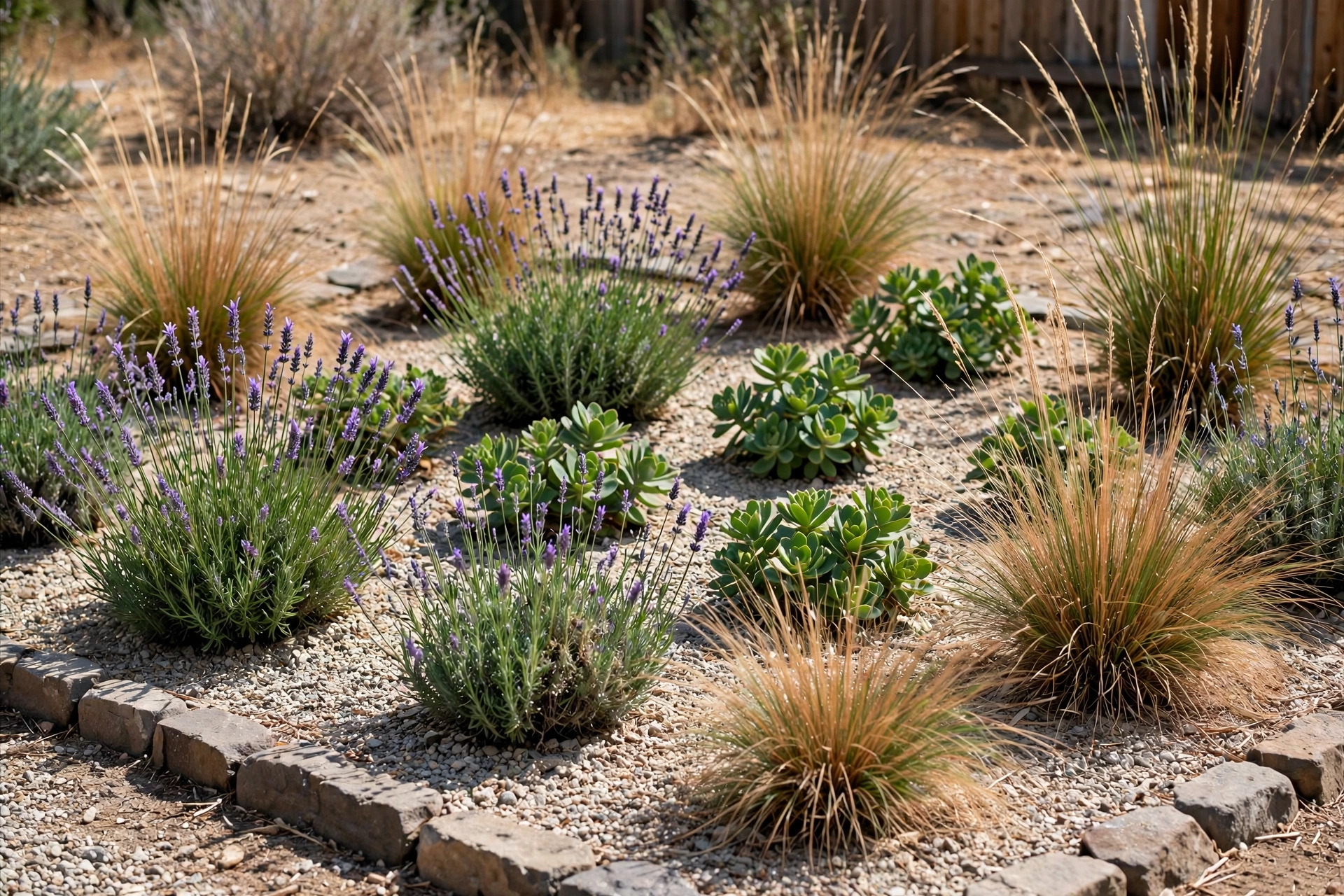
Lavender earns its place on drainage before fragrance. It wants gritty, lean soil and a slope or a raised spot, and in heavy clay it fails from wet roots in winter far more often than from summer drought.
Sedum covers the opposite problem: the hot strip along a driveway or a south wall where reflected heat cooks shallow-rooted plants by July. Upright forms such as Autumn Joy carry late-season flower heads, while the low stonecrops close bare soil between stepping stones.
Yarrow and Russian sage take the middle of the bed. Yarrow flowers on almost no water and spreads where it is happy, which is a virtue in a big bed and a chore in a small one, so give it room or a cultivar bred to stay compact.
Russian sage runs 3 to 4 feet in every direction, with silver stems and a long run of blue flower spikes from midsummer on. Plant one where a shrub would go, not where a border plant would go.
Flower and pollinator weight
Coneflower is the least drought-proof plant on this list and still a clear step down from thirsty bedding flowers. It wants a deep soak in a long dry spell rather than a weekly schedule, and it pays that water back in goldfinches working the seed heads in September.
The bed hums on a still afternoon when coneflower and yarrow overlap in bloom. That sound is a practical sign as much as a pleasant one: a dry bed in flower is feeding pollinators through the weeks when irrigated annuals have already quit.
Structure: grasses and accents
Ornamental grasses hold a dry bed together in winter, when the perennials have died back to crowns. Little bluestem and switchgrass are the reliable cold-climate choices, both native, both content on rainfall once their roots are down.
Yucca and agave are zone decisions, not style decisions. Yucca species rated to Zone 4 or 5 overwinter across most of the country and ask for almost nothing afterward, while most agaves are Zone 8 plants that belong in the ground only in the warm South and Southwest, or in pots elsewhere.
Regional planting timing matters as much as the plant list. The Florida planting calendar shows how one warm state splits its planting windows by region, and the same regional logic applies to dry yards everywhere.
The first season is the exception
Every plant on this list needs regular water in its first season. Drought tolerance is a property of an established root system, and a lavender in its first August has roots that reach inches, not feet.
Water deeply at planting, then keep the root zone moist while the plant settles, tapering the schedule as new growth shows the roots have taken hold. By the second summer, most of these species run on rainfall in all but the driest climates.
Soil and spacing come first
Most low-water plants fail in rich, wet soil, not in poor, dry soil. Skip the compost-heavy bed preparation that annual flowers want, plant into the soil as it stands, and add drainage — a slope, a raised edge, a gravel admixture in the planting hole — before adding fertility.
Spacing is the second discipline. These species are sized for their mature spread in the table above, and a bed planted at mature spacing looks thin for one season and right for the next ten, while a bed planted tight becomes a crowded, mildew-prone thicket that needs dividing by year three.
Mulch does the quiet work
A 2- to 3-inch mulch layer over the bed cuts evaporation from the soil surface and keeps the root zone cooler through a heat wave. Gravel or crushed stone suits lavender, sedum, yucca, and agave, which resent wet mulch against their crowns, while shredded bark suits coneflower, yarrow, and the grasses.
Keep mulch a few inches clear of stems and crowns either way. A dry bed fails at the crown more often than at the roots, and a ring of bare soil at the base is cheap insurance.
Bottom line
Build the bed on lavender, sedum, yarrow, and Russian sage, add coneflower where a deep soak is possible, and let grasses carry the winter. Plant them in spring, water them through one honest first season, and the bed stops being a hose schedule.