Landscape & Leisure is reader-supported. When you buy through links on our site, including Botanical Interests seed links, we may earn a commission at no extra cost to you. Prices change, so click through to confirm current pricing.
You have room for one block of corn, and the seed rack holds five packets that all promise the same August dinner. Only one of them is the corn you actually want to eat — the rest are fine corn for somebody else’s garden, or somebody else’s dinner. The packet tells you the days to maturity and the ear size. It stays quiet about which one stays sweet after picking, which one shrugs off leaf blight, or which one tastes like the corn you remember.
The five varieties below are the sweet corns Botanical Interests has in stock right now, and they cover the whole range: a bicolor workhorse, a yellow classic, a creamy canning corn, an old-fashioned open-pollinated variety, and a blue-corn novelty that earns its row for looks alone. For how to grow whichever you pick, see our guide to growing sweet corn. For the bigger question — sweet corn, popcorn, or field corn — see our sweet vs. popcorn vs. field corn comparison.
Sweet Corn Types, in Plain English
Sweet corn comes in two types on this shelf, and the letters on the packet matter more than the picture. Sugary types, marked su, are the old-fashioned sweet corns: tender and rich, but their sugar turns to starch fast once picked, so they are best eaten the day they come off the stalk. Sugar-enhanced types, marked se, hold their sweetness longer after harvest — a real advantage when the picking and the eating are a day or two apart. Every variety below is one or the other, and it is the first thing worth knowing before you choose.
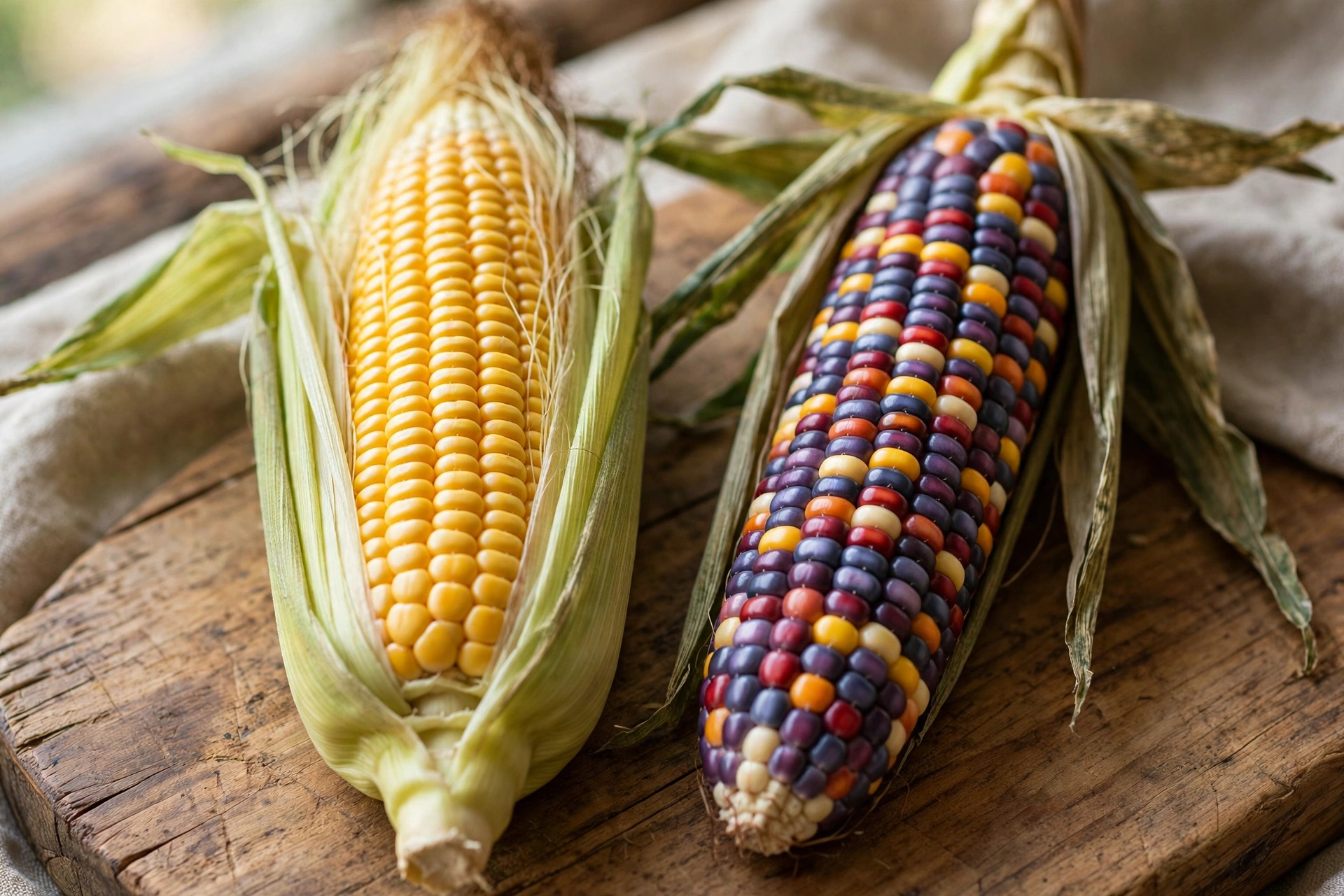
The photo below shows the difference a variety makes before you ever taste one: a bicolor ear beside a plain yellow one, husks pulled back, both picked the same morning.

Best Overall: Ambrosia
Ambrosia is the sweet corn to plant when you only get one block and you want the summer table covered. It is a sugar-enhanced hybrid with 8-inch bicolor ears — white and yellow kernels on the same cob — that mature in 75 days. It carries resistance to Stewart’s wilt and northern corn leaf blight, the two diseases that turn a promising stand ragged by August. Gardeners rate it 4.6 from 12 reviews, the highest gardener rating of any sweet corn here.
The trade-off is that a bicolor ear is not everybody’s idea of corn. If you grew up on plain yellow ears, the white kernels look wrong until you taste them. Taste them first, then decide.
Pros: bicolor ears with creamy, tender kernels; holds sweetness after picking; resists Stewart’s wilt and northern corn leaf blight; 75 days to maturity.
Cons: bicolor kernels are not the classic yellow look; a hybrid, so saved seed will not come true.
Ambrosia Sweet Corn Seeds
Bicolor ears that stay sweet after picking, with disease resistance built in — the one-block corn.
Runner-Up: Bodacious
Bodacious is the yellow corn for gardeners who want the classic ear and nothing to argue about. It is a sugar-enhanced hybrid that matures in 75 days, with 8-inch ears packed with 16 rows of golden kernels, and it carries one of the strongest disease packages on the shelf: high resistance to common rust and maize dwarf mosaic virus, intermediate resistance to Stewart’s wilt and northern corn leaf blight. The stalks are medium height and sturdy, and the ears fill out well even in a middling summer.
The trade-off is that Bodacious has no gardener rating shown on its page yet, so its record here is the disease package and the description, not a crowd of reviews. Ambrosia has the higher gardener rating; Bodacious has the deeper disease resistance.
Pros: classic yellow ears, 16 rows; strong disease package; sturdy medium stalks; 75 days to maturity.
Cons: no gardener rating shown yet; a hybrid, so saved seed will not come true.
Bodacious Sweet Corn Seeds
The classic yellow ear with the strongest disease package on the shelf.
Best for Canning and Freezing: Honey and Cream
Honey and Cream is the corn to plant when the freezer is the plan, not the grill. It is a sugary hybrid with 7-inch bicolor ears — about 12 rows of sweet, creamy kernels — that matures in 84 days and cans and freezes well, so summer keeps past the season. It resists common rust and northern leaf blight. Gardeners rate it 3.5 from 17 reviews, a middling score with a clear theme: the flavor earns praise, while a few gardeners report small ears and thin stands.
The trade-off is the rating itself. The corn that cans best is not the corn with the cleanest reviews, and the complaints are about ear size and germination, not flavor. Plant it a little thick and thin to the strongest seedlings, and it earns its freezer space.
Pros: bicolor ears with creamy flavor; cans and freezes well; resists common rust and northern leaf blight; a large packet is available for big plantings.
Cons: tied for the lowest rating here at 3.5; some gardeners report small ears; 84 days to maturity.
Honey and Cream Sweet Corn Seeds
Creamy bicolor ears that can and freeze well — the corn for putting summer away.
Best Old-Fashioned Flavor: True Gold
True Gold is the corn for gardeners who want the flavor their grandparents grew, and who are willing to eat it the day it is picked. It is an open-pollinated sugary variety, selected from a 1955 hybrid, with large 9-inch ears of tender golden kernels. The plants resist stalk lodging — they stay standing in wind that kinks lesser corn — and each stalk often carries two or three ears. Because it is open-pollinated, you can save the seed and grow the same corn next year. Gardeners rate it 3.5 from 8 reviews, and the reviews split honestly: near-perfect germination and sturdy stalks on one side, and a gummy, mealy texture on the other when the harvest ran late.
The trade-off is timing. True Gold is a sugary type, so its sweetness fades fast after picking, and the texture complaints all trace back to ears left on the stalk too long. Pick it on time, cook it the same day, and it is the corn the name promises. Let it sit, and it is the corn the low rating warns about.
Pros: large 9-inch ears, 2–3 per stalk; open-pollinated — save your own seed; resists stalk lodging; old-fashioned sweet flavor.
Cons: sugary type — sweetness fades fast after picking; texture turns gummy if harvest runs late; the lowest rating here, tied with Honey and Cream.
True Gold Sweet Corn Seeds
Big golden ears from a 1955 open-pollinated variety — pick on time and eat it the same day.
Best Novelty: Martian Jewels
Martian Jewels is the corn you plant for the look of it, and you should be honest with yourself about that before you sow it. It is an open-pollinated sugary variety bred from Hopi blue-corn parents, with glowing white kernels over deep-violet cobs, and it matures in 80 to 90 days. The flavor is more traditional than modern — slightly less sweet than the hybrids, with a hearty texture — and the kernels are loaded with anthocyanins, the same antioxidants that color blueberries. Gardeners rate it 4.0 from 24 reviews, and the most useful review in the pile makes the same point this section does: plant it as a novelty, not as your main summer sweet corn.
The trade-off is that novelty corn is a side dish, not the main crop. It also leaves violet stains on hands when you shuck it, one gardener found, and pollination can be patchy even in a good breeze. Plant a short row for the table and the dye pot, and let Ambrosia or Bodacious carry the summer.
Pros: striking white kernels over violet cobs; open-pollinated — save your own seed; anthocyanin-rich; doubles as a dye corn and a flour corn if left to dry.
Cons: less sweet than modern hybrids; pollination can be inconsistent; stains hands when shucked; 80–90 days — a long wait for a novelty.
Martian Jewels Sweet Corn Seeds
White kernels over violet cobs from Hopi blue-corn parents — the corn that steals the table.
The One to Skip: Painted Hill
Painted Hill would have belonged in this roundup on merit. It is an open-pollinated sweet corn with 7-inch ears of multicolored kernels, bred for short growing seasons and cool, wet soils, and gardeners rate it 4.4 from 23 reviews. But it is sold out right now, and a variety you cannot buy is not a recommendation. Check back later in the season, or plant Martian Jewels above — it covers the same colorful-corn ground and it is in stock.
Side-by-Side Comparison
| Variety | Type | Days | Ear | Best for | Rating |
|---|---|---|---|---|---|
| Ambrosia | se hybrid, bicolor | 75 | 8 in | Eating fresh, disease resistance | 4.6 (12) |
| Bodacious | se hybrid, yellow | 75 | 8 in, 16 rows | Classic yellow ears | No rating shown |
| Honey and Cream | su hybrid, bicolor | 84 | 7 in, 12 rows | Canning and freezing | 3.5 (17) |
| True Gold | su open-pollinated, yellow | 70–80 | 9 in, 2–3 per stalk | Old-fashioned flavor, seed saving | 3.5 (8) |
| Martian Jewels | su open-pollinated, white/violet | 80–90 | Novelty, dye and flour | Looks, novelty | 4.0 (24) |
Final Thoughts
Plant Ambrosia first. It is the corn most likely to make you wonder why you ever bought ears at the store, and the one your neighbors will ask about when the bicolor cobs come out of the pot. Then add Bodacious for the classic yellow ears and Honey and Cream for the freezer — and if you grill, a short row of Martian Jewels earns its space twice over. Read our before you sow, because the one mistake that ruins a corn season is planting a single long row and finding out in August that half the kernels never filled.