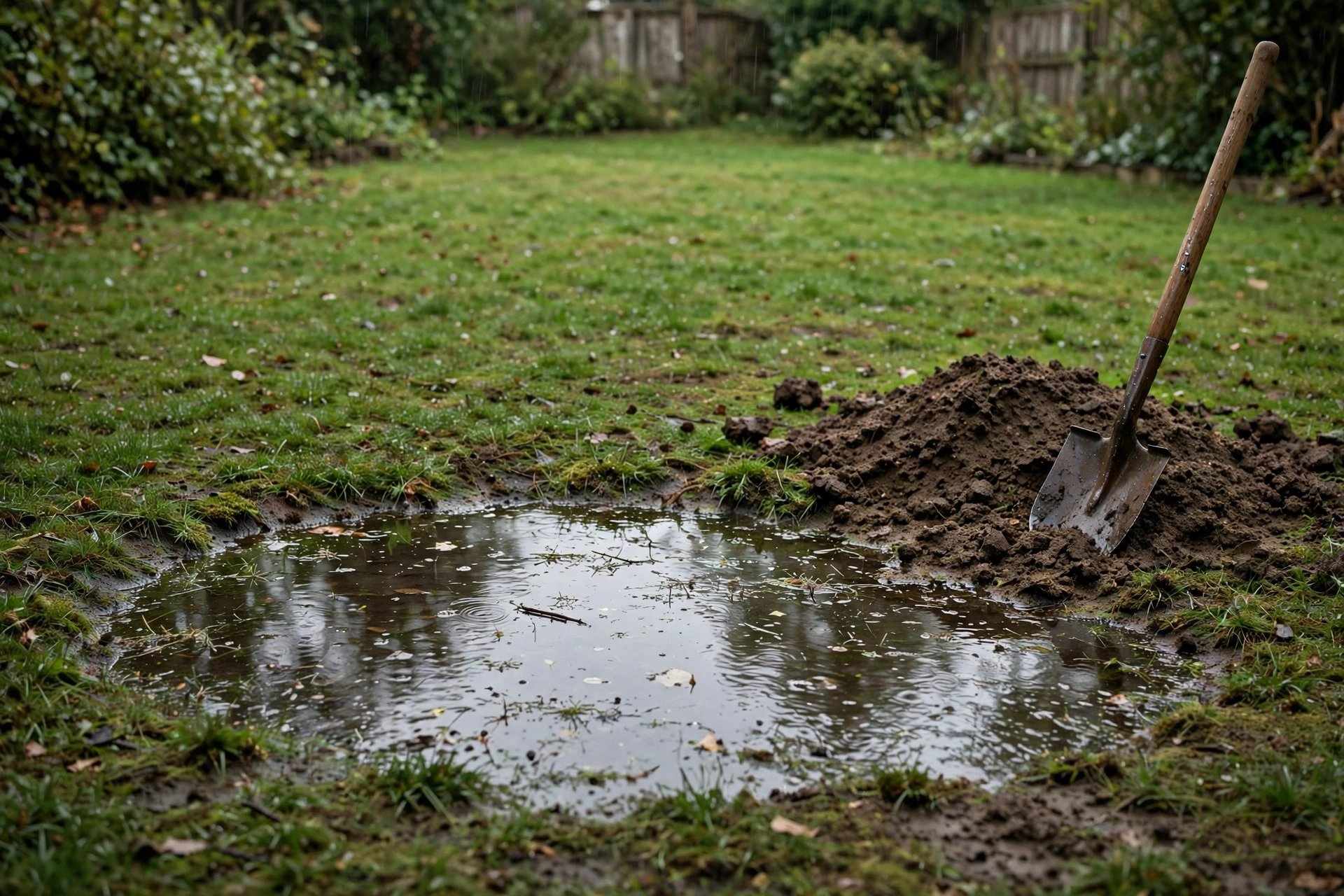
You dig the pit, fill it with gravel, and the next storm fills it in an hour and leaves the yard just as wet. That is the most expensive way to learn the difference between a French drain and a dry well: one moves water somewhere else, the other stores a modest amount and waits for the soil to take it.
Pick the wrong one and you have not bought drainage — you have bought a hole. Here is how to pick the right one the first time.
What each one actually does
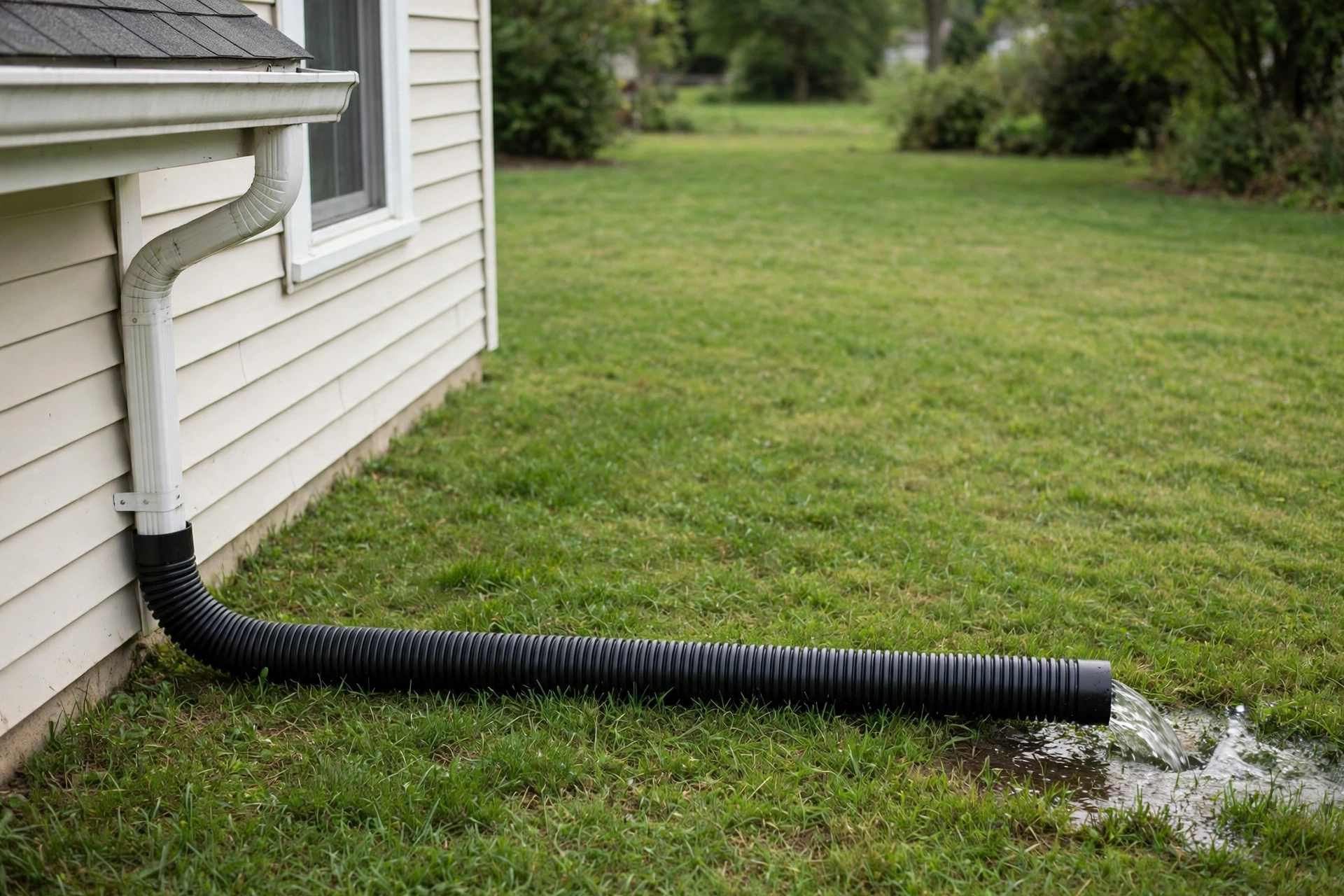
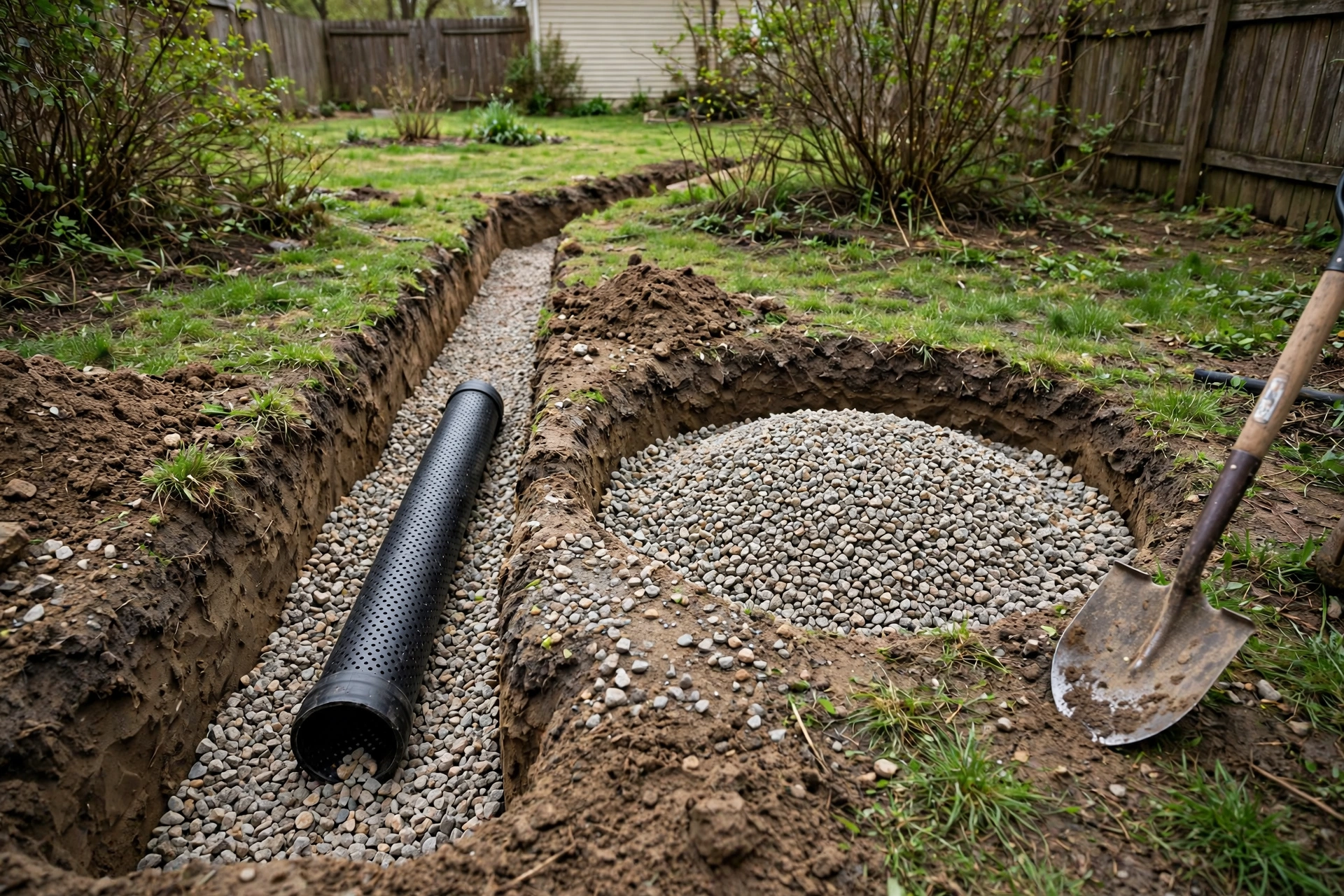
A French drain moves water. It is a trench, typically 12 to 18 inches deep, lined with fabric and filled with washed gravel around a perforated pipe laid holes-down. Water enters the trench along its whole length, drops into the pipe, and flows to an outlet — a slope, a ditch, a pop-up emitter on lower ground. No outlet, no drain: the pipe has to daylight somewhere lower than the trench.
A dry well stores water. It is a buried, gravel-filled pit, often built around a plastic chamber, that collects water from a downspout or a small low area and lets it soak into the surrounding soil slowly, over hours. Nothing leaves through a pipe. The pit is a waiting room, and the soil sets the pace.
Side by side
| Option | What it does | Needs an outlet? | Best for | Main failure mode |
|---|---|---|---|---|
| French drain | Collects water along a trench and carries it away in a perforated pipe | Yes — must daylight on lower ground | Water that has to move: hillside runoff, long wet strips, foundation protection | Outlet blocked or trench fabric clogged with silt, so the line backs up |
| Dry well | Holds water in a gravel pit or chamber and lets it soak into the soil | No — the soil is the outlet | A modest volume with nowhere to send it: one downspout, a small low spot on decent soil | Volume exceeds capacity, or clay soil soaks too slowly, so the pit fills and stays full |
The mistake that costs the most
Most homeowners who regret a dry well asked it to handle a whole roof. A roof sheds a startling amount of water — a heavy rain on even a modest roof section sends hundreds of gallons down one downspout — and a pit sized for a garden hose problem fills in the first hour of that storm.
Once the pit is full, every additional gallon has nowhere to go, and the yard floods exactly as it did before the digging. The dry well did not fail at its job. It was handed a moving-water job with a storage tool.
The mirror-image mistake is a French drain with nowhere to go. On a dead-flat lot with no lower ground, a trench and pipe just relocate the puddle to the end of the line, which is why the outlet question comes before the trench question, every time.
Soil decides more than the catalog does
Halfway through digging, the trench tells you the truth about your soil: sandy or loamy walls that crumble and drain are dry-well country, while dense clay that comes up in slick slabs is not. Clay soaks so slowly that a dry well in clay can hold yesterday’s storm when today’s arrives.
If your soil is clay and the water has to go, the French drain wins because it does not ask the soil to absorb anything — it asks only for a route downhill. If your soil drains well and the volume is small, the dry well wins because it needs no route at all.
Keep both away from two places: never drain toward a septic field, and never run an outlet onto a neighbor’s lot. For water collecting right at the house, work through how to fix water pooling at your house foundation first — gutters and grade solve more of those cases than either system here.
What the digging actually involves
A French drain is a linear job: a trench 12 to 18 inches deep running the length of the wet area and on to the outlet, which for a typical side yard means moving a lot of soil by hand or with a rented trencher. The pipe goes in holes-down on a bed of washed gravel, the gravel wraps over the top, and the fabric wraps around the whole bundle before the soil goes back — skip the fabric, and silt migrates into the gravel and shortens the drain’s life by years.
A dry well is a point job: one pit, commonly 3 to 4 feet across and several feet deep, filled with washed gravel or fitted with a plastic chamber wrapped in fabric. The digging is heavier in one spot and lighter everywhere else, and there is no long trench to restore, which is why dry wells tempt people — the work looks smaller, even when the capacity math says the job is bigger.
Either way, call for utility marking before the first shovel goes in, and keep both systems well clear of the septic field if your lot has one. A drain that solves a puddle and severs a line has not solved anything.
Cost and effort, honestly compared
Materials for a dry well are usually the cheaper pile: one chamber or a load of gravel, fabric, and a short run of pipe from the downspout. A French drain costs more in pipe, gravel, and hours as the trench gets longer, and the outlet work — a pop-up emitter or a daylighted end on a slope — adds its own digging at the far end.
The honest comparison is not materials, though. It is cost per problem solved. A dry well that overflows every third storm costs its full price and buys nothing, while a French drain that ends the flooding pays for its extra trench in one season. Price the system that fits your water, not the smaller pile of parts.
Maintenance differs, too. A French drain asks you to keep its outlet clear and visible — a two-minute check after big storms. A dry well asks almost nothing until the day it starts filling faster than it empties, at which point the fix is excavation, not a cleaning, so sizing it generously at the start is the only cheap maintenance there is.
Verdict
Choose a French drain when water must move somewhere — a slope to intercept, a long wet strip, a foundation to protect — and you have lower ground for the outlet. Choose a dry well when a modest volume just needs somewhere to soak in, your soil drains at a reasonable pace, and there is genuinely nowhere to send it.
For the yard that is wet everywhere rather than in one defined place, start with the broader plan in how to fix a muddy backyard before digging either one. Dig once, for the system your water actually needs.