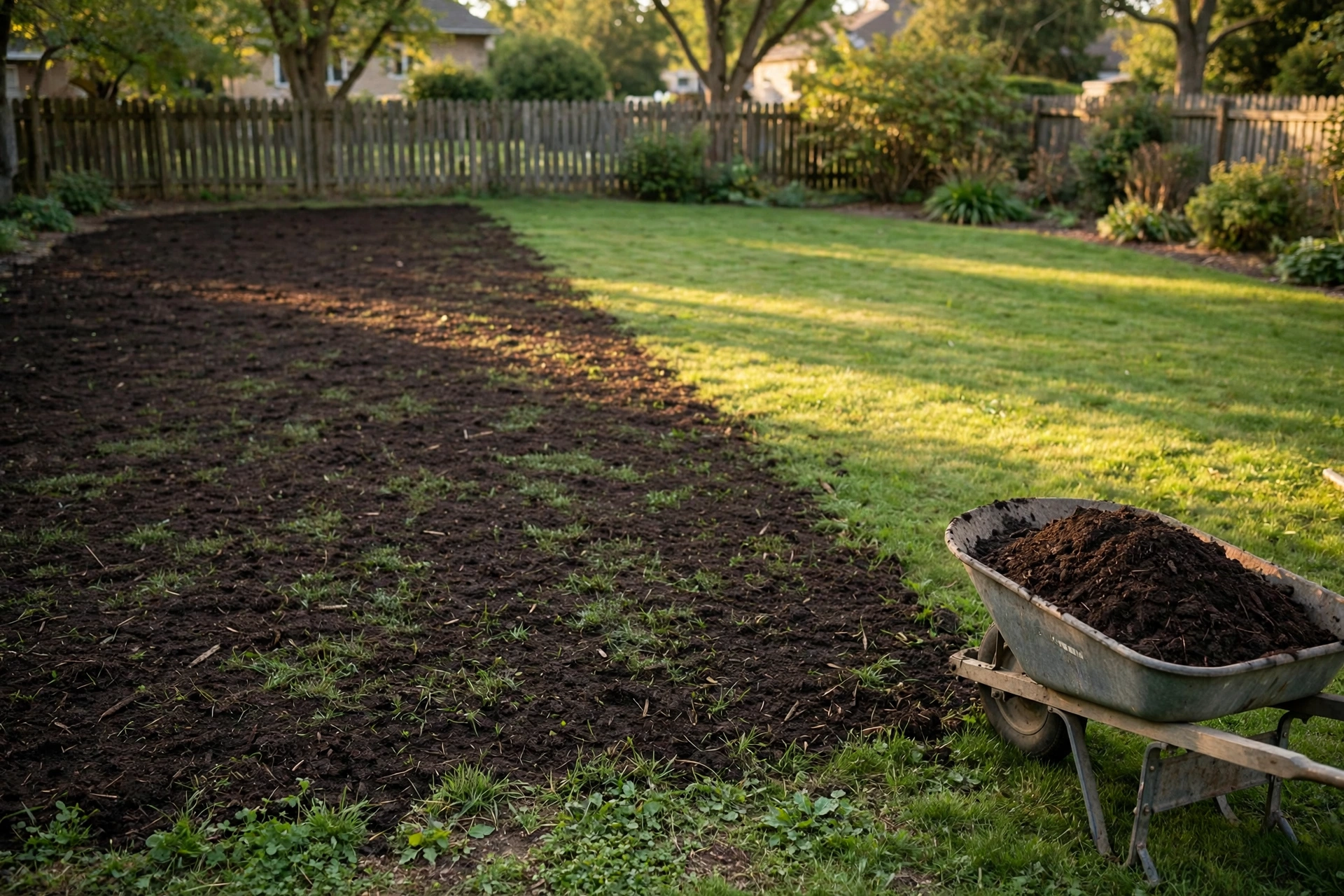
The compost sits in a dark pile at the end of the driveway, earthy and still warm in the middle, and the lawn in front of you looks thin enough to see soil between the blades — spread that pile too thick and you smother the grass, too thin and you have made three trips for nothing.
This calculator settles the order before you start: type in your lawn area and the depth of the layer, and it tells you how much compost you need in cubic yards and cubic feet, and in bags if you are buying it bagged. Aim for a thin layer, about 1/4 inch — at that depth, 1,000 square feet takes about 0.77 cubic yards.
Topdressing volume calculator
Measure length times width, and subtract your house, driveway, and beds. For an uneven lawn, measure it in rectangles and add them together.
About 1/4 inch is the layer to aim for — thin enough to work down between the blades instead of sitting on top of them.
Only if you are buying bagged compost. Read the size off the bag — common bags hold 1 or 2 cubic feet. Leave this blank if you are ordering a bulk load by the cubic yard.
Your browser has JavaScript turned off, so the calculator cannot run. The tables and worked examples below give you the same answers by hand.
What your numbers mean
The cubic-yard number is the one to order by, because bulk compost is sold by the cubic yard. The cubic-feet number sits beside it so you can check the order makes sense — one cubic yard is 27 cubic feet, so the yard figure should always look like the feet figure divided by about 27.
The per-1,000-square-feet line is your quick sanity check. At 1/4 inch, you need about 0.77 cubic yards for every 1,000 square feet, so a 5,000-square-foot lawn lands near 4 cubic yards — if your result is nowhere near that kind of size, check the area you typed.
If you entered a bag size, the bag count is rounded up to whole bags, because the last patch of lawn does not care that you ran half a bag short. For anything bigger than a small lawn, compare that bag count with a bulk delivery before you buy — dozens of bags add up to a lot of lifting.
How the math works
The calculator takes your area and your depth and turns them into a volume: first into cubic feet, then into cubic yards by dividing by 27. If you gave it a bag size, it divides the cubic feet by that size and rounds up to whole bags. That is the whole job — no hidden extras, no waste factor added on top.
By hand, the same math reads like this: cubic feet is your area in square feet times your depth in inches, divided by 12. Cubic yards is that cubic-feet figure divided by 27. Bags is the cubic feet divided by your bag size, rounded up.
Worked examples
A 1,000-square-foot lawn at 1/4 inch. 1,000 times 0.25, divided by 12, is 20.83 cubic feet. Divided by 27, that is 0.77 cubic yards. The Penn State table below prints 1 cubic yard for this lawn because the table rounds every figure to the nearest whole yard — order on the 0.77 and you will not be short.
A 5,000-square-foot lawn at 1/4 inch. 5,000 times 0.25, divided by 12 and then by 27, is 3.86 cubic yards. The table prints 4, again because it rounds to whole yards.
The 1,000-square-foot lawn in bags. At 20.83 cubic feet, bags of 2 cubic feet each come to 20.83 divided by 2, which is 10.42 — rounded up, 11 bags.
One more hand check, if you like a second way to run the numbers: multiplying area times depth times 0.0031 also gives cubic yards. For 10,000 square feet at 1/4 inch that shortcut gives 7.75 cubic yards against the exact 7.72 — the small gap is the shortcut factor’s own rounding, and either figure orders the same load.
Compost amounts by lawn size
| Unit area (sq ft) | Surface 1/4 in | Tilled 1/2 in | Tilled 1 in | Tilled 1 1/2 in | Tilled 2 in |
|---|---|---|---|---|---|
| 1,000 sq ft | 1 | 2 | 3 | 5 | 6 |
| 5,000 sq ft | 4 | 8 | 15 | 23 | 31 |
| 10,000 sq ft | 8 | 15 | 31 | 46 | 62 |
| 20,000 sq ft | 15 | 31 | 62 | 93 | 123 |
| 30,000 sq ft | 23 | 43 | 93 | 139 | 185 |
| 40,000 sq ft | 31 | 62 | 123 | 185 | 247 |
Amounts are cubic yards, rounded to the nearest whole numbers — that rounding is why the table’s 1 cubic yard for a 1,000-square-foot lawn sits above the calculator’s exact 0.77. Read the columns carefully: only the first column is a topdressing, spread on top of an established lawn. The tilled columns are a different job — compost worked 4 to 6 inches into bare soil before a new lawn goes in, at about 3.1 cubic yards per 1,000 square feet for a 1-inch layer and about 6.2 for a 2-inch layer. This calculator figures topdressing only, up to 1/2 inch.
Choosing compost that spreads well
For a layer this thin, the compost itself matters as much as the amount. Look for compost that has passed through a 3/8-inch screen, so it falls between the blades instead of landing in clumps the rake cannot break up. It should feel damp but not soggy — about 30 to 50 percent moisture — and smell earthy, like forest floor, with no large stones, wood chunks, or trash in it.
On the label or the supplier’s test sheet, look for a carbon-to-nitrogen ratio at or below 30 to 1, a pH between 6.0 and 8.0, and organic matter above 30 percent. A ratio above 30 to 1 ties up nitrogen while the material finishes breaking down, which is the opposite of what a thin lawn needs.
Spreading it and working it in
Spread the compost first, then work it down to the soil. The surest way is several passes with a hollow-tine aerator followed by a heavy drag mat, which breaks up the cores and drags the mix into the holes; a leaf rake and some patience do the same job on a small lawn. Do this work in a cool, moist stretch while the grass is actively growing, because aerating and dragging stress turf in hot, dry weather.
Water the lawn right after you finish, enough to wash the compost off the blades and settle it against the soil. That watering also leaches salts down through the mix, which matters most in hot weather. And keep the material compost: sand or topsoil spread the same way can form layers in the soil instead of blending in, so this is not the place to use them up.
What this calculator does not do
This tells you how much compost a thin surface layer takes — not how often to topdress, which compost to buy, or what the load will cost. It does not figure the deeper tilled-in amounts for building new soil; the table above carries those for reference.
For the jobs around this one, the grass seed calculator figures seed for overseeding into the fresh layer, the sprinkler catch can calculator times the watering that settles it, and the compost blend calculator helps you balance a homemade mix before it ever reaches the lawn.
Sources
- Penn State Extension, “Using Composts to Improve Turf Performance” — https://extension.psu.edu/using-composts-to-improve-turf-performance (fetched November 14, 2026)
- University of Minnesota Turfgrass Science, “Home Lawn Care Newsletter, Issue #40 — October 2026” — https://turf.umn.edu/home-lawn-care-newsletter-october-2026 (fetched November 14, 2026)
- Oregon State University Extension, “How to use compost in gardens and landscapes,” EM-9308 — https://extension.oregonstate.edu/catalog/pub/em-9308-how-use-compost-gardens-landscapes (fetched November 18, 2026)