Landscape & Leisure is reader-supported. When you buy through links on our site, including Botanical Interests seed links, we may earn a commission at no extra cost to you. Prices change, so click through to confirm current pricing.
The usual kohlrabi mistake happens before the seed is even in the ground: it gets sown like a summer crop, in warm soil, on a warm week, and then it sulks. Kohlrabi is a cool-season brassica that wants to size up while the air is cooling down, and nearly every disappointment with it traces back to that one timing decision.
So this guide starts with the calendar, not the trowel. Get the sowing window right and Purple Vienna is a forgiving crop — 50 to 69 days, a swollen stem that sits above the soil where you can watch it, and a harvest you judge by eye. The variety background is in the kohlrabi varieties roundup; here, the job is sowing, spacing, and knowing when to cut.
When to sow — two windows, both cool
The packet gives two sowings. Outdoors, sow 4 to 6 weeks before your average last frost date, or as soon as the soil reaches at least 45°F — ideally 65 to 80°F. Then sow again in late summer for a fall harvest, which is the sowing I would protect if I could only make one, because bulbs that swell into cooling weather taste sweeter and hold better.
Mild climates get a third option: sow in fall and winter for a cool-season harvest. What kohlrabi does not want is a midsummer sowing in hot soil, where the stem swells slowly and turns tough while it waits for the heat to break.
Indoors, the packet’s window mirrors the outdoor one: start 4 to 6 weeks before the last frost date, and 10 to 12 weeks before the first frost date for fall, transplanting out after 4 to 6 weeks. A transplant gives the fall crop a head start while the bed is still occupied, which is the practical reason to bother starting a direct-sow crop inside at all.
Sowing depth and spacing
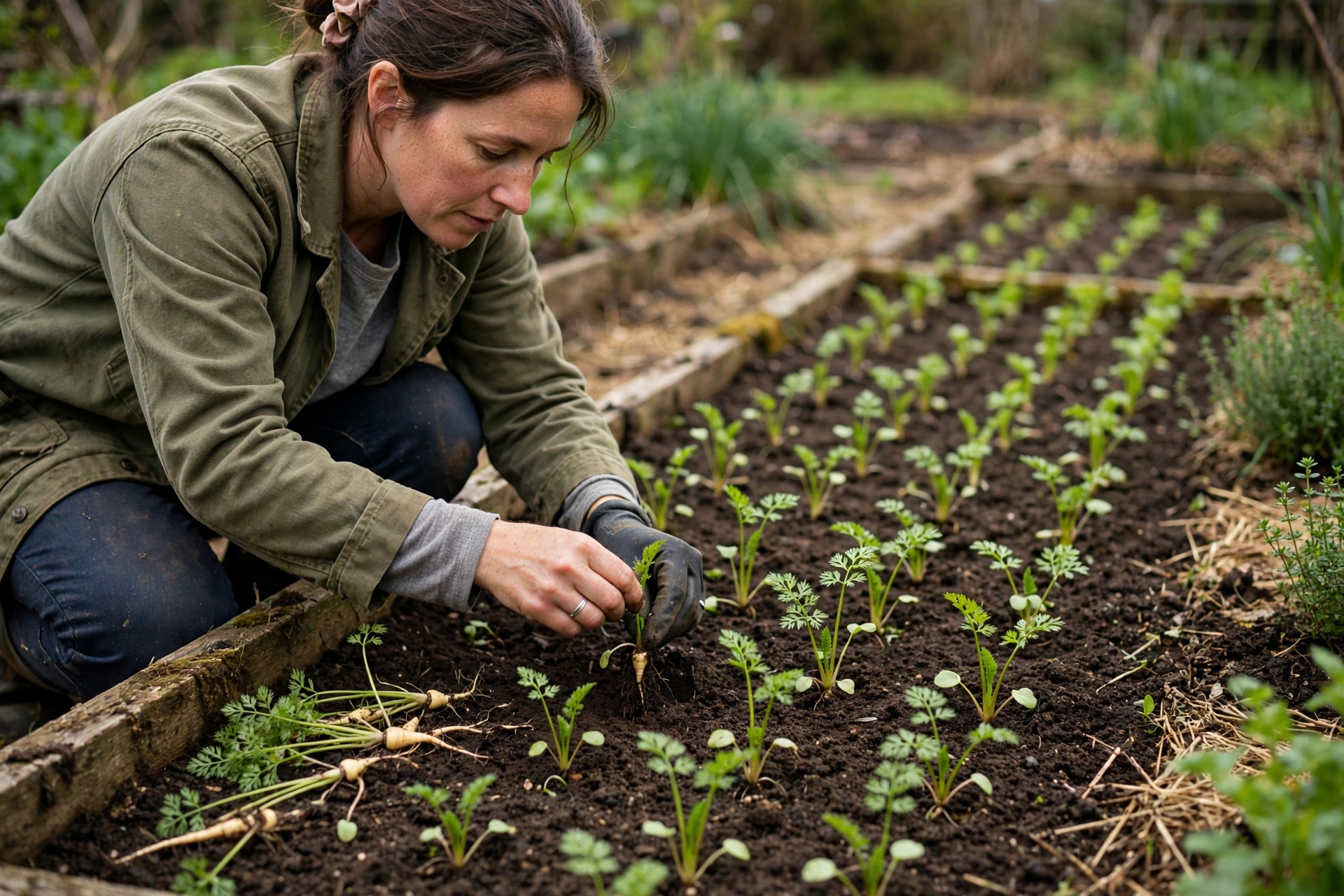
Sow a group of 3 seeds every 4 inches, a quarter to a half inch deep, with rows 12 to 18 inches apart. Germination takes 10 to 14 days. When the seedlings stand 2 inches tall, thin to one plant every 4 inches — and thin without mercy, because three plants sharing one spot produce three undersized stems instead of one good bulb.
The thinnings are not waste. Young kohlrabi leaves are edible brassica greens, and the pulled seedlings go straight into a salad or a sauté pan, which takes some of the sting out of the thinning pass.
Four inches sounds tight for a plant that makes a 3-inch bulb, but kohlrabi grows up more than out — the leaves stand like spokes around the stem, and the plants stay under 12 inches tall. That compact habit is also why the packet marks Purple Vienna good for containers: a wide pot with a few plants is a legitimate way to grow it on a patio.
| Step | Packet figure | Timing |
|---|---|---|
| Direct sow | Group of 3 seeds every 4 inches, ¼–½ inch deep | 4–6 weeks before last frost; again in late summer |
| Start indoors | One seed per cell, transplant at 4–6 weeks | 4–6 weeks before last frost; 10–12 weeks before first frost |
| Thin | To 1 plant every 4 inches; rows 12–18 inches | When seedlings are 2 inches tall |
| Harvest | Cut below the swollen stem | At 2–3 inches across; 50–69 days |
Water and feeding while the stem swells
The swollen stem is mostly water, and it shows when the soil dries out mid-swell: growth stalls, and the flesh that forms afterward is coarser. Keep the bed evenly moist from thinning to harvest, especially in the last three weeks, when the bulb does most of its sizing.
A mulch layer once the plants are established holds that moisture and keeps soil from splashing onto the stems. Feed lightly — kohlrabi is a fast, short crop, and heavy nitrogen pushes leaf at the expense of the stem you are actually growing it for. The leaves standing up around a swelling bulb in the evening light are the sign things are on track: steady, upright, and still adding size a little at a time.
Reading a ready bulb
Harvest when the bulb is 2 to 3 inches in diameter. That is the packet’s figure and it is the whole game — smaller kohlrabi is the sweetest and most tender, and bulbs that grow much bigger than a tennis ball turn pithy or woody in the middle.

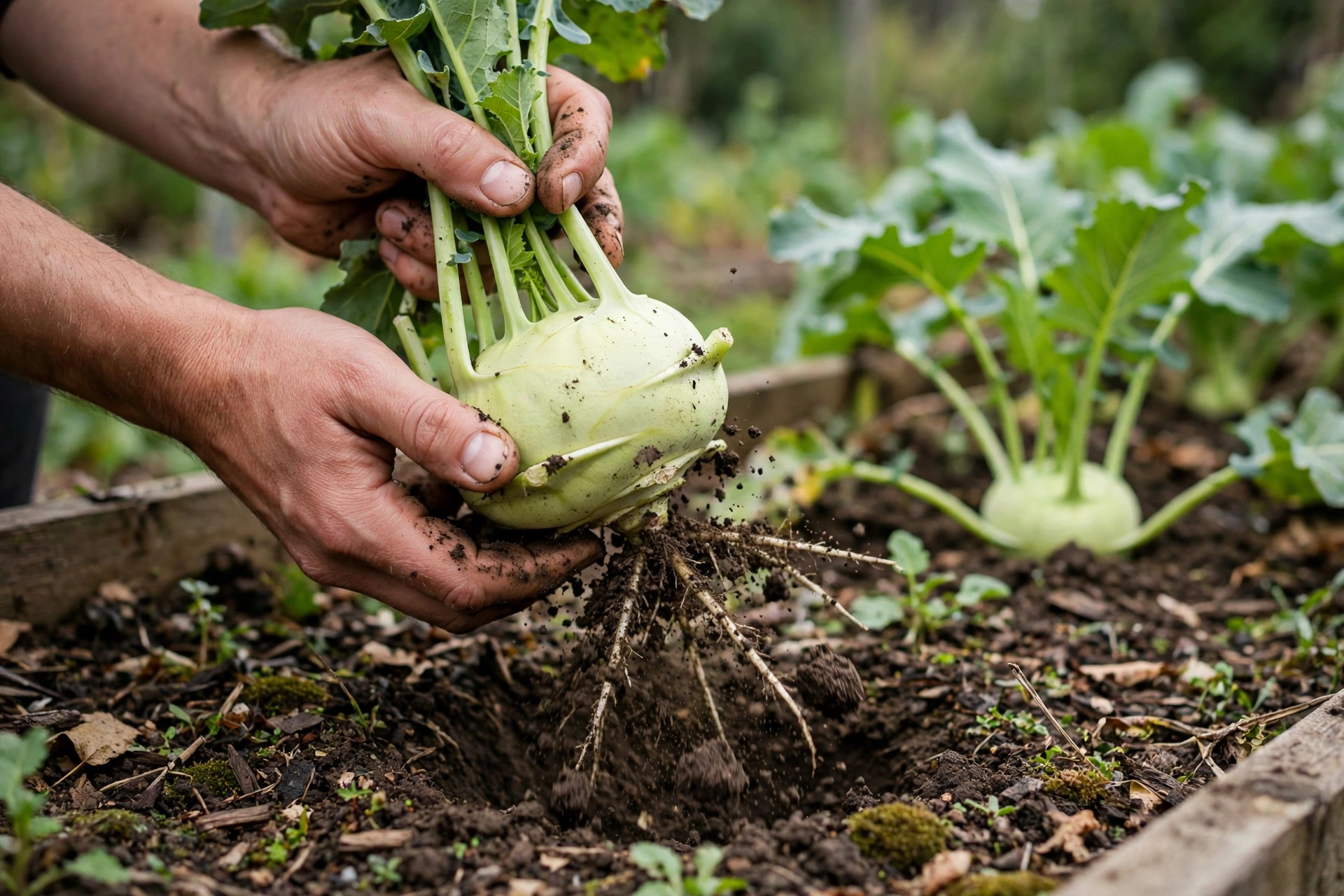
The size check is a hand check. A ready bulb sits at about tennis-ball size against your palm — roughly 2 to 3 inches across, with smooth, tight skin and leaves still fresh. If you are squinting and wondering whether it could go another week, cut it: a slightly small bulb eaten crisp beats a large one peeled down to a woody core.
Cut the stem between the soil and where it widens. Then keep cutting — kohlrabi does not hold in the ground the way a turnip does, so a succession sowing every couple of weeks through the window keeps bulbs arriving at eating size instead of all at once. If the turnip comparison is still open for you, Kohlrabi vs Turnips: Which to Grow compares which crop holds better and which eats better raw.
THE VARIETY
Purple Vienna Kohlrabi Seeds
50–69 days, sown a group of 3 every 4 inches — the one garden kohlrabi in the Botanical Interests catalog.
Check Price at Botanical InterestsBEST FOR STARTING INDOORS
Epic 6-Cell Seed Starting Trays
For the indoor start — transplants ready at 4–6 weeks, pushed out clean with the finger holes.
Check Price at Botanical InterestsWORTH ADDING
Epic Seed Starting Heat Mat
For cool starting rooms — holds soil in the packet’s ideal 65–80°F germination range.
Check Price at Botanical InterestsThe short version
Sow Purple Vienna cool, thin it to one plant every 4 inches without flinching, keep the water steady while the stem swells, and cut every bulb at 2 to 3 inches. Do those four things and the woody-kohlrabi story never happens in your bed — the crop fails on timing and patience, not on difficulty.