Landscape & Leisure is reader-supported. When you buy through links on our site, including Botanical Interests seed links, we may earn a commission at no extra cost to you. Prices change, so click through to confirm current pricing.
Kohlrabi or turnips — which one deserves the cool-season row?
It is a fair question, because the two get confused constantly: kohlrabi is even misclassified as a root vegetable, per its own packet, on account of that round shape. But one of them grows its harvest above the soil where you can see it, and the other hides it below — and that single difference drives almost everything else about growing and eating them. The packet figures for both crops are on the table below — the choice comes down to the job you want the row to do.
What you are actually harvesting
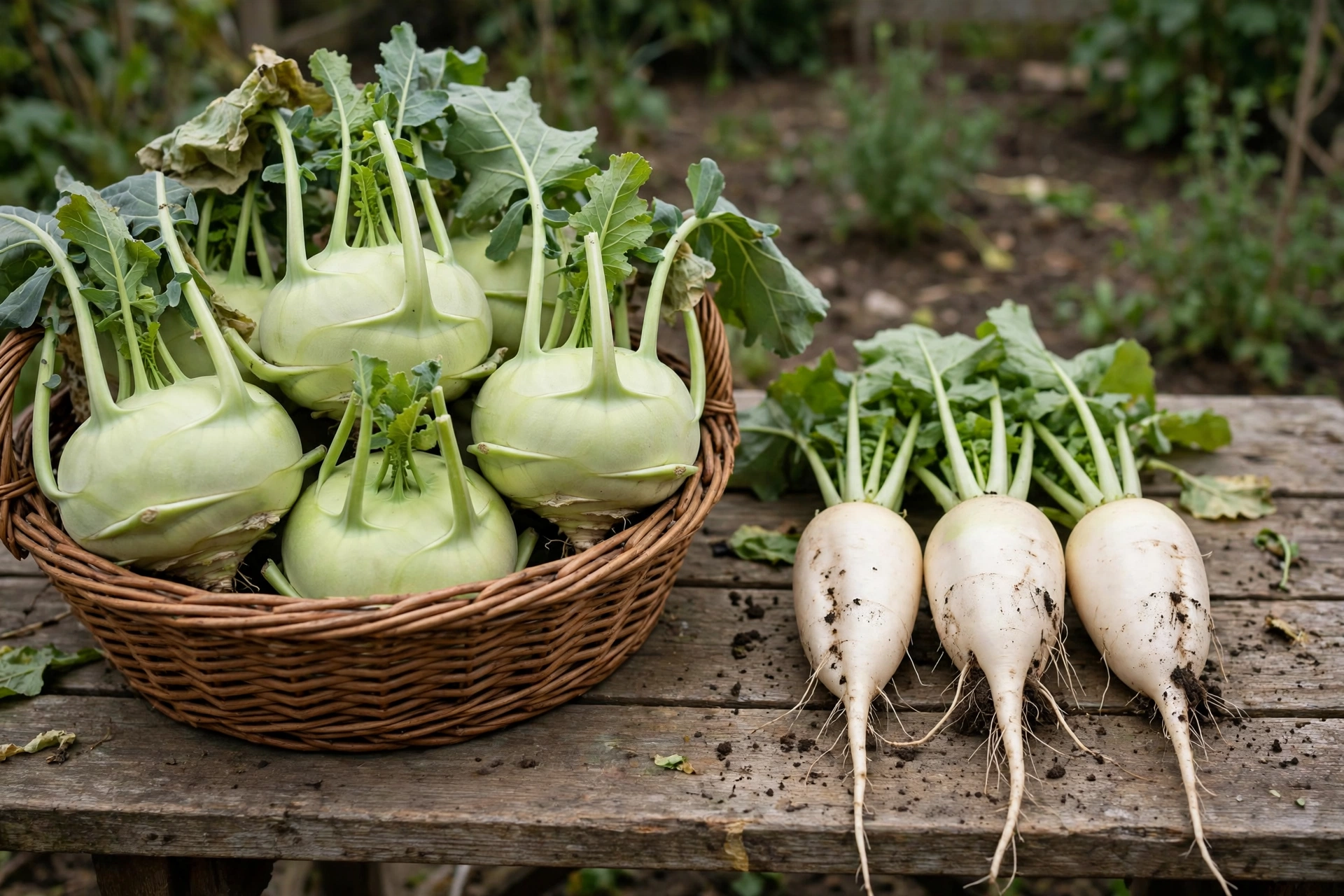
Kohlrabi’s edible part is an enlarged stem that forms just above the soil surface. Purple Vienna makes a reddish-purple, slightly flattened globe with tender white flesh, and you watch it swell day by day — there is no guessing and no exploratory digging.
A turnip’s edible part is a true root, underground. Market Express — sold as Turnip White Lady — makes a pure white Japanese salad turnip root you judge by the shoulders showing at the soil line and by the calendar, because the part that matters is out of sight until you pull it.
That visibility is kohlrabi’s quiet advantage for new growers. A stem you can see gets picked on time; a root you cannot see gets left a week too long.
Days, spacing, and the sowing job
Turnips are faster. Market Express lists 30 to 40 days — the quickest finish on this page — against Purple Vienna’s 50 to 69 days. If the row needs to turn over quickly between other crops, the turnip wins that argument outright.
Spacing is closer than you might expect. Kohlrabi goes in as a group of 3 seeds every 4 inches, a quarter to a half inch deep, thinned to one every 4 inches. Turnips go in as a group of 3 every 4 to 6 inches, a quarter inch deep, thinned to one every 4 to 6 inches, in rows 18 inches apart. Both germinate fast by brassica standards — turnips in 5 to 10 days, kohlrabi in 10 to 14.
One handling difference matters: turnips should not be started indoors, because their roots resent disturbance, while kohlrabi transplants happily from a cell tray at 4 to 6 weeks. Gardeners who like to raise transplants while a bed is still busy will find kohlrabi the more flexible crop; the full method is in Growing Kohlrabi: Sowing, Spacing, and Harvest.
| Question | Kohlrabi — Purple Vienna | Turnip — Market Express (White Lady) |
|---|---|---|
| What you harvest | Swollen stem, above the soil | True root, below the soil |
| Days to maturity | 50–69 days | 30–40 days |
| Harvest size | 2–3 inches; woody past tennis-ball size | Most tender at 2 inches or under |
| Start indoors | Yes — transplant at 4–6 weeks | Not recommended; roots resent disturbance |
| Best eating | Raw like an apple; steamed, sautéed, pickled | Raw in salads, pickled, or cooked; greens edible too |
| Gardener rating | 3.6 stars, 12 reviews | 4.7 stars, 21 reviews |
Eating them — raw crunch against storage roots
Raw is where kohlrabi pulls ahead. Its flavor sits between an apple and a mild turnip — the packet’s own comparison — crisp and delicately sweet with a slight peppery finish, and the texture holds up in slaws in a way a raw turnip rarely matches. White Lady is the turnip bred to compete here: pure white, mild, smooth-textured, and slightly sweet and fruity, made for salads, crudité trays, and pickling as a baby turnip. It is a genuinely good raw turnip. Kohlrabi is still the better raw bite, because raw crunch is its whole reason to exist.
Cooked and stored, the turnip takes its turn. Turnips roast, mash, and cook like potatoes, the greens are edible as well as the root, and the crop stores particularly well — the packet says so plainly. Kohlrabi does not store like that; it is a pick-it-and-eat-it crop, best within days, and its greens are a bonus rather than a second harvest.
The ratings tell the same story from the gardeners’ side. White Lady holds 4.7 stars across 21 reviews; Purple Vienna holds 3.6 across 12. Turnips forgive a late harvest better than kohlrabi does, and forgiving crops collect kinder reviews.
BEST FOR RAW EATING
Purple Vienna Kohlrabi Seeds
The above-ground stem with apple-crisp flesh — picked at 2–3 inches, it is the better raw bite of the two.
BEST FOR A FAST, STORABLE ROOT
Market Express Turnip Seeds — Turnip White Lady
A 30–40 day Japanese salad turnip — mild and white, good raw or cooked, and it stores well.
A note on the other turnip
The classic storage turnip in this catalog, Purple Top White Globe — 50 days, 4.9 stars across 16 reviews, roots that keep well and greens 14 to 22 inches tall — is currently out of stock, so it carries no card here. If it returns and storage is your priority, it is the turnip to beat; until then, Market Express is the turnip you can actually buy. The wider root picture, turnips included, is in the parsnips, turnips, and rutabagas roundup.
The verdict
Grow kohlrabi if the row is for eating fresh — slaws, snacking, a crisp raw bite in the fall — and you can pick on time at 2 to 3 inches. Grow turnips if you want speed, a cooked root, edible greens, and a harvest that stores. If I had one cool-season row and a family that eats vegetables raw off the cutting board, I would plant Purple Vienna and succession-sow it, and let the turnips have the spring row instead. The full variety picture is in the kohlrabi varieties roundup.