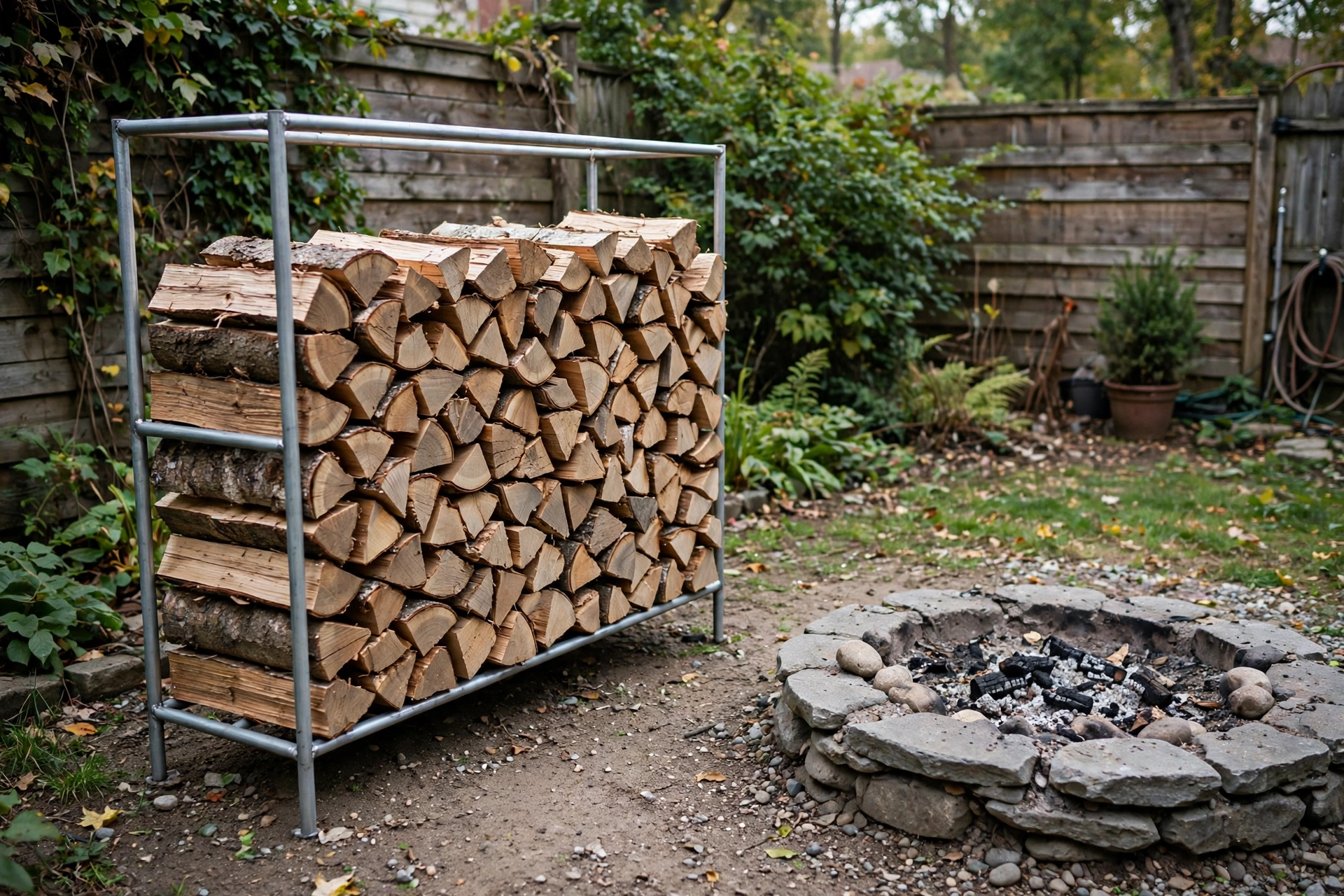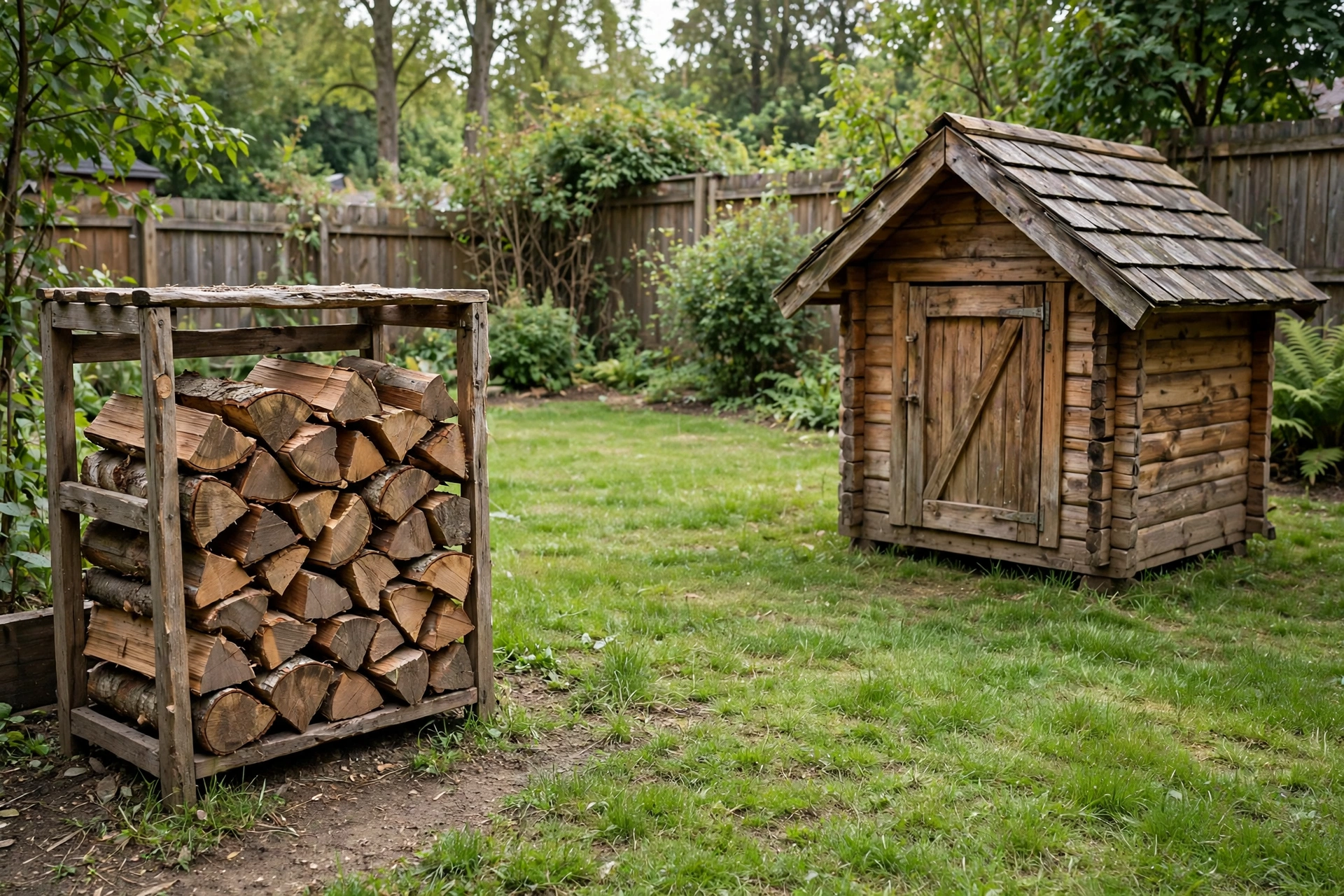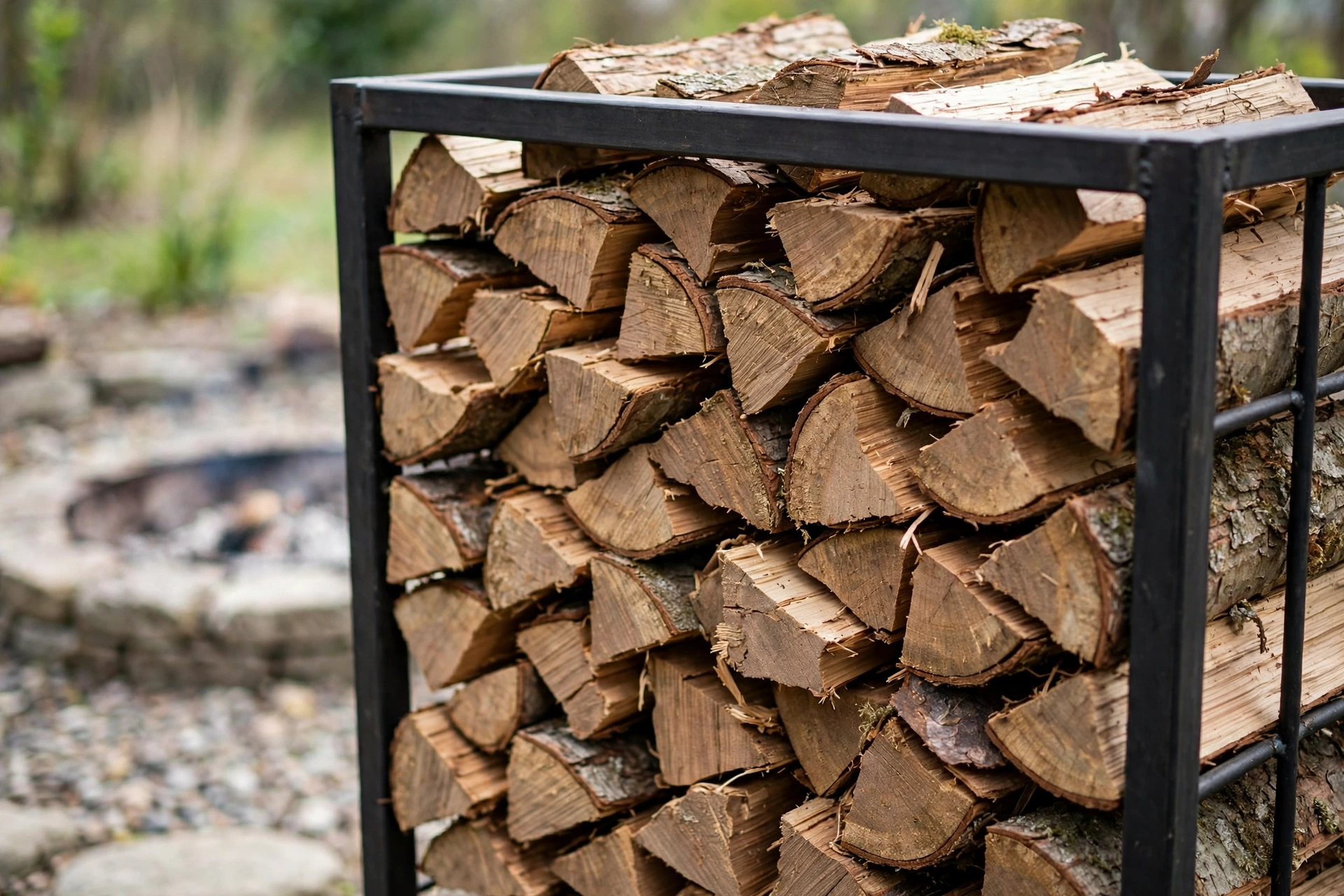
A rack that looks full on Saturday and stands half-empty by the second fire is not lying to you. It is measuring in a unit you never agreed to, and once you know which unit that is, the rack stops surprising you.
The confusion is not your fault. Firewood is sold in cords, face cords, and ricks, and only one of those is a fixed amount of wood. A rack’s capacity changes with the length of the splits inside it, a seller’s face cord changes with the length of the splits they cut, and a rack listing can state a capacity that is perfectly accurate and still not describe the wood you will actually stack in it. Here is how to sort it out before you pay for a delivery.
What you are actually seeing
When a rack empties faster than expected, three causes cover nearly every case, and they are worth checking in order. First, the face cord itself is not a fixed volume: a face cord is a stack 4 feet high and 8 feet long, one split deep, so its volume is whatever the cut length makes it. Second, rack listings usually state capacity using the longest splits the rack can take, which is 24 inches on most 8-foot racks, while the 16-inch splits most sellers deliver hold a third less wood in the same rack. Third, a loosely stacked rack holds less than a tightly stacked one, because the air gaps between crooked splits are volume you paid for and cannot burn.
None of those is a defect in the rack. The fix is to measure in cubic feet and ask for the cut length, every time, before the wood arrives.
The numbers, cut by cut
A full cord is the one fixed unit in firewood: a stack 4 feet high, 4 feet deep, and 8 feet long, which is 128 cubic feet of wood and air. The Missouri Department of Conservation’s home-heating guidance uses the same definition, and it is the definition most states require sellers to use. A face cord keeps the 4-by-8-foot face and swaps the 4-foot depth for the length of one split, so the volume follows the cut.
| Cut length | Face cord volume | Share of a full cord |
|---|---|---|
| 12 inches | 32 cubic feet | 1/4 cord |
| 16 inches | 42.7 cubic feet | 1/3 cord |
| 20 inches | 53.3 cubic feet | 5/12 cord |
| 24 inches | 64 cubic feet | 1/2 cord |
The pattern is simple enough to do in your head: a face cord at 16 inches is a third of a cord, and every 4 inches of cut length adds about a twelfth. If a seller quotes a face cord without a cut length, the number means nothing yet, because a 24-inch face cord holds half again as much wood as a 16-inch one.
What that means for your rack
A rack is one row deep, so its capacity is the same arithmetic with a shorter length. An 8-foot rack stacked 4 feet high holds one face cord of 16-inch splits, or 42.7 cubic feet. A 5-foot rack holds about 27 cubic feet of the same splits, which is roughly five-eighths of a face cord. A 4-foot rack holds about 21 cubic feet, or half a face cord. Fill any of them with 24-inch splits and the volume jumps by half, which is why a listing can honestly claim a half cord for an 8-foot rack while your delivery of 16-inch wood fills only a third of a cord.
That is also why three 8-foot racks side by side hold one full cord of 16-inch splits, while a single 8-foot rack never will. If three racks sounds like too much steel for one yard, that is the point where a shed starts to make sense, as the comparison in firewood rack vs firewood shed lays out. If you are comparing racks in our roundup of the best firewood racks for backyard fire pits, check each pick’s capacity against its cut length before you decide the size — the 8-foot racks hold a face cord of the wood you will actually buy, not the half cord on the box.
The rick problem
A rick has no fixed size, so never convert one without dimensions. In most of the country a rick means the same stack as a face cord — 4 feet high, 8 feet long, one split deep — which makes it 42.7 cubic feet when the splits are 16 inches and 64 cubic feet when they are 24. But the word is informal, and a seller using it may mean a shorter stack, a different cut, or simply whatever fits in their truck. The only safe way to buy a rick is to ask for the stack’s dimensions and the cut length in the same sentence, then do the cubic-feet math yourself. Most states require firewood to be sold by the cord or a fraction of a cord, following the model rule in NIST Handbook 130, so a seller who will not state the fraction is a seller to walk away from.
Measure your own stack
Measure the rack, not the pile. Take the length, height, and depth of the rack itself in feet, and multiply the three numbers. That is the volume the rack holds when it is full and stacked tight.
Divide by 128 for cords, or by 42.7 for face cords. A rack that measures 32 cubic feet holds a quarter of a cord, and a rack that measures 42.7 cubic feet holds one face cord of 16-inch splits. The firewood cord calculator does the same math from your own measurements and adds the heat value, so you can compare a delivery against the price before you pay.
Ask for the cut length before ordering. Get the split length in the same message as the price, and confirm it when the truck arrives. If the splits are shorter than agreed, the stack will hold less wood than the rack’s listed capacity, and that is the moment to sort it out — not after the truck has left.
Stack it tight and measure again. Crooked splits and crossed ends leave air gaps that look like wood from the driveway. Stack with the ends flush and the pieces parallel, as our guide to how to stack firewood so it dries shows, and you will fit noticeably more wood in the same rack.
How long will it last?
No table can tell you how many fires a rack holds, because that depends on how big you build each fire and how often you light one. The useful number is your own: fill the rack, note the date, and count the fire nights until it is empty. After two full racks you will know your household’s burn rate better than any chart could, and the next order becomes a simple question of how many racks you want to fill.
What to do next
Measure the rack, divide by 128, and ask every seller for the cut length before you pay. A face cord is a real unit once the cut length is attached to it, and a rack is a known quantity once you have measured it — which leaves no room for a delivery to surprise you.