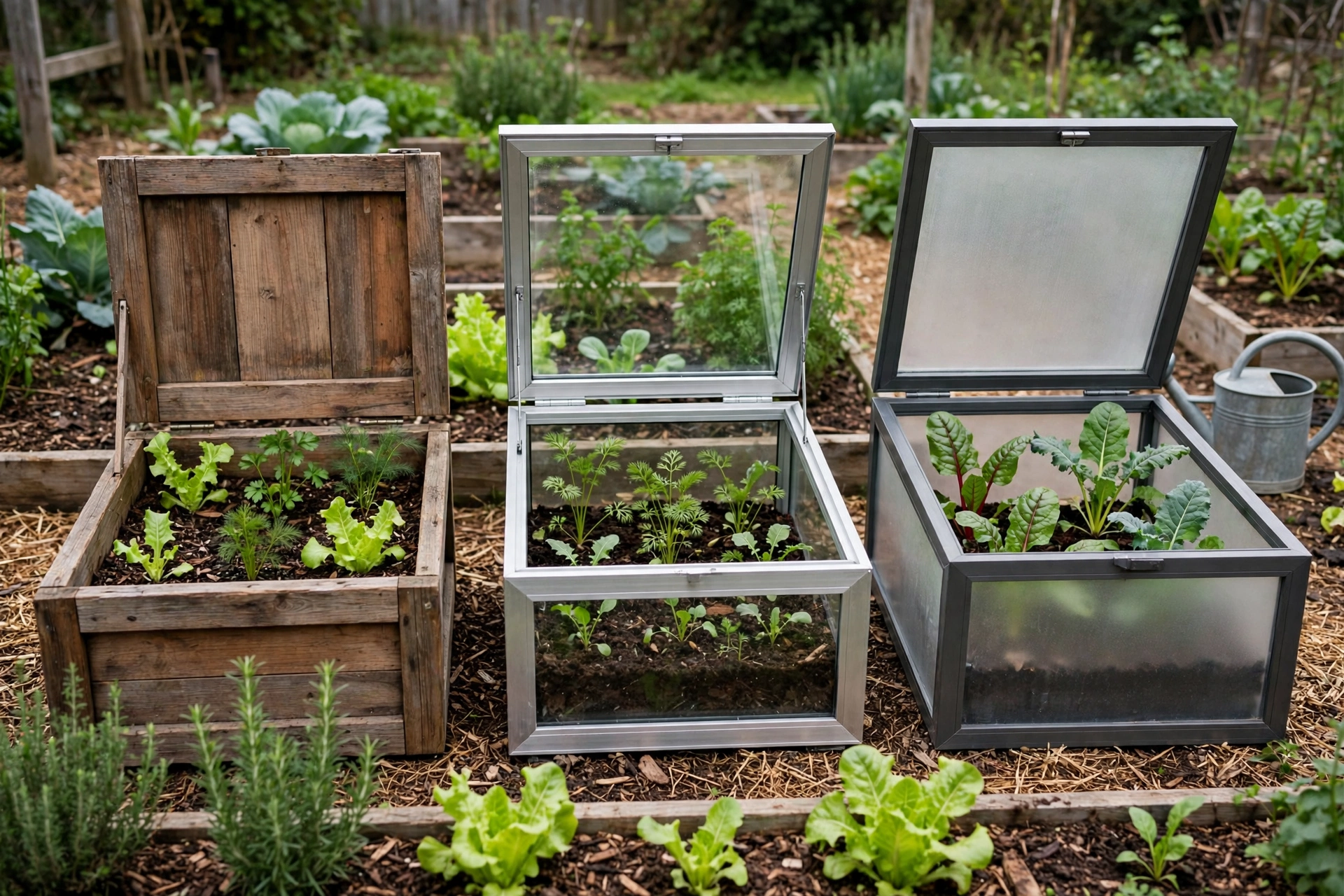
Wood insulates and rots if you neglect it, aluminum never rots and conducts cold, and polycarbonate panels decide how much warmth either frame keeps.
Most cold frame buying mistakes are material mistakes. A frame bought for one cheap season gets priced like a bargain and then replaced, while a frame bought for a decade of springs costs more once and stops costing anything.
Material decides which of those purchases you are making. It sets the lifespan, the insulation, the weight you haul around the yard, and the upkeep owed every year, so it is the decision to get right before size or price.
Wood vs aluminum vs polycarbonate cold frames, compared
| Material | Strengths | Weaknesses | Upkeep | Best use |
|---|---|---|---|---|
| Wood (cedar or fir) | Insulates well, easy to repair, sits naturally in a bed | Rots from the ground up if left unsealed | Seal or oil on a regular cycle, check corners yearly | Permanent beds and raised planters |
| Aluminum | Never rots or rusts, light for its strength | Conducts cold, thin sections dent and bend | Wash panels, check fasteners and seals | Long-life frames that get moved between beds |
| Polycarbonate panels | Light, hard to break, twin-wall form traps air | Scratches, and cheap thin sheets flex and cloud | Wash with mild soap, no abrasive pads | The glazing on either frame type |
Wood: warm, repairable, and on a maintenance clock
Wood is the traditional cold frame material because it does two jobs at once. Thick boards insulate the sides of the box, and any homeowner with a saw and a drill can replace a failed board without replacing the frame.
Cedar and fir are not the same purchase, though. Cedar resists rot on its own and suits a planter that stays outside year-round, while fir costs less and asks for sealant, because unsealed fir in ground contact gives you a few seasons rather than a long service life.
The failure pattern is predictable. Rot starts where the frame meets wet soil, at corners and at the bottom edge, so a wooden frame lifted onto bricks or a gravel strip outlasts the same frame sitting in mud.
Aluminum: the frame you stop thinking about
Aluminum removes rot from the equation entirely. It does not rust, it does not need sealing, and a framed panel system stays square in a way that aging wood often does not.
The trade-off is thermal. Metal conducts, so an aluminum frame passes cold into the box along every rail on a hard night, and thin extrusions bend when a frame gets dragged across the yard by one corner.
Weight cuts the other way in aluminum’s favor. A frame one person can carry gets moved to the bed that needs it, while a heavy frame stays wherever it was first set down, needed or not.
Polycarbonate: the panel is the insulation decision
One clarification saves buyers money: polycarbonate is the glazing, not the structure. Frames sold as polycarbonate cold frames pair these panels with aluminum or plastic framing, so the panel and the frame get judged separately.
Panel build is where the warmth is won. An 8 mm twin-wall panel traps a layer of air between two sheets, and that trapped air insulates in a way a single thin sheet cannot match, while also diffusing light so seedlings do not scorch in one bright patch.
Single-sheet panels cost less and still beat glass on safety and weight, since polycarbonate flexes instead of shattering. What they give up is overnight heat retention, which is the exact quality a cold frame exists to provide in early spring.
The panel comparison runs deeper in our look at polycarbonate vs plastic greenhouse kits, where film and single sheets are priced against twin-wall over their working lives.
Which material fits which gardener
Permanent bed, planter looks, hands willing to maintain it: cedar. The best cold frames for season extension lead with a cedar raised planter for exactly this situation.
Frame moved between beds, no appetite for upkeep: aluminum with twin-wall panels. It survives being carried, stored, and carried back out without a sealing weekend in between.
Cheapest entry, one or two seasons: fir, bought with open eyes. Seal it before its first night outside and it earns its price; leave it raw in wet soil and the replacement purchase is already scheduled.
Whichever material you choose, daily handling stays the same, and how to use a cold frame covers the venting and watering routine that makes any of them work. If the material question is really a size question, cold frame vs mini greenhouse settles that one first.
Bottom line
Buy aluminum framing with twin-wall polycarbonate panels if lasting is the priority, because that pairing asks for the least upkeep and gives up the least heat. Buy cedar when the frame doubles as a permanent planter you are happy to maintain, and treat budget fir as a short-term purchase, never a long-term one.