A bag marked 10-10-10 and a bag marked 46-0-0 do very different work at the same weight. Ten pounds of the first delivers 1 pound of actual nitrogen per 1,000 square feet, while a little over 2 pounds of the second delivers that same pound, because the first number on the bag is the percentage of nitrogen inside it.
That difference is where lawns get burned or left hungry. Guess by the bag and a high-analysis fertilizer goes down far too heavy, while a balanced fertilizer goes down too light to matter.
Seven common analyses are covered here, at the two rates lawns use most often.
The table
Read across from the analysis printed on your bag. The middle columns give the pounds of product to spread per 1,000 square feet to deliver 1.0 pound of actual nitrogen, and the lighter 0.5-pound rate beside it.
| Bag analysis | Nitrogen in the bag | Pounds per 1,000 sq ft for 1.0 lb nitrogen | Pounds per 1,000 sq ft for 0.5 lb nitrogen | Source |
|---|---|---|---|---|
| 10-10-10 | 10% | 10.0 | 5.0 | Iowa State University Extension |
| 16-4-8 | 16% | 6.2 | 3.1 | Iowa State University Extension |
| 24-0-11 | 24% | 4.2 | 2.1 | Iowa State University Extension |
| 32-0-10 | 32% | 3.1 | 1.6 | Iowa State University Extension |
| 46-0-0 (urea) | 46% | 2.2 | 1.1 | Iowa State University Extension |
| 10-0-0 | 10% | 10.0 | 5.0 | Iowa State University Extension |
| 15-0-15 | 15% | 6.7 | 3.3 | Iowa State University Extension |
How the math works on any bag
Divide the nitrogen rate you want by the nitrogen percentage on the bag, written as a decimal. For 1 pound of nitrogen from a 32% product, that is 1 divided by 0.32, which gives 3.125 pounds of product per 1,000 square feet.
For a whole lawn, multiply that per-thousand figure by your lawn area and divide by 1,000. At 3.125 pounds per 1,000 square feet, a 5,625-square-foot lawn takes 17.58 pounds in total.
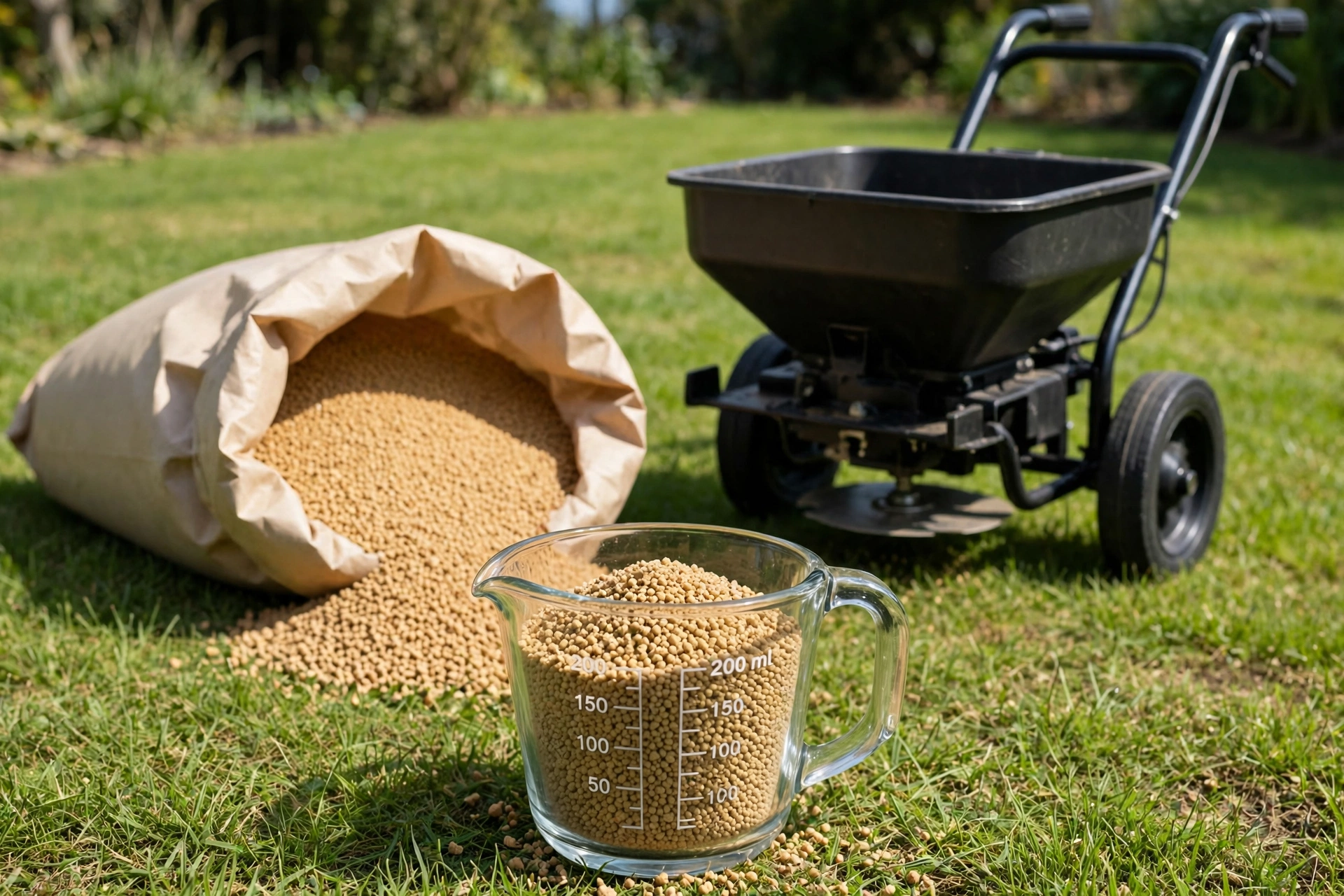
The spreader hopper rarely matches a tidy number, and that is fine. The granules rattle in, the hopper sits half full, and there is no line to trust. Weigh the amount for your lawn once, mark the hopper level with a piece of tape, and the next feeding starts from a known place instead of a guess.
What this table does not decide
This table converts a target nitrogen rate into product weight. It does not set that target, because the right rate and the right month depend on your grass and on what a soil test shows.
For timing and annual amounts by grass type, see the fertilize-timing reference table, which gives the months and the pounds for cool-season and warm-season lawns.
One practical measure helps at the spreader: about 1 cup of granular fertilizer weighs roughly 0.5 pound, so a small patch can be measured in the kitchen when a scale is not handy.
Start from the number on your bag, not from a neighbor’s bag. Two products that look alike in the garage can differ by more than four times in the nitrogen they deliver at the same weight, and the table above is the quickest way to keep that difference from showing up in the lawn.
Sources
Iowa State University Extension — How to Calculate Fertilizer Rates for the Lawn: https://yardandgarden.extension.iastate.edu/how-to/how-calculate-fertilizer-rates-lawn — fetched November 26, 2026.