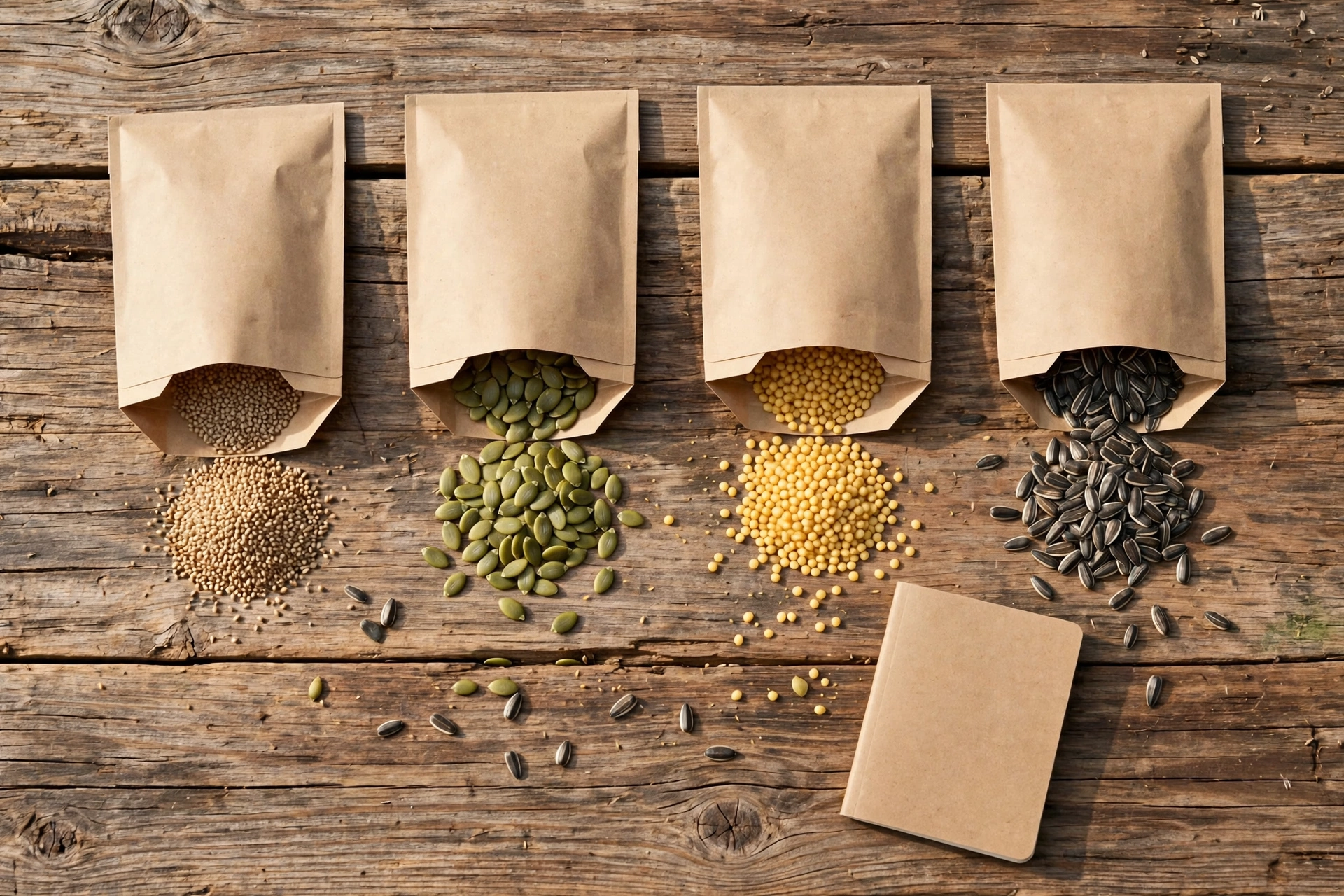
You open the seed box in February and find last spring’s packets — half-used, a little crumpled, and every one of them asking the same question: is this still worth planting, or am I sowing disappointment?
This table answers that question for 38 vegetables. The numbers come from two university Extension guides — Colorado State University Extension’s Fact Sheet 7.221 and Iowa State University Extension’s seed storage guide — so you can check how long a packet should last before you decide whether to sow it, test it, or replace it.
The table
“Years viable” means relative longevity under good storage: dry, cool, and sealed. The minimum germination figure is the federal and Colorado sales standard for seed sold in Colorado — the germination rate a packet must meet when it is sold, not a prediction for a packet sitting in your shed. A dash in the Iowa State column means Iowa State does not list that crop, not that the seed lasts zero years.
| Crop | Minimum germination (%) — CSU | Years viable — CSU | Years viable — Iowa State | Seeds per ounce — CSU |
|---|---|---|---|---|
| Asparagus | 60% | 3 | 3 | 1,400 |
| Beans | 70% | 3 | 3 | 100 |
| Beets | 65% | 4 | 4 | 2,000 |
| Broccoli | 75% | 3 | 5 | 8,100 |
| Brussels sprouts | 70% | 4 | — | 8,500 |
| Cabbage | 75% | 4 | 5 | 7,700 |
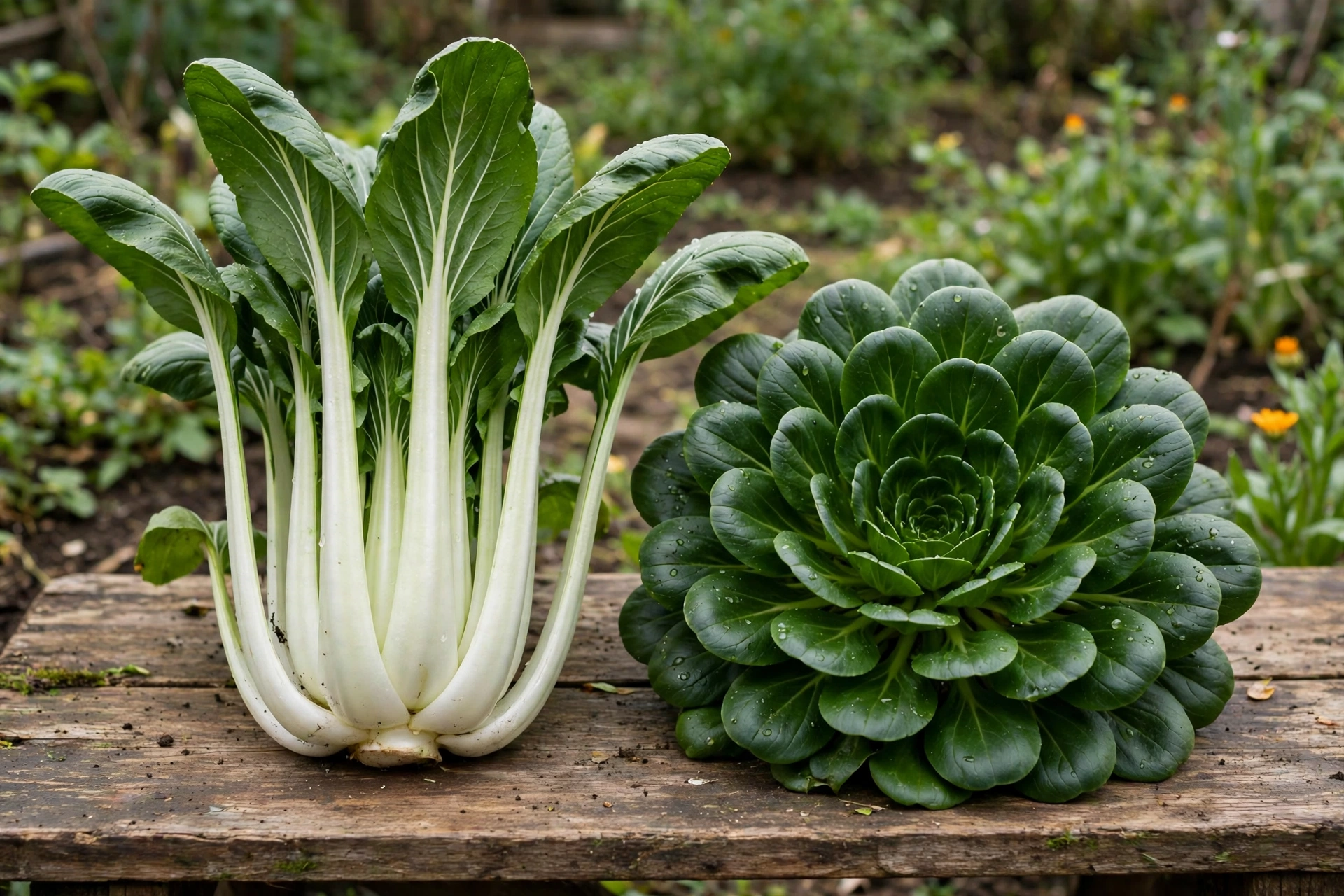
| Cabbage, Chinese | 75% | 3 | — | 7,000 |
| Carrot | 55% | 3 | 3 | 22,000 |
| Cauliflower | 75% | 4 | 5 | 8,600 |
| Celeriac | 55% | 3 | — | 50,000 |
| Celery | 55% | 3 | — | 76,000 |
| Chard, Swiss | 65% | 4 | — | 1,500 |
| Chicory | 65% | 4 | — | 20,000 |
| Corn, sweet | 75% | 2 | 2 | 140 |
| Cucumber | 80% | 5 | 5 | 1,100 |
| Eggplant | 60% | 4 | — | 7,200 |
| Endive | 70% | 5 | — | 17,000 |
| Kale | 75% | 4 | — | 10,000 |
| Kohlrabi | 75% | 3 | — | 9,200 |
| Leek | 60% | 2 | — | 9,900 |
| Lettuce | 80% | 1 | 5 | 26,000 |
| Muskmelon | 75% | 5 | 5 | 1,100 |
| Okra | 50% | 2 | — | 500 |
| Onion | 70% | 1 | 1 | 8,500 |
| Parsley | 60% | 1 | — | 18,000 |
| Parsnip | 60% | 1 | — | 6,800 |
| Pea | 80% | 3 | 3 | 200 |
| Pepper | 55% | 2 | 2 | 4,500 |
| Pumpkin | 75% | 4 | 4 | 200 |
| Radish | 75% | 4 | 5 | 3,100 |
| Rutabaga | 75% | 4 | — | 11,000 |
| Salsify | 75% | 1 | — | 2,000 |
| Spinach | 60% | 3 | 5 | 2,900 |
| Spinach, New Zealand | 40% | 3 | — | 430 |
| Squash | 75% | 4 | 4 | 300 |
| Tomato | 75% | 4 | 4 | 10,000 |
| Turnip | 80% | 4 | — | 14,000 |
| Watermelon | 70% | 4 | 4 | 300 |
Where the two guides disagree
The two Extensions agree on 14 of the 20 crops they both list. On six they do not, and the table shows both figures rather than picking one. Broccoli runs 3 years in Colorado’s table against 5 in Iowa State’s; cabbage 4 against 5; cauliflower 4 against 5; radish 4 against 5; spinach 3 against 5.
Lettuce is the widest gap in the whole table: Colorado gives it 1 year, Iowa State gives it 5. An older reference, Harrington & Minges (1954) as adapted in Knott’s Handbook, gives it 6 years — which tells you how much this one varies with the seed lot and the storage conditions. For lettuce, the test is the only number that matters.
Where Iowa State does not list a crop, the Colorado figure stands alone. That is a gap in coverage, not a disagreement.
How to test an old packet
The table tells you whether a packet is worth testing. The test tells you whether it is worth sowing. Count out at least 20 seeds — 50 is better, 100 is best — spread them on moist paper towels, roll the towels up, and keep the roll in a plastic bag somewhere warm, 70 to 80 degrees. Check in two or three days, then every day for about a week. A seed has germinated when a root or cotyledon pokes through the coat.
Divide the number that sprouted by the number you tested. A rate of 90 percent or better is very good. Seventy to 80 percent is perfectly acceptable for most vegetables, especially the small-seeded ones. At 50 percent or below, the seed is too weak to be worth using — throw it out and buy fresh. If the rate is low but not hopeless, sow thicker than usual to make up the difference.
How to store seed so it lasts
Good storage is two things: dry and cool. Seed kept below 8 percent moisture and below 40 degrees can last 10 years or more — Colorado State’s guide says a 10-year storage life is achievable for many seeds by drying at 100 degrees for six hours, then sealing the seed in a moisture-proof container and refrigerating or freezing it. A sealed glass jar in the refrigerator does the job for most gardeners.
Beans and peas are the exception. Dry them as hard as other seed and you can create hard seed that refuses to absorb water. If beans or peas have been overdried, let them sit in a humid atmosphere for two weeks before planting. And remember the baseline: even with no special effort, vegetable seed keeps for one year at room temperature without much loss of germination.
None of this rescues a packet left in a hot garage. Heat and damp undo every year in the table, so treat the figures as what good storage earns.
Bottom line
Before you toss a packet, check the table, then run the test. Onion, lettuce, parsnip, parsley, and salsify are the short-lived ones — a year, by Colorado’s measure — so those are the packets to replace first. Cucumber, muskmelon, and endive are the keepers, good for five. And when a packet is past its listed years, the paper-towel test takes ten minutes to set up and settles the argument for good. For the storage side of the job — jars, labels, and keeping seed dry — our seed storage guide covers the method, and our seed spacing, sowing depth, and days to maturity table picks up where this one leaves off, once the seed is in the ground.
Sources
Colorado State University Extension, Fact Sheet 7.221, “Storing Vegetable and Flower Seeds” (J.E. Ells, L.N. Bass, D. Whiting; reviewed 5/20, page updated 2025-09-02) — https://extension.colostate.edu/resource/storing-vegetable-and-flower-seeds/ — fetched November 8, 2026.
Iowa State University Extension and Outreach, “How to Store Seeds and Test Germination Rates” (Horticulture and Home Pest News; page updated 2026-08-14) — https://hortnews.extension.iastate.edu/1995/3-3-1995/seedv.html — fetched November 8, 2026.