This site contains product affiliate links. We may receive a commission if you make a purchase after clicking on one of these links.
Brown patches that show up in the same place every late summer, grass that stays brown no matter how much you water it, turf that feels soft underfoot — any one of those could be grubs, or it could be three other problems that look exactly like grubs. The difference between treating the right thing and throwing product at the wrong one comes down to two minutes with a shovel.
The Four Signs That Point to Grubs
Grubs are the white, C-shaped larvae of beetles — Japanese beetles, masked chafers, European chafers, and June beetles cause most lawn damage in the United States. They live in the top few inches of soil and eat grass roots, and the damage shows up in late summer through fall, when the grubs are largest and feeding hardest.
Here is what to look for, in the order that matters most:
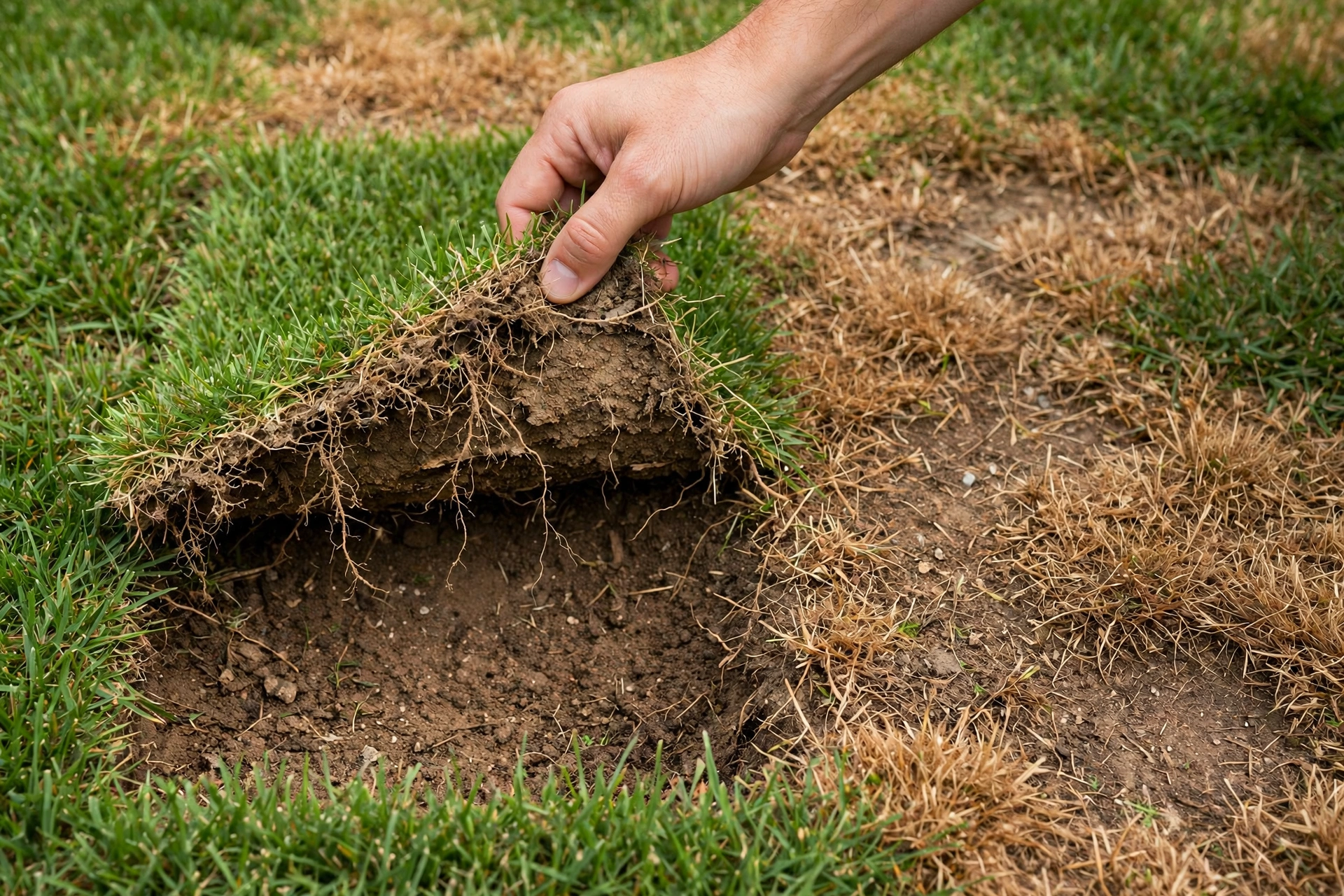
- Turf that lifts like loose carpet. Grab a handful of brown grass at the edge of a damaged patch and pull up firmly. If the turf rolls back with almost no roots attached, the roots are gone — and grubs are the usual reason. Healthy grass resists the pull because its roots hold it in place.
- Brown patches that will not green up. Grub damage looks like drought: irregular brown patches that stay brown even when the soil underneath is damp. Watering does nothing, because the grass has no roots left to drink with.
- Spongy turf underfoot. Walk across the suspect area. Where grubs have been feeding, the turf feels soft and bouncy, because the root mat that normally firms it up has been chewed away.
- Animals digging at night. Skunks, raccoons, and crows tear up lawns to eat grubs, and they will dig even when grub numbers are fairly low. Fresh holes and peeled-back sod in the morning are a strong hint, even before you see a brown patch.
One sign alone proves nothing. Brown patches without grubs could be drought, disease, or fertilizer burn — the tug test is what turns a suspicion into an answer.
The Tug Test, Step by Step
This is the same method university extension programs recommend, and it takes about five minutes.
Pick your spots. Check two or three places: at the edge of a damaged patch, where green grass meets brown, and one healthy-looking area for comparison. Grubs cluster, so one hole proves very little.
Cut a flap. With a spade, cut three sides of a one-foot square of sod, about two to three inches deep. Leave the fourth side attached as a hinge.
Peel it back and count. Fold the flap over and look in the top two to three inches of soil and roots. Count the white, C-shaped grubs — they are usually a half inch to an inch and a half long, curled into a comma shape.
Put it back. Fold the sod back into place, step it down firmly, and water it in so it re-roots. The test does no lasting damage when you replace the flap properly.
How Many Grubs Mean Trouble?
Every lawn has some grubs. A healthy lawn tolerates a low population without any visible damage, because it regrows roots faster than a few grubs can remove them. The count is what decides whether treatment is worth it.
| Grubs per square foot | What it means | What to do |
|---|---|---|
| 0–5 | Normal population | No treatment. A healthy lawn handles this on its own. |
| 6–9 | Borderline | Treat only if the lawn is stressed, unirrigated, or animals are digging it up. |
| 10 or more | Genuine infestation | Treatment is justified. Match the product to the season — see below. |
The threshold is about 10 grubs per square foot for most species, and extension guidance generally puts it there — Ohio State and Cornell both use roughly 10 as the line where visible damage becomes likely. European chafer can damage a lawn at lower counts, around five per square foot, and it favors dry, unirrigated lawns in the North. If your count is under 10 and the lawn still looks fine, do nothing. Treating grubs that are not hurting anything wastes money and product.
What to Do If the Count Says Treat
Timing matters more than the product. Grub control falls into two kinds, and they work in different seasons.
Preventive products go down in late spring to early summer, roughly May through early July, before beetle eggs hatch. The active ingredient to look for is chlorantraniliprole — it has a long soil residual, so an early application is still working when eggs hatch in July. Beetles lay most of their eggs from late June to mid-July, so the product needs to be in the soil before they arrive.
Scotts GrubEx1 Season Long Grub Killer, 5,000 sq. ft.
Chlorantraniliprole preventive that goes down in spring and protects the lawn for up to four months — one application covers the egg-laying season.
Curative products work on grubs that are already feeding, in late summer when the young grubs are small and near the surface. Trichlorfon is the fast-acting curative ingredient, and it is the right call when a late-summer count comes back at 10 or more and the lawn is actively thinning.
If you find grubs in November, the fix is a spring plan, not a November spread. By late fall the grubs are moving deeper into the soil to overwinter, and neither a preventive nor a curative does much good now. Mark the damaged spots, confirm the count while you can still find the grubs, and put the preventive down in late spring. That is the honest answer for a fall diagnosis, and it is the one that actually works.
For a non-chemical option, beneficial nematodes — microscopic Heterorhabditis bacteriophora — hunt grubs in the soil. They work best applied in late summer, when the soil is warm and moist, so they are a late-summer tool, not a fall one.
Plants That Make Beetles Look Elsewhere
Most lawn grubs start as Japanese beetle eggs, and adult Japanese beetles lay those eggs in lawns near the plants they feed on. You cannot plant your way out of a grub problem — no plant is beetle-proof. But over time, choosing plants the beetles tend to skip lowers the draw.
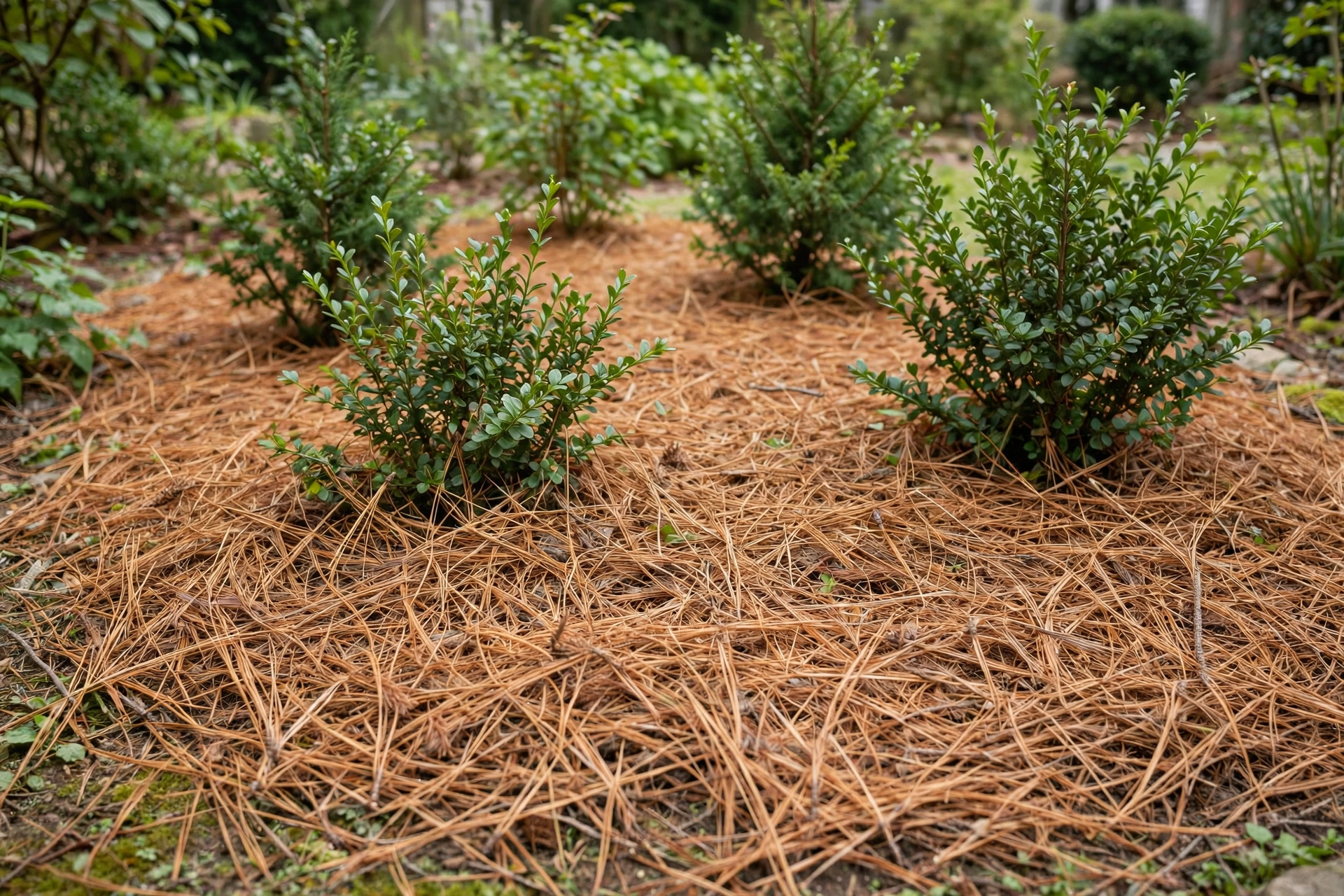
Wisconsin Extension and the USDA both list plants that suffer less feeding damage from adult Japanese beetles: boxwood, lilac, forsythia, holly, magnolia, red maple, dogwood, yew, and conifers like spruce, fir, and pine. The beetles’ favorites — roses, grapes, linden, birch, and crabapple — are the plants to keep away from the lawn’s edge if beetles are a recurring problem. It is a long-term nudge, not a treatment — it pairs with a spring preventive rather than replacing one.
When It Isn’t Grubs
If the tug test comes back clean, the problem is something else, and grub products will do nothing for it. Brown patches have a dozen causes. Start with the full rundown in What’s Wrong With My Lawn? 8 Common Problems and How to Fix Them, and check whether the brown grass is simply resting for winter in Is Your Lawn Dormant or Dead? How to Tell the Difference. Drought stress, in particular, mimics grub damage closely — the grass browns in the same irregular patches — but drought-stressed turf still has its roots, so the tug test settles it in seconds.
Bottom Line
Do the count before you buy anything. Cut the flap, count the grubs, and let the number decide: under 10 per square foot, leave it alone and let the lawn outgrow them. At 10 or more, match the product to the season — a chlorantraniliprole preventive like GrubEx1 in late spring, a curative in late summer — and give the lawn water and an overseed to recover.